
Convert Hasselblad 3FR RAW to JPG. Offline.

Your files stay on your Mac.
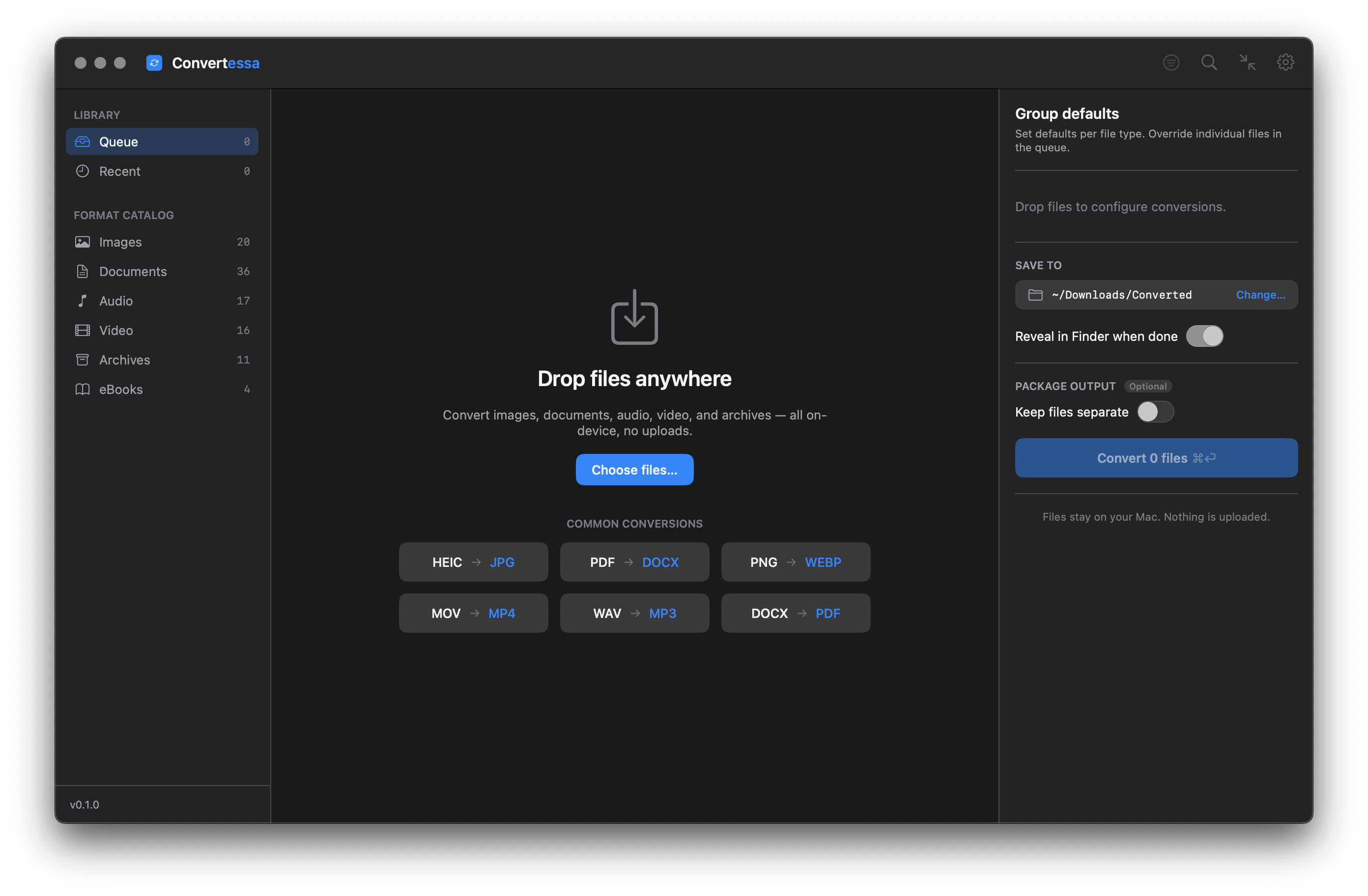
Convertessa app window showing the format catalog and drop area
What it does

From RAW sensor data to shareable JPG

Hasselblad's 3FR is a capture file, not a delivery file: Phocus opens it and almost nothing else does. Convertessa decodes each one on your Mac and writes a standard JPG that Mail, Slack, a client's browser and Finder previews all handle without complaint. You set the quality for the run, drop an entire card into one queue, and the original 3FR files are left untouched.

Hasselblad 3FR in practice

What a 3FR loses on the way to JPG

A .3fr is what a Hasselblad writes to the card and nothing more — H-system bodies, the X1D and X2D, and the CFV backs all produce one. Phocus, Hasselblad's own software, converts that file into an .fff the moment you import it, which tells you how the format is meant to be treated: as a negative, not as a photograph.

Convertessa is not Phocus, and that is the single most useful thing to understand here. libvips does the image work, and the demosaic behind it comes from the open-source raw decoder lineage rather than from Hasselblad's own rendering pipeline. What you get is a neutral read of the sensor data: the white balance the camera recorded, a standard colour matrix, sRGB out. What you do not get is Hasselblad Natural Colour Solution, the default Phocus tone curve, or any adjustment you made inside Phocus.

Carried over

  • Every pixel. A 100-megapixel X2D frame lands as a 100-megapixel JPG; nothing is scaled.
  • As-shot white balance, read from the file and baked into the output.
  • Orientation, so portrait frames come out upright.

Left behind

  • Bit depth. Sixteen bits per channel become eight — 256 steps — so a long, smooth sky gradient can band once you push it in an editor.
  • The maker-note block, where lens correction profiles and per-back calibration live. A JPG has no shelf for any of it.
  • Raw latitude. Highlight recovery and after-the-fact exposure are raw-only moves.

One practical detail worth knowing: libvips writes JPG without chroma subsampling at quality 90 and above, and with 4:2:0 subsampling below it. On a Hasselblad file that shows up first in fine red detail and along skin edges, so if the output is going anywhere near a layout, stay at 90 or higher. For a contact sheet, 80 is fine and the file is a third of the size.

How it works

Three steps. No upload required.

1

Queue a whole card

Drag the DCIM folder off the Hasselblad card straight onto Convertessa. Every .3fr inside joins a single queue, and the image engine is installed on first run once you approve it.

2

Pick JPG and a quality

Choose JPG as the target, then set the quality. Around 90 keeps the fine texture a client review needs; nearer 80 makes a 100-megapixel frame small enough to email without thinking about it.

3

Convert, keep the originals

Run the queue. Each 3FR is demosaiced and encoded on your Mac, output lands beside the source or in the folder you name, and the .3fr files themselves are never rewritten.

Format catalog

From everyday files to pro media.

Images, audio, video, documents, archives, eBooks and fonts — all converted natively, right on your Mac.

Conversion explorer

What do you want to convert?

Pick a format you have — see everything Convertessa can turn it into.

conversion combinations
I have a
can be converted to
From MP4

Features

Built for real work.

Batch conversion

Convert hundreds of files at once with per-type group defaults and individual overrides.

Modern image formats

First-class support for HEIC, AVIF and WebP — encode and decode, both ways. Read JPEG XL and a dozen more modern formats too.

Drag & drop

Drop files anywhere on the window. Native, instant, and exactly what you’d expect on a Mac.

Quality control

Dial in compression, resolution and bitrate. Keep originals pristine or shrink for sharing.

Collision-safe naming

Never overwrite a file by accident. Convertessa appends safe suffixes automatically.

Conversion history

Every job is logged locally. Re-run a previous conversion or revisit recent outputs in a click.

Archive the output

Bundle your converted files straight into a single ZIP, TAR or 7z — packaged and ready to share the moment a job finishes.

Convert from Finder

Right-click any file in Finder and choose Convert. A Quick Action handles it on the spot — no need to open the app first.

Compact mode

Shrink Convertessa to a tidy mini window that tucks into a corner — just a drop zone and a format picker for quick, one-off conversions.

Your files never leave your Mac.

No cloud. No account. No upload. Every conversion happens entirely on-device, using the power already in your Mac. What you convert is nobody’s business but yours.

On-device processing Zero telemetry No file uploads
For power users

There’s a command line, too.

Script conversions, wire them into your build, or batch a folder from the terminal. The same engine, no GUI required.

Read the full CLI documentation
zsh — convertessa
# Convert a single file
$ convertessa input.3fr --to jpg
photo.jpg · 1.2 MB · 0.4s
 
# Batch a whole folder
$ convertessa ./*.3fr --to jpg -o ~/Exports
14 files converted · 4.1s
Made to fit

And a compact mode.

Shrink Convertessa down to a small, focused window — drop, convert, done, with your recent conversions one click away.
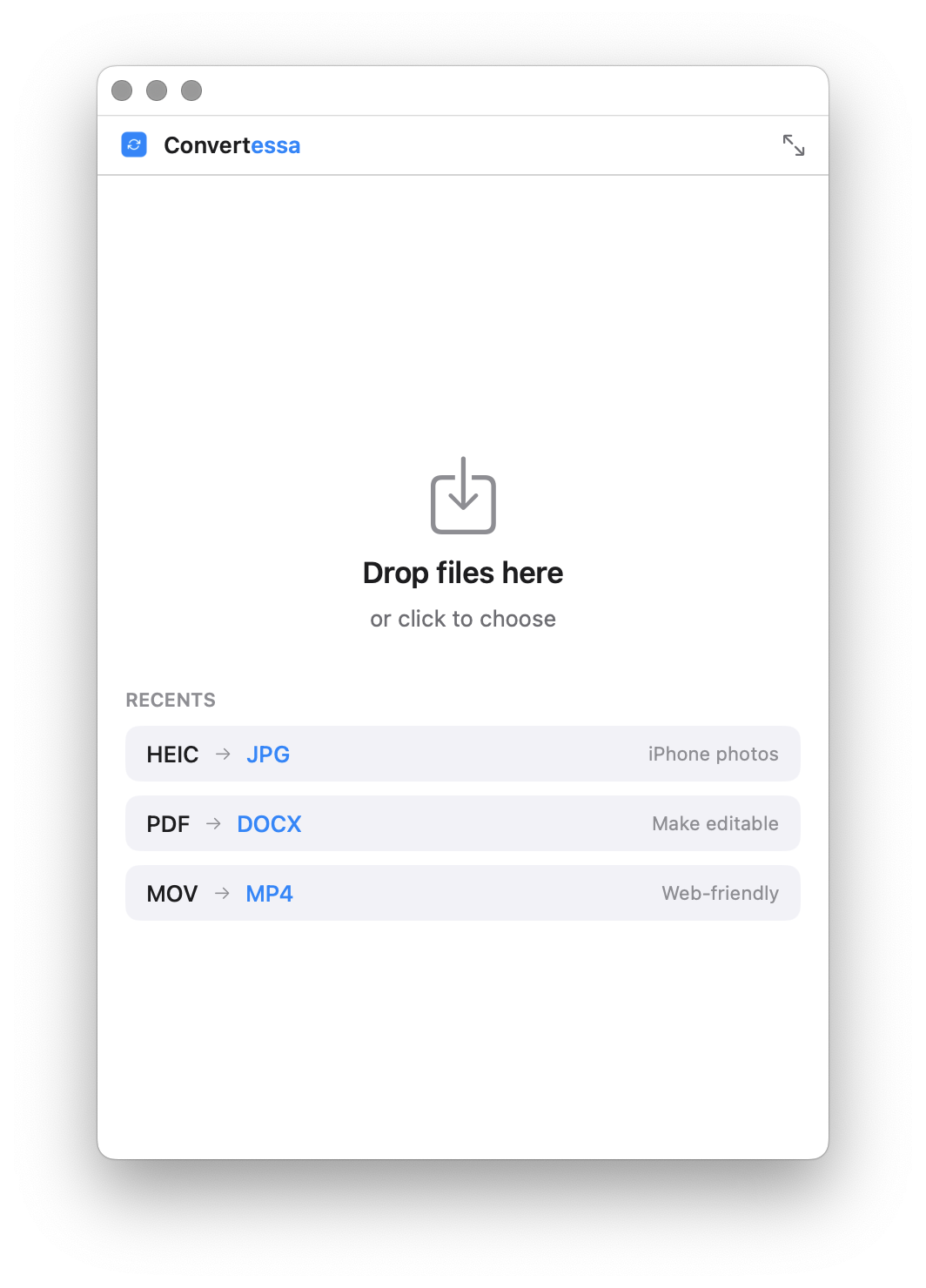
Convertessa in compact mode — a small window with a drop area and recent conversions
Pricing

One price. Yours for good.

Lifetime license
$19
One-time payment
No subscription. No renewals. Ever.
Get the app
  • 1,000+ conversion combinations
  • Lifetime future updates
  • No account required
  • Unlimited devices

macOS 14+ · Apple Silicon & Intel

Changelog

What’s shipped so far.

New formats, new features, and fixes — every release, on the record.

FAQ

Good questions.

Convertessa is a native macOS app that converts your files between formats — images, audio, video, documents, archives and eBooks — entirely on your Mac. Drop a file in, choose an output, and it’s done. No uploads, no account, no subscription.
Convertessa is an orchestrator. Under the hood it relies on best-in-class open-source engines — FFmpeg for audio & video, Pandoc for documents, libvips for images, LibreOffice for office formats, and Calibre for eBooks. It installs them for you with a click, then calls the right tool, or chain of tools, in the right order for whatever you’re converting. You get one clean native interface instead of a tangle of command-line flags. These binaries aren’t bundled with the app and are never installed without your approval — Convertessa simply calls them in a terminal session on your behalf.
Popular ones include JPEG, PNG, HEIC, WebP and AVIF; MP3, AAC, FLAC and WAV; MP4, MOV and MKV; PDF, DOCX and EPUB; ZIP, TAR and 7z — and many more. See exactly what converts to what in the conversion explorer →
Email us and we’ll add it in an upcoming release. Convertessa’s format coverage grows with what people actually need, so your request genuinely helps shape the app.
Your files? Never. Every conversion happens locally on your Mac. Your files are never uploaded, and nothing you convert is ever sent anywhere. Our Privacy Policy spells out exactly what limited data the app does store.
No analytics, no tracking, no telemetry. Your files and conversions stay entirely on your Mac — nothing you convert is ever sent anywhere. The app periodically checks for software updates in the background; like any web request, that check reveals only standard request metadata (your IP and app/OS version) to our update server — never your files, name, email, or license — and updates are always user-approved. Separately, on the website only, our purchase-confirmation page reports a completed sale to Google Ads so we can measure our own ad performance — it never runs while you’re browsing or converting, only after checkout. Our Privacy Policy spells out exactly what’s stored — and what isn’t.
Yes. Convertessa is a universal app and runs natively on Intel Macs. It requires macOS 14 or later.
Yes. It’s tuned for Apple Silicon (M-series) and runs natively — fast and energy-efficient. macOS 14 or later.
Yes — your license works on an unlimited number of your own Macs. Buy once and install it everywhere you work.
You get a genuinely useful, private, native Mac app for a single $19 payment — no subscription, ever. And your purchase directly supports a small independent developer and the app’s ongoing updates and new formats.
There’s no separate trial, but every purchase is backed by a 14-day money-back guarantee. If Convertessa isn’t right for you, contact your payment processor within 14 days to request a full refund — no questions asked. You can also email us and we’ll help route it.
Quite possibly — just email us. If you’re a student, run a non-profit, or have another good reason, reach out and we’ll sort you out.
Convertessa was built by Daler Azimov — a developer who needed a fast, private, native file converter for his own work, and decided to make the one he wished existed. Connect on LinkedIn →

Because Phocus is applying Hasselblad's own colour rendering and default tone curve, and Convertessa is not. The decode here is deliberately neutral: as-shot white balance, a standard colour matrix, sRGB output, no curve on top. Nothing is broken — you are looking at the sensor data rather than at Hasselblad's interpretation of it. If the Phocus look is the point, export a TIFF or JPG from Phocus and convert that file instead.

It depends which one carries your work. The .3fr is the untouched card file; the .fff is what Phocus writes on import, and it can carry the adjustments you made there. Convert the FFF when you want your edit reflected, the 3FR when you want the original capture. Convertessa reads both, and in either case the source file is only ever read.

No. JPG stores 8 bits per channel — 256 levels — where the 3FR holds 16. For viewing, sending and printing an already-finished frame that is plenty. It stops being plenty the moment you want to lift exposure or pull back a highlight, because those moves need tonal headroom that only exists in the raw file. Convert for delivery; archive the 3FR for editing.

Roughly a tenth to a twentieth of the size. A 100-megapixel X2D capture of around 150 MB typically lands between 8 and 25 MB as a JPG, depending on the quality you pick and how much fine detail the frame holds. For a lightweight review set:

convertessa ./*.3fr --to jpg -o ~/Review --quality 80

No. Distortion, vignetting and chromatic aberration profiles for HC, HCD, XCD and V-system optics are recorded in the file's maker-note block and applied by Phocus at render time. A general-purpose raw decoder has no access to that pipeline, so the JPG shows what the sensor recorded through the lens, uncorrected. On most XCD glass the difference is slight; at the wide end it shows in the corners.

Because demosaicing 100 million photosites is real arithmetic, and the file is 150 MB before the work starts. libvips is multithreaded and the queue keeps every core busy, so throughput across a batch is much better than the per-file time suggests — a full card is a coffee break, not an afternoon. Nothing is waiting on a network, because nothing is going over one.

Yes — the CLI runs the same engine. One file:

convertessa input.3fr --to jpg --quality 92

A whole card into its own folder:

convertessa ./*.3fr --to jpg -o ~/Exports --quality 92

Names carry over with the extension swapped, so B0001234.3FR becomes B0001234.jpg and your sequence stays readable.

We’d love to hear from you. Email us and you’ll get a reply from a real person — the one who made the app.