
Convert AVI to MP4. Offline.

Your files stay on your Mac.
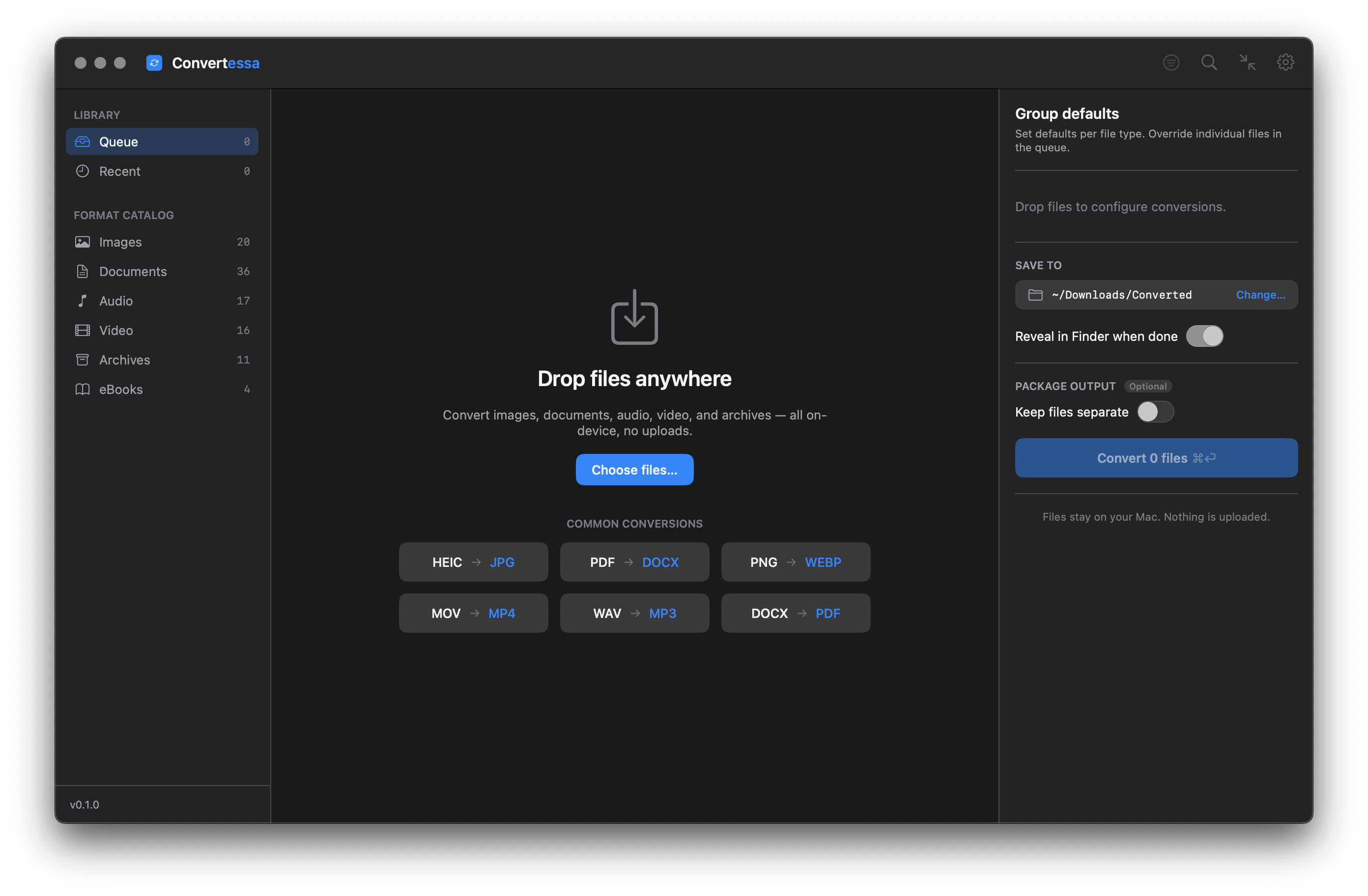
Convertessa app window showing the format catalog and drop area
What it does

From legacy AVI to the format every device accepts

AVI files are usually old, and old is the problem: legacy codecs macOS abandoned, audio that drifts out of sync, recordings split at two gigabytes. Convertessa runs them through FFmpeg on your Mac and writes a modern MP4 at a quality you choose. Same frames, same footage, in a container that QuickTime Player, iPhones, Android devices and browsers all accept without argument.

Old files, new Macs

Why that AVI will not open on macOS

AVI is 1992 technology. Microsoft built it on the RIFF chunk format and it shows: the header assumes one fixed frame rate, there is no field for pixel aspect ratio, and there is no concept of subtitles, chapters or attachments. What modern containers describe with per-sample timestamps, AVI describes with an index of evenly spaced frames.

The AVI files people still have tend to fall into three piles: DivX and Xvid rips from the early 2000s, Motion JPEG clips from compact cameras and camcorders, and captures made with old cards using Cinepak, Indeo or DV. That last pile explains the error message on a current Mac, because those decoders lived inside QuickTime 7, which was 32-bit, and macOS Catalina dropped 32-bit support entirely in 2019. FFmpeg still decodes all of them, and FFmpeg is what Convertessa calls, so the footage is not lost. It is stranded in a wrapper macOS walked away from.

What actually changes

  • Timing gets real timestamps. AVI's fixed-rate index combined with variable-rate MP3 audio is the classic recipe for sound drifting away from picture. MP4 timestamps each sample, so a converted file often holds sync where the original did not.
  • Aspect ratio can look wrong. An anamorphic PAL DV capture is 720x576 pixels meant to display as widescreen, and AVI has nowhere to record that intention. If the original looked stretched, so will the MP4: Convertessa never crops or resizes, it converts.
  • Interlacing stays. Anything captured from tape carries fields, and you will see combing on fast motion. Deinterlacing is an editing step, not a conversion step.
  • Size collapses. Motion JPEG stores every frame as a separate JPEG. Re-encoding to H.264 routinely cuts an old camcorder file to a fraction of its size at the same visible quality.

Audio moves from MP3 or PCM to AAC, and the two-gigabyte ceiling of the original AVI specification, the reason long recordings arrive as numbered parts, stops mattering.

How it works

Three steps. No upload required.

1

Drop the AVI files

Drag old camcorder clips, capture-card recordings or a folder of downloads onto the window. FFmpeg decodes formats macOS itself gave up on, Xvid and DivX among them, along with Cinepak, Indeo, MJPEG and DV.

2

Choose MP4 and quality

Pick MP4 and set the quality. A transfer from tape deserves a high setting because the source cannot be recaptured; a 2000s Xvid rip already lost that detail years ago and gains nothing from one.

3

Convert and check sync

Play the finished MP4 from the middle rather than the start. AVI files with variable-rate MP3 audio drift progressively later, and only the middle of a clip tells you whether the new timestamps fixed it.

Format catalog

From everyday files to pro media.

Images, audio, video, documents, archives, eBooks and fonts — all converted natively, right on your Mac.

Conversion explorer

What do you want to convert?

Pick a format you have — see everything Convertessa can turn it into.

conversion combinations
I have a
can be converted to
From MP4

Features

Built for real work.

Batch conversion

Convert hundreds of files at once with per-type group defaults and individual overrides.

Modern image formats

First-class support for HEIC, AVIF and WebP — encode and decode, both ways. Read JPEG XL and a dozen more modern formats too.

Drag & drop

Drop files anywhere on the window. Native, instant, and exactly what you’d expect on a Mac.

Quality control

Dial in compression, resolution and bitrate. Keep originals pristine or shrink for sharing.

Collision-safe naming

Never overwrite a file by accident. Convertessa appends safe suffixes automatically.

Conversion history

Every job is logged locally. Re-run a previous conversion or revisit recent outputs in a click.

Archive the output

Bundle your converted files straight into a single ZIP, TAR or 7z — packaged and ready to share the moment a job finishes.

Convert from Finder

Right-click any file in Finder and choose Convert. A Quick Action handles it on the spot — no need to open the app first.

Compact mode

Shrink Convertessa to a tidy mini window that tucks into a corner — just a drop zone and a format picker for quick, one-off conversions.

Your files never leave your Mac.

No cloud. No account. No upload. Every conversion happens entirely on-device, using the power already in your Mac. What you convert is nobody’s business but yours.

On-device processing Zero telemetry No file uploads
For power users

There’s a command line, too.

Script conversions, wire them into your build, or batch a folder from the terminal. The same engine, no GUI required.

Read the full CLI documentation
zsh — convertessa
# Convert a single file
$ convertessa input.avi --to mp4
photo.mp4 · 1.2 MB · 0.4s
 
# Batch a whole folder
$ convertessa ./*.avi --to mp4 -o ~/Exports
14 files converted · 4.1s
Made to fit

And a compact mode.

Shrink Convertessa down to a small, focused window — drop, convert, done, with your recent conversions one click away.
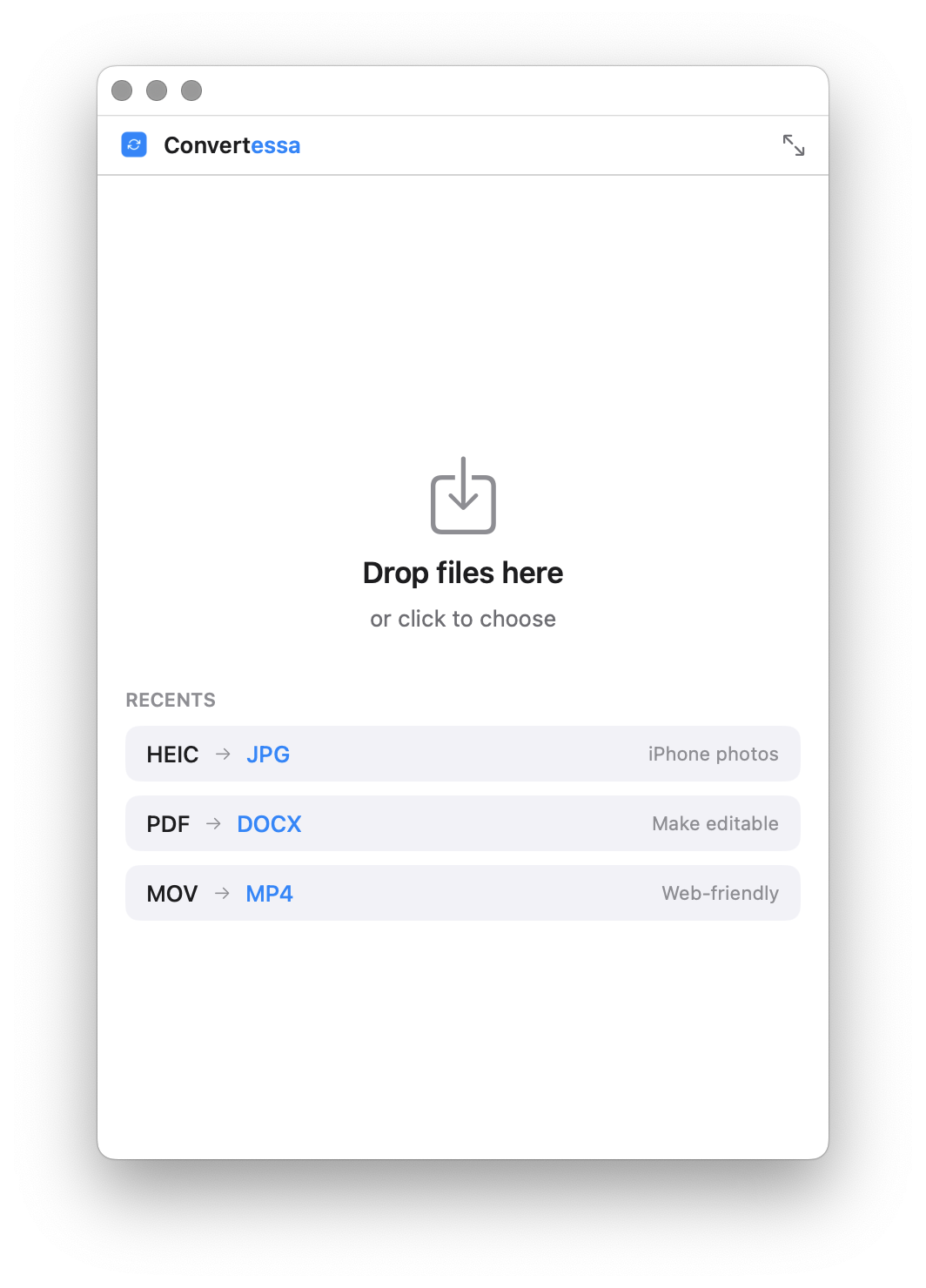
Convertessa in compact mode — a small window with a drop area and recent conversions
Pricing

One price. Yours for good.

Lifetime license
$19
One-time payment
No subscription. No renewals. Ever.
Get the app
  • 1,000+ conversion combinations
  • Lifetime future updates
  • No account required
  • Unlimited devices

macOS 14+ · Apple Silicon & Intel

Changelog

What’s shipped so far.

New formats, new features, and fixes — every release, on the record.

FAQ

Good questions.

Convertessa is a native macOS app that converts your files between formats — images, audio, video, documents, archives and eBooks — entirely on your Mac. Drop a file in, choose an output, and it’s done. No uploads, no account, no subscription.
Convertessa is an orchestrator. Under the hood it relies on best-in-class open-source engines — FFmpeg for audio & video, Pandoc for documents, libvips for images, LibreOffice for office formats, and Calibre for eBooks. It installs them for you with a click, then calls the right tool, or chain of tools, in the right order for whatever you’re converting. You get one clean native interface instead of a tangle of command-line flags. These binaries aren’t bundled with the app and are never installed without your approval — Convertessa simply calls them in a terminal session on your behalf.
Popular ones include JPEG, PNG, HEIC, WebP and AVIF; MP3, AAC, FLAC and WAV; MP4, MOV and MKV; PDF, DOCX and EPUB; ZIP, TAR and 7z — and many more. See exactly what converts to what in the conversion explorer →
Email us and we’ll add it in an upcoming release. Convertessa’s format coverage grows with what people actually need, so your request genuinely helps shape the app.
Your files? Never. Every conversion happens locally on your Mac. Your files are never uploaded, and nothing you convert is ever sent anywhere. Our Privacy Policy spells out exactly what limited data the app does store.
No analytics, no tracking, no telemetry. Your files and conversions stay entirely on your Mac — nothing you convert is ever sent anywhere. The app periodically checks for software updates in the background; like any web request, that check reveals only standard request metadata (your IP and app/OS version) to our update server — never your files, name, email, or license — and updates are always user-approved. Separately, on the website only, our purchase-confirmation page reports a completed sale to Google Ads so we can measure our own ad performance — it never runs while you’re browsing or converting, only after checkout. Our Privacy Policy spells out exactly what’s stored — and what isn’t.
Yes. Convertessa is a universal app and runs natively on Intel Macs. It requires macOS 14 or later.
Yes. It’s tuned for Apple Silicon (M-series) and runs natively — fast and energy-efficient. macOS 14 or later.
Yes — your license works on an unlimited number of your own Macs. Buy once and install it everywhere you work.
You get a genuinely useful, private, native Mac app for a single $19 payment — no subscription, ever. And your purchase directly supports a small independent developer and the app’s ongoing updates and new formats.
There’s no separate trial, but every purchase is backed by a 14-day money-back guarantee. If Convertessa isn’t right for you, contact your payment processor within 14 days to request a full refund — no questions asked. You can also email us and we’ll help route it.
Quite possibly — just email us. If you’re a student, run a non-profit, or have another good reason, reach out and we’ll sort you out.
Convertessa was built by Daler Azimov — a developer who needed a fast, private, native file converter for his own work, and decided to make the one he wished existed. Connect on LinkedIn →

Almost always the codec, not the container. Cinepak, Indeo, Sorenson and the older DV decoders shipped inside QuickTime 7, and macOS Catalina removed the 32-bit frameworks they depended on in 2019. QuickTime Player X only handles a narrow slice of what an AVI might contain. FFmpeg carries decoders for essentially all of it, so a file that Finder shows as a blank preview usually converts without any complaint.

Frequently, yes. AVI stores audio and video as interleaved streams at an assumed constant rate, and a variable-rate MP3 track breaks that assumption, so the two separate further and further as the file plays. MP4 timestamps every sample and FFmpeg reconstructs the timing during conversion. It is not a guaranteed repair for a badly damaged file, but it fixes the ordinary case.

A DivX and Xvid quirk. To smuggle B-frames through a container that cannot express them, those encoders packed two frames into one chunk and inserted dummy frames to keep the count right. FFmpeg reports this and unpacks the stream. The symptom in the original file is stuttering or an occasional duplicated frame; in the MP4 the frames land at their proper times, because MP4 describes B-frames natively.

Not by converting. The original AVI specification tops out at two gigabytes, and although OpenDML raised that ceiling plenty of capture software kept splitting anyway, which is why long recordings arrive in numbered pieces. Convertessa converts each piece into its own MP4. Joining them is an editing job for iMovie, Final Cut or FFmpeg's concat feature, and it is easier once they are MP4s.

No, and it cannot. Conversion re-encodes what is already there. It cannot restore detail a 2003 Xvid encoder discarded, undo blocking, or invent resolution that was never captured. What improves is compatibility and, usually, file size. Set a high quality so the second encode does not stack its own damage on top of the first, which is the only real quality decision this conversion involves.

AVI has no subtitle track at all; the format predates the idea. If a download came with subtitles they live in a sidecar .srt or .sub file next to the video, untouched by the conversion. Rename that file to match the new MP4 and VLC or IINA will load it automatically. Subtitles burned into the picture by an old encoder stay burned in, since they are part of the image.

Drop the folder onto the window, or use the terminal: convertessa ./*.avi --to mp4 --quality 92 -o ~/Movies/Transfers. Each AVI becomes an MP4 of the same name in the destination folder, processed one after another. A single file is convertessa tape03.avi --to mp4. A tape transfer is worth doing at a high quality setting, and worth doing once.

Two suspects. If the source was a modest Xvid rip and you asked for a very high quality setting, H.264 is being told to reproduce the original's compression artefacts faithfully, and that costs space. If the source was DV, MJPEG or uncompressed, it should not happen at all; expect a large reduction instead. Lower the quality a notch and convert the original again.

We’d love to hear from you. Email us and you’ll get a reply from a real person — the one who made the app.