Your files stay on your Mac.
Kodak's DCS cameras wrote .dcr, and Kodak's software for reading them is long gone. Convertessa decodes the file locally with LibRaw, writes a JPG with libvips, and lets you set the quality on the way out. Resolution is preserved, whole folders convert in one pass, and the original .dcr files are left exactly where they were — no internet connection and no Windows machine involved.
First, a check worth thirty seconds: not every .dcr is a photograph. Macromedia — later Adobe — used the same three letters for compressed Shockwave movies, so a .dcr pulled off an old CD-ROM or website may well be a Director file. If it weighs a few hundred kilobytes, that is what it is, and no image converter will do anything with it.
The real thing is Kodak Digital Camera RAW, written by the professional DCS line: the DCS 460 and 560, the 620, 620x and 660, the 720x and 760, and the full-frame DCS Pro 14n, SLR/n and SLR/c that closed the series in 2004. Kodak left the DSLR business the following year, and DCS Photo Desk — the software that read these files — was Windows-only and has not been touched since. That is why .dcr archives strand.
LibRaw handles the decode. Kodak used its own compression and its own colour matrices, which is why generic TIFF readers choke on a .dcr even though the container looks TIFF-shaped from the outside. libvips then encodes the JPG. What you get is a neutral rendering of the capture, not the look a Photo Desk operator once dialled in: those recipes lived outside the pixel data and are not read.
Drop the .dcr in. Kodak DCS captures are multi-megabyte files; if yours is tiny and refuses to decode, it is the Shockwave format that shares the extension rather than a photograph.
Choose JPG as the target and set the quality value. These files are usually being converted so they can finally be viewed at all, so high or max keeps the option of editing the result later.
Run it. LibRaw decodes each Kodak frame, libvips writes the JPG at the capture's own pixel count, and the .dcr files stay exactly as they were on the card you copied them from.
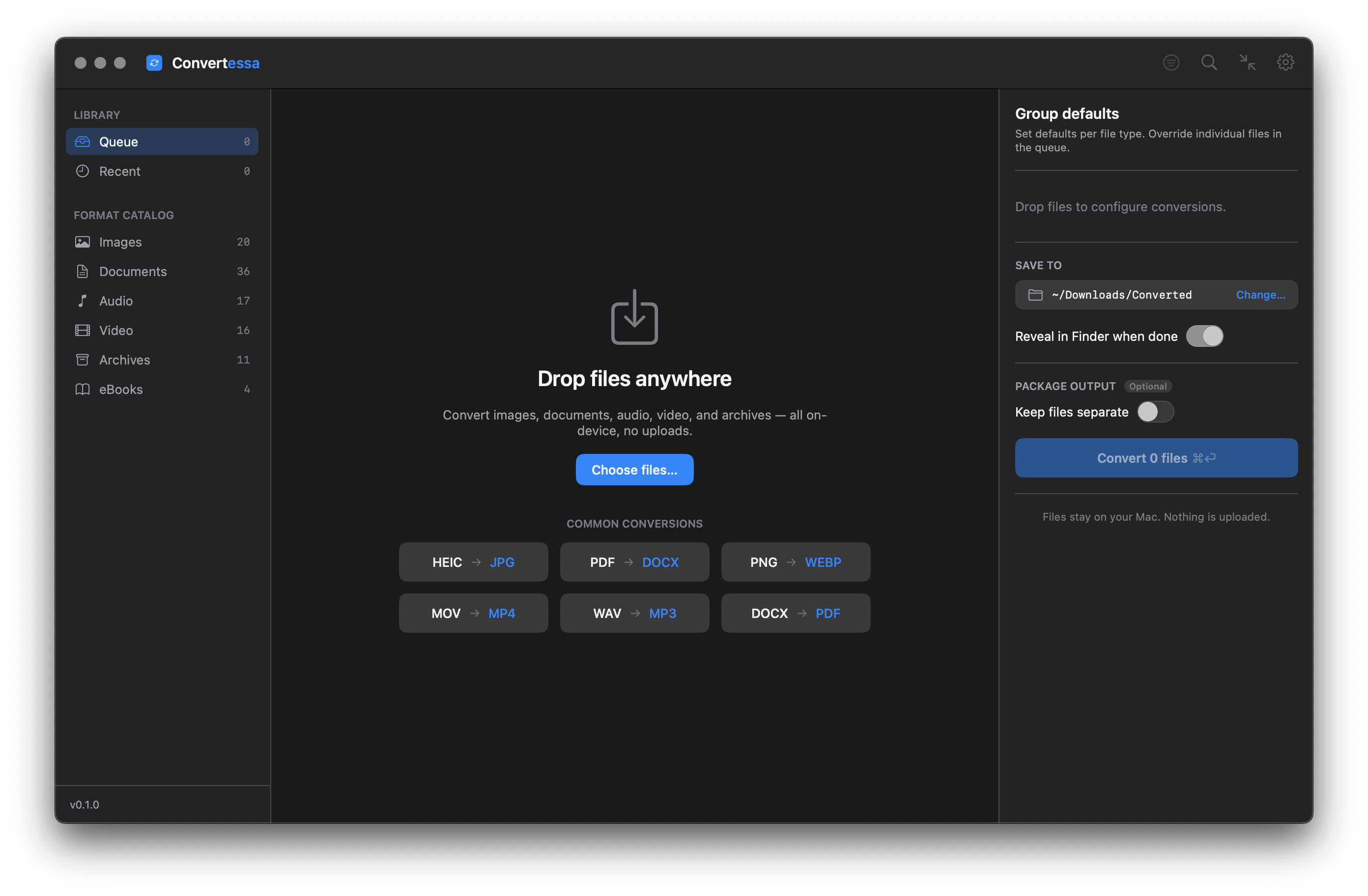
Images, audio, video, documents, archives, eBooks and fonts — all converted natively, right on your Mac.
Pick a format you have — see everything Convertessa can turn it into.
Convert hundreds of files at once with per-type group defaults and individual overrides.
First-class support for HEIC, AVIF and WebP — encode and decode, both ways. Read JPEG XL and a dozen more modern formats too.
Drop files anywhere on the window. Native, instant, and exactly what you’d expect on a Mac.
Dial in compression, resolution and bitrate. Keep originals pristine or shrink for sharing.
Never overwrite a file by accident. Convertessa appends safe suffixes automatically.
Every job is logged locally. Re-run a previous conversion or revisit recent outputs in a click.
Bundle your converted files straight into a single ZIP, TAR or 7z — packaged and ready to share the moment a job finishes.
Right-click any file in Finder and choose Convert. A Quick Action handles it on the spot — no need to open the app first.
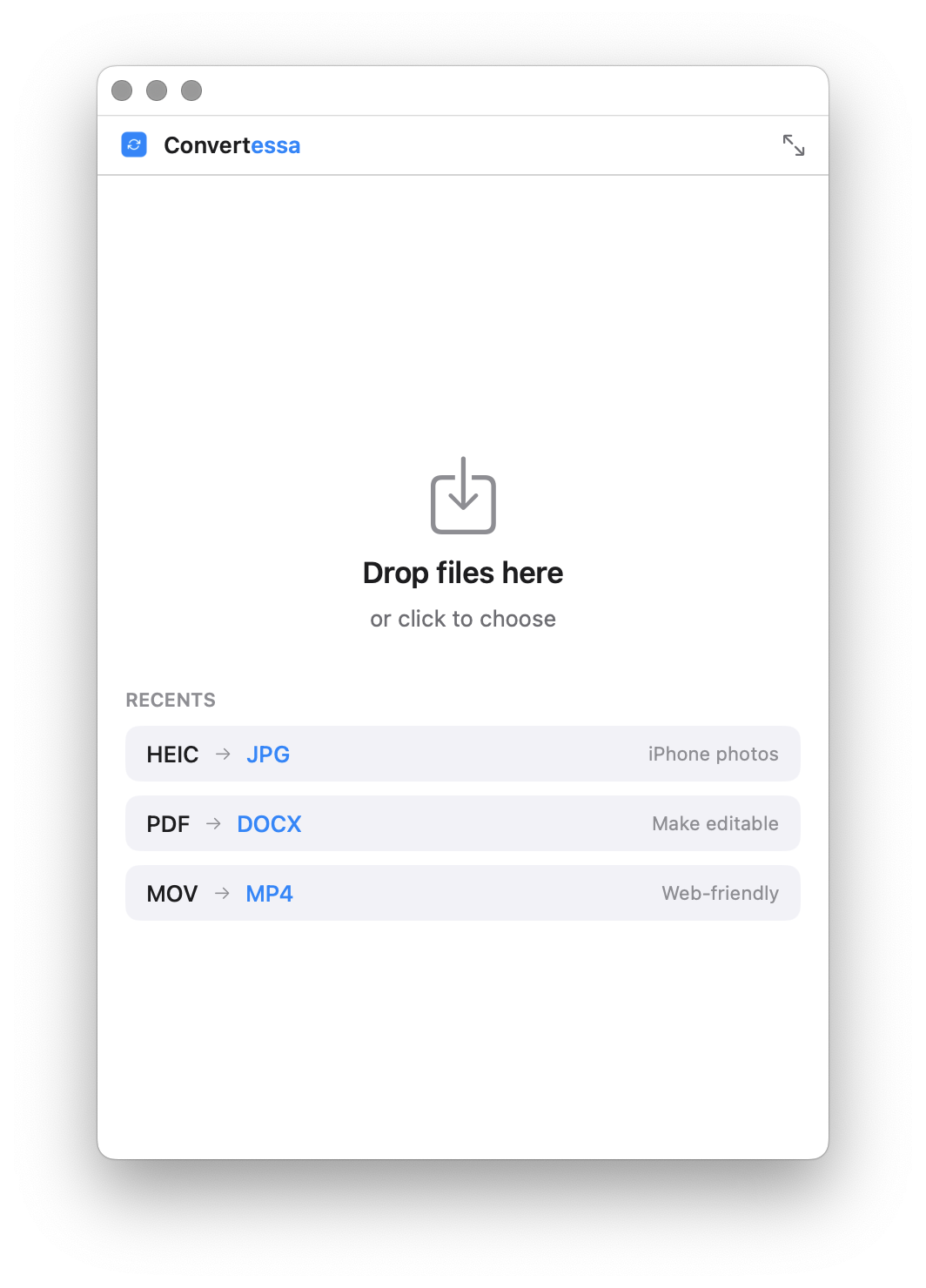
Shrink Convertessa to a tidy mini window that tucks into a corner — just a drop zone and a format picker for quick, one-off conversions.
No cloud. No account. No upload. Every conversion happens entirely on-device, using the power already in your Mac. What you convert is nobody’s business but yours.
Script conversions, wire them into your build, or batch a folder from the terminal. The same engine, no GUI required.
Read the full CLI documentation →Shrink Convertessa down to a small, focused window — drop, convert, done, with your recent conversions one click away.
macOS 14+ · Apple Silicon & Intel
New formats, new features, and fixes — every release, on the record.
Check the file size first. Kodak DCS RAW files run from roughly 6 MB on the older bodies to 14 MB or more from the 14n. A file of a few hundred kilobytes carrying the same extension is almost certainly a Shockwave Director movie, which used .dcr for years. Convertessa decodes the camera format only. Run convertessa file.dcr --to jpg --debug and the decoder error will tell you which of the two you are holding.
The professional DCS series, mostly built on Nikon and Canon bodies: the DCS 460 and 560, the 620, 620x and 660, the 720x and 760, the DCS Pro Back for medium format, and the full-frame DCS Pro 14n, SLR/n and SLR/c that ended the line in 2004. Consumer Kodak cameras — the EasyShare P-series, for example — wrote .kdc instead, a separate Kodak RAW format with its own decoder path.
No. DCS Photo Desk kept its interpretation — white balance choices, tone curves, saved looks — as settings applied at export time, not as changes to the sensor data inside the .dcr. A fresh decode has no way to know about them, so what you get is the capture as recorded, rendered neutrally. If you still have TIFFs exported back then, those are the files carrying your old look, not the RAWs.
That is the sensor, not the conversion. The DCS bodies, the 14n in particular, were built for base-ISO studio and daylight work and got grainy quickly when pushed. A neutral RAW decode reports that honestly instead of hiding it, and Convertessa does not crop, resize, denoise or sharpen. Cosmetic work belongs in an editor after the JPG exists, or in a dedicated RAW developer before it.
KDC is Kodak's other RAW extension, used by the early DC-series and by later EasyShare models such as the P712 and P880. It is decoded on its own path, so pick the .kdc conversion rather than renaming files — the two formats differ internally despite the shared badge. Mixed folders are no problem: drop them all in and each file takes its own route through the queue.
Yes, and it is the quickest way through a shoebox of old cards:
convertessa ~/Kodak/1999/*.dcr --to jpg --quality balanced -o ~/Kodak_JPG
The output directory is created if it is not already there, and the .dcr files are untouched. balanced is the 80 preset; use high or max if these JPGs are becoming your working copies rather than just a browsable set.
No. The JPG is written as a new file beside the .dcr, or into whatever directory you name with -o. If a JPG of that name already exists, the CLI refuses that one file and says so instead of replacing it — pass --force when an overwrite is what you actually want. Re-running a batch that stopped halfway is therefore safe.