
Convert Word 97–2003 to PDF. Offline.

Your files stay on your Mac.
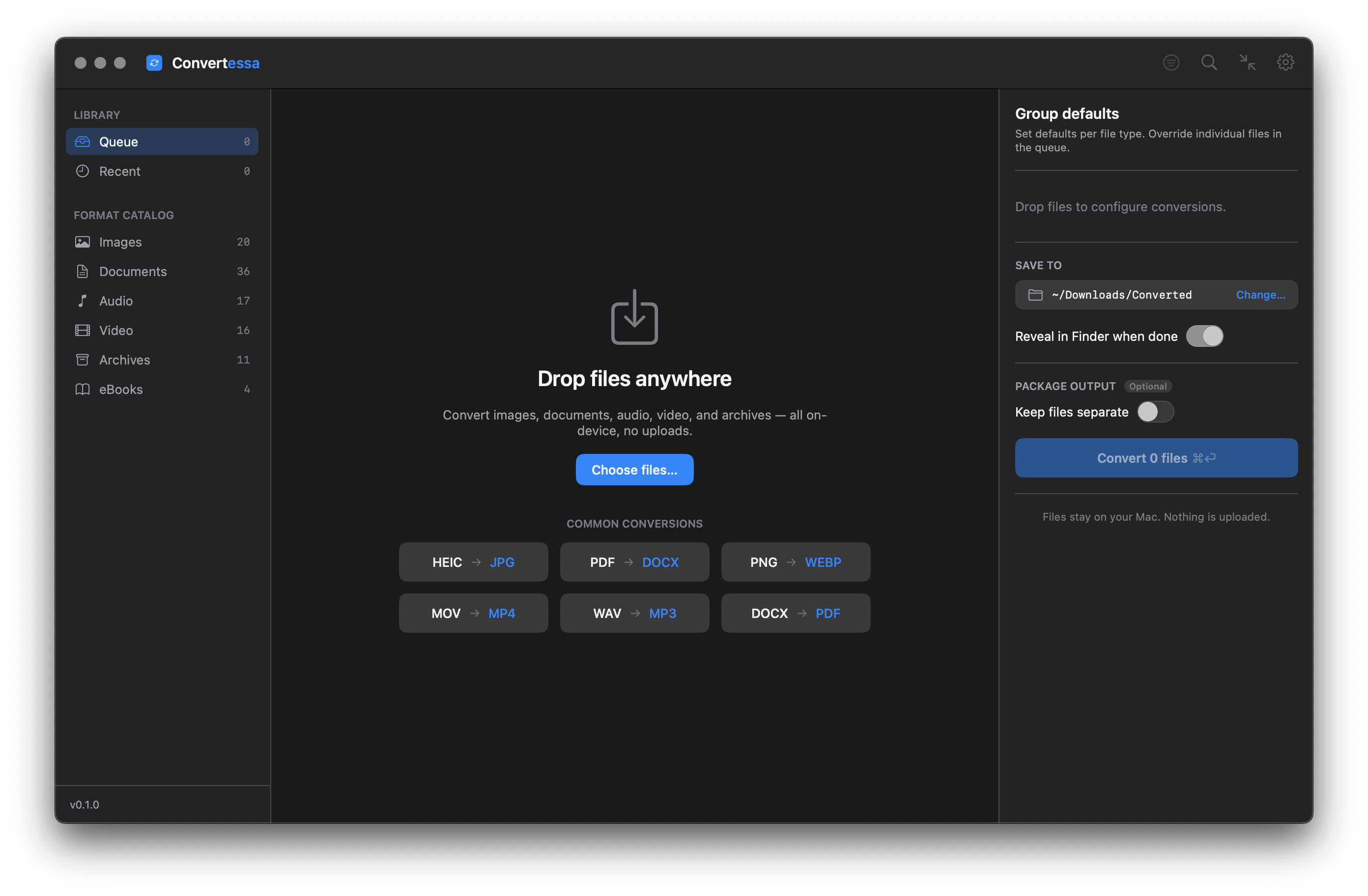
Convertessa app window showing the format catalog and drop area
What it does

What this conversion does

Convertessa opens the Word 97–2003 binary format with LibreOffice and prints each document to PDF on your own Mac. Styles, tables, headers, footers, footnotes and embedded pictures are laid out as they render, then written as selectable text with the fonts embedded alongside. Quality governs how photographs inside the document are stored. Drop a folder of legacy files and the whole archive converts in one pass.

Word 97–2003 in practice

What LibreOffice keeps and what it freezes

Open a .doc in a hex editor and you do not find a document, you find an OLE compound file: a miniature filesystem holding separate streams for text, formatting tables and embedded objects, written by Word between 1997 and 2003. Nothing on a current Mac opens it by double-click any more, which is why these files usually surface in bulk — an old archive, a legal disclosure, a shared drive nobody has touched in fifteen years.

The renderer decides where the pages break

Convertessa routes .doc through LibreOffice, which lays the document out and prints it to PDF. That layout is LibreOffice reading Word's rules, not Word itself. It usually lands within a line or two, because LibreOffice swaps in metric-compatible faces — Liberation Serif for Times New Roman, Liberation Sans for Arial — that take up the same width per character. Trouble starts with a document built on a font that is neither installed on your Mac nor has a metric twin: lines rewrap, and a page break moves.

Live fields become dead ink

PDF has no scripting and no fields that recalculate. Anything Word used to work out when the file opened — a DATE field, an auto page count, mail-merge placeholders — is written with the value it held at the moment of conversion and stays that way permanently. VBA macros are dropped, because PDF cannot hold them. An embedded Excel chart becomes a flat picture of a chart.

What comes through cleanly is more than people expect. Text stays text, so the PDF is selectable and searchable; Convertessa does not run OCR here and has no reason to. Fonts are subset and embedded, so the file reads correctly on a machine that never had them. Hyperlinks survive as clickable annotations.

Two practical notes. A password-protected .doc will fail rather than convert, since the engine cannot open it. And quality only touches photographs pasted into the document — a text-and-tables memo comes out about the same size wherever you set it.

How it works

Three steps. No upload required.

1

Queue the archive

Drag a folder of Word 97–2003 documents onto Convertessa. Every .doc it finds joins the queue, including the ones buried three folders deep, so a fifteen-year-old shared drive converts in a single drag.

2

Pick PDF and quality

Choose PDF as the target. Quality applies to photographs and scans pasted inside the document; body text, tables and drawings are written as vectors and look identical wherever the control sits.

3

Convert, then check page one

Convertessa runs LibreOffice per file and writes the PDFs where you asked. Open the first result next to the original: if a font was substituted, the first paragraph shows it immediately.

Format catalog

From everyday files to pro media.

Images, audio, video, documents, archives, eBooks and fonts — all converted natively, right on your Mac.

Conversion explorer

What do you want to convert?

Pick a format you have — see everything Convertessa can turn it into.

conversion combinations
I have a
can be converted to
From MP4

Features

Built for real work.

Batch conversion

Convert hundreds of files at once with per-type group defaults and individual overrides.

Modern image formats

First-class support for HEIC, AVIF and WebP — encode and decode, both ways. Read JPEG XL and a dozen more modern formats too.

Drag & drop

Drop files anywhere on the window. Native, instant, and exactly what you’d expect on a Mac.

Quality control

Dial in compression, resolution and bitrate. Keep originals pristine or shrink for sharing.

Collision-safe naming

Never overwrite a file by accident. Convertessa appends safe suffixes automatically.

Conversion history

Every job is logged locally. Re-run a previous conversion or revisit recent outputs in a click.

Archive the output

Bundle your converted files straight into a single ZIP, TAR or 7z — packaged and ready to share the moment a job finishes.

Convert from Finder

Right-click any file in Finder and choose Convert. A Quick Action handles it on the spot — no need to open the app first.

Compact mode

Shrink Convertessa to a tidy mini window that tucks into a corner — just a drop zone and a format picker for quick, one-off conversions.

Your files never leave your Mac.

No cloud. No account. No upload. Every conversion happens entirely on-device, using the power already in your Mac. What you convert is nobody’s business but yours.

On-device processing Zero telemetry No file uploads
For power users

There’s a command line, too.

Script conversions, wire them into your build, or batch a folder from the terminal. The same engine, no GUI required.

Read the full CLI documentation
zsh — convertessa
# Convert a single file
$ convertessa input.doc --to pdf
photo.pdf · 1.2 MB · 0.4s
 
# Batch a whole folder
$ convertessa ./*.doc --to pdf -o ~/Exports
14 files converted · 4.1s
Made to fit

And a compact mode.

Shrink Convertessa down to a small, focused window — drop, convert, done, with your recent conversions one click away.
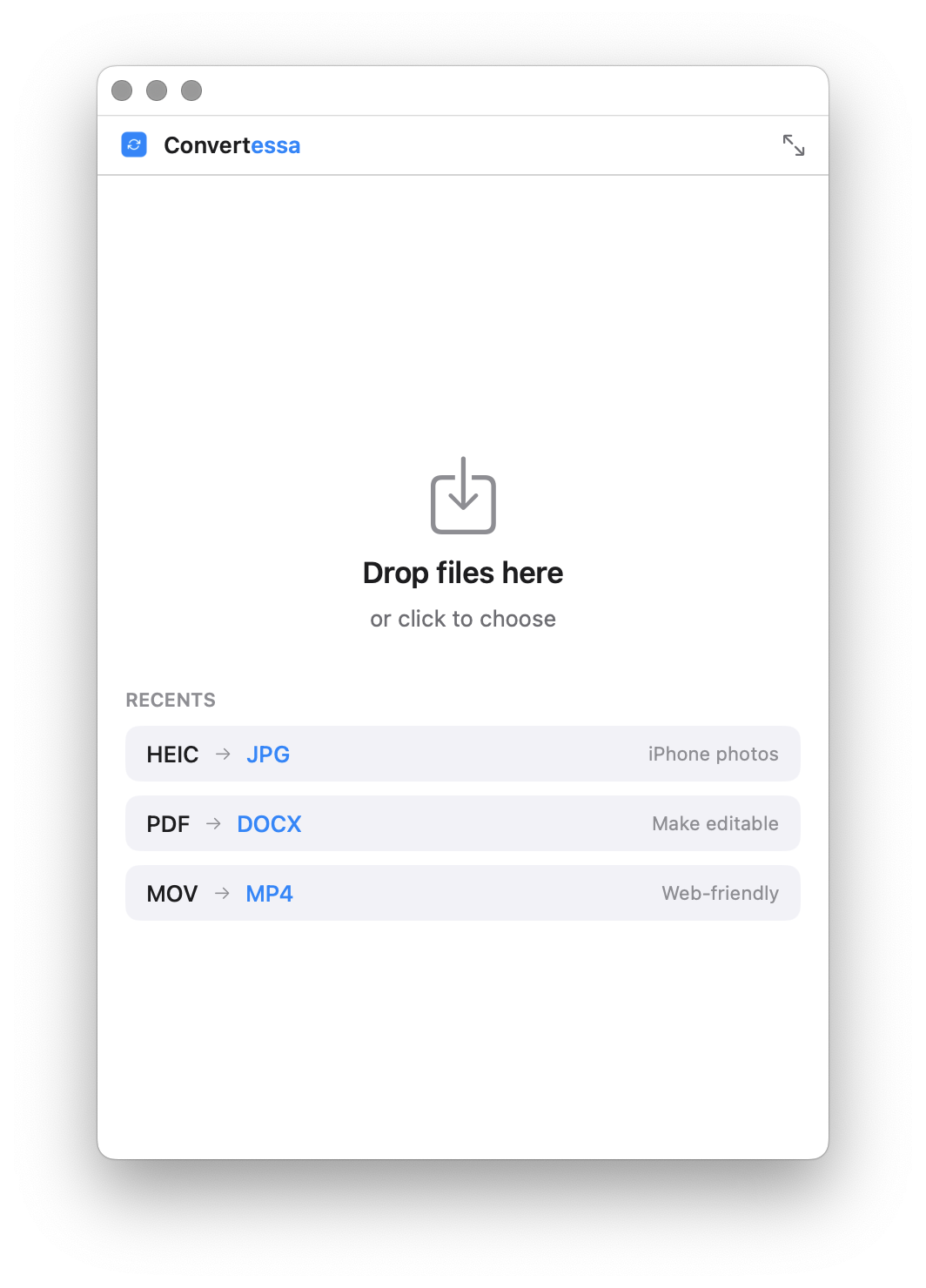
Convertessa in compact mode — a small window with a drop area and recent conversions
Pricing

One price. Yours for good.

Lifetime license
$19
One-time payment
No subscription. No renewals. Ever.
Get the app
  • 1,000+ conversion combinations
  • Lifetime future updates
  • No account required
  • Unlimited devices

macOS 14+ · Apple Silicon & Intel

Changelog

What’s shipped so far.

New formats, new features, and fixes — every release, on the record.

FAQ

Good questions.

Convertessa is a native macOS app that converts your files between formats — images, audio, video, documents, archives and eBooks — entirely on your Mac. Drop a file in, choose an output, and it’s done. No uploads, no account, no subscription.
Convertessa is an orchestrator. Under the hood it relies on best-in-class open-source engines — FFmpeg for audio & video, Pandoc for documents, libvips for images, LibreOffice for office formats, and Calibre for eBooks. It installs them for you with a click, then calls the right tool, or chain of tools, in the right order for whatever you’re converting. You get one clean native interface instead of a tangle of command-line flags. These binaries aren’t bundled with the app and are never installed without your approval — Convertessa simply calls them in a terminal session on your behalf.
Popular ones include JPEG, PNG, HEIC, WebP and AVIF; MP3, AAC, FLAC and WAV; MP4, MOV and MKV; PDF, DOCX and EPUB; ZIP, TAR and 7z — and many more. See exactly what converts to what in the conversion explorer →
Email us and we’ll add it in an upcoming release. Convertessa’s format coverage grows with what people actually need, so your request genuinely helps shape the app.
Your files? Never. Every conversion happens locally on your Mac. Your files are never uploaded, and nothing you convert is ever sent anywhere. Our Privacy Policy spells out exactly what limited data the app does store.
No analytics, no tracking, no telemetry. Your files and conversions stay entirely on your Mac — nothing you convert is ever sent anywhere. The app periodically checks for software updates in the background; like any web request, that check reveals only standard request metadata (your IP and app/OS version) to our update server — never your files, name, email, or license — and updates are always user-approved. Separately, on the website only, our purchase-confirmation page reports a completed sale to Google Ads so we can measure our own ad performance — it never runs while you’re browsing or converting, only after checkout. Our Privacy Policy spells out exactly what’s stored — and what isn’t.
Yes. Convertessa is a universal app and runs natively on Intel Macs. It requires macOS 14 or later.
Yes. It’s tuned for Apple Silicon (M-series) and runs natively — fast and energy-efficient. macOS 14 or later.
Yes — your license works on an unlimited number of your own Macs. Buy once and install it everywhere you work.
You get a genuinely useful, private, native Mac app for a single $19 payment — no subscription, ever. And your purchase directly supports a small independent developer and the app’s ongoing updates and new formats.
There’s no separate trial, but every purchase is backed by a 14-day money-back guarantee. If Convertessa isn’t right for you, contact your payment processor within 14 days to request a full refund — no questions asked. You can also email us and we’ll help route it.
Quite possibly — just email us. If you’re a student, run a non-profit, or have another good reason, reach out and we’ll sort you out.
Convertessa was built by Daler Azimov — a developer who needed a fast, private, native file converter for his own work, and decided to make the one he wished existed. Connect on LinkedIn →

Usually, but it is a rendering, not a copy. LibreOffice substitutes metric-compatible fonts for the common Microsoft ones — Liberation Serif stands in for Times New Roman, Liberation Sans for Arial — and because those have identical character widths, lines and page breaks land where you expect. A document set in a font your Mac does not have, and which has no metric equivalent, is the case where text rewraps and a heading slides onto the next page. If pagination is contractual, install the original fonts before converting.

Revision marks are carried into the rendering and printed as markup — Convertessa does not silently accept or reject anything on your behalf. If you want a clean deliverable, resolve the changes in a word processor first, then convert. Treat this as a feature when you are producing a redline for the other side, and as a trap when you are producing the final version.

No, and this catches people out. PDF has no live fields. A { DATE } field that showed today's date every time the document opened is frozen to the day you ran the conversion, and stays there for the life of the file. The same goes for auto-numbering, cross-references and mail-merge placeholders: whatever they displayed at conversion time is what the PDF says forever.

No. Word 97–2003 encryption sits between the engine and the content, so the file fails in the queue rather than producing an unreadable PDF. Remove the password in a word processor first, save, then convert. Files that are merely marked read-only or protected against editing are a different thing — those convert normally, because the content itself is not encrypted.

It depends entirely on what is inside. A text-heavy document often grows a little, because the PDF embeds font subsets the .doc merely referenced. A document carrying camera-resolution photographs usually shrinks, and that is where quality earns its keep:

convertessa report.doc --to pdf --quality 80

Presets work too — --quality balanced is the same setting by name.

Yes. LibreOffice reads the file's actual structure rather than trusting the extension, so a mislabelled DOCX, an RTF wearing a .doc name, or a genuine Word 6 file all convert. This is common in archives that were bulk-renamed at some point. The only real failure mode is a file that was truncated or corrupted in transfer, which fails loudly instead of producing half a PDF.

Macros do not — PDF has no place to put VBA, so it is dropped. Legacy Word form fields and content controls are printed in the state they were in: a checkbox shows ticked or unticked, a drop-down shows its current selection, and none of it stays interactive. If you need a fillable PDF, build the form in a PDF editor after conversion.

We’d love to hear from you. Email us and you’ll get a reply from a real person — the one who made the app.