Convert EPUB to PDF. Offline.

Your files stay on your Mac.
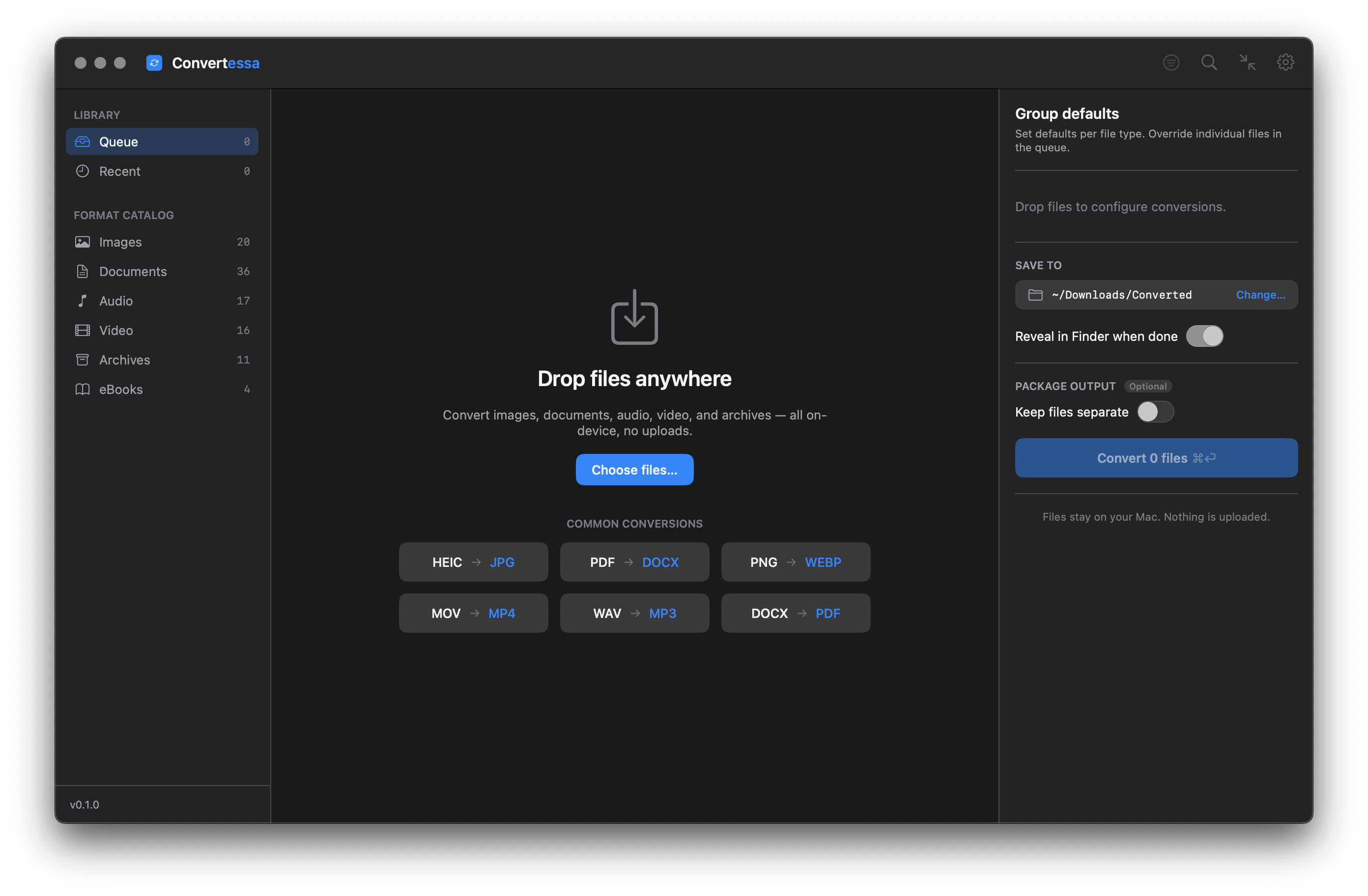
Convertessa app window showing the format catalog and drop area
What it does

EPUB to PDF, right on your Mac

Convertessa runs each EPUB through Calibre: unpacking the archive, following the spine for reading order, and typesetting the book into a fixed-page PDF whose bookmark outline comes from the table of contents. Text stays selectable, images ride along, and you choose the quality value that governs how that artwork is encoded onto the page. Drop a whole library folder and convert it in one pass, entirely on your Mac.

Reflow becomes pages

Pagination is created here, not preserved

An EPUB is a ZIP archive with strict contents: XHTML documents holding the text, CSS for styling, images, often embedded fonts, and an OPF package file listing the metadata and the spine — the order those documents are meant to be read in. Nowhere inside is there a page. A reading app invents pages at display time from your screen size and chosen typeface, which is why the "page 214" on your phone is not the page anyone else is looking at.

PDF is the opposite kind of object: a fixed canvas with content pinned to coordinates. So this conversion does not translate pages, it manufactures them. Calibre lays the book's XHTML out once, at one page size with one font stack, and freezes the result. Everything you gain and everything you lose follows from that single decision.

Carried across

  • Reading order, taken from the spine, chapter by chapter.
  • The table of contents, which becomes the PDF's bookmark outline in the sidebar.
  • Internal cross-references and footnote links, rewritten as PDF link annotations.
  • Title and author from the OPF metadata, landing in the PDF's document properties.
  • Real selectable, searchable text — words stay text objects, never pictures of words.

Left behind

  • Reflow itself. Font size is baked in now, so reading on a phone means pinching and panning.
  • Reader themes: sepia, night mode, your preferred typeface, your preferred line spacing.
  • Media overlays for read-along audio, and any embedded audio or video elements.
  • Pop-up footnotes from EPUB 3 semantics, which degrade into ordinary links.

The failure that surprises people most is DRM. Books bought from most stores are encrypted with Adobe ADEPT or a shop-specific scheme, and an encrypted EPUB cannot be read by any converter — the archive opens, but the content documents inside are ciphertext. That is DRM working exactly as intended rather than a defect in the app. Titles from Standard Ebooks, Project Gutenberg, publisher direct downloads and your own exports convert without complaint.

How it works

Three steps. No upload required.

1

Drop the library

Drag one EPUB or a folder of several hundred onto the queue. Each archive is unpacked locally, its OPF spine read for reading order and its navigation document read for the table of contents.

2

Choose PDF and quality

PDF is a lossy target here, because artwork from the EPUB is encoded again as it lands on the page. Raise quality for illustrated books and comics; lower it for novels where the cover is the only image.

3

Convert and check bookmarks

Calibre typesets each book and writes the PDF beside it. Open the sidebar in Preview and confirm the chapters arrived as outline entries before you archive or delete the source EPUB.

Format catalog

From everyday files to pro media.

Images, audio, video, documents, archives, eBooks and fonts — all converted natively, right on your Mac.

Conversion explorer

What do you want to convert?

Pick a format you have — see everything Convertessa can turn it into.

conversion combinations
I have a
can be converted to
From MP4

Features

Built for real work.

Batch conversion

Convert hundreds of files at once with per-type group defaults and individual overrides.

Modern image formats

First-class support for HEIC, AVIF and WebP — encode and decode, both ways. Read JPEG XL and a dozen more modern formats too.

Drag & drop

Drop files anywhere on the window. Native, instant, and exactly what you’d expect on a Mac.

Quality control

Dial in compression, resolution and bitrate. Keep originals pristine or shrink for sharing.

Collision-safe naming

Never overwrite a file by accident. Convertessa appends safe suffixes automatically.

Conversion history

Every job is logged locally. Re-run a previous conversion or revisit recent outputs in a click.

Archive the output

Bundle your converted files straight into a single ZIP, TAR or 7z — packaged and ready to share the moment a job finishes.

Convert from Finder

Right-click any file in Finder and choose Convert. A Quick Action handles it on the spot — no need to open the app first.

Compact mode

Shrink Convertessa to a tidy mini window that tucks into a corner — just a drop zone and a format picker for quick, one-off conversions.

Your files never leave your Mac.

No cloud. No account. No upload. Every conversion happens entirely on-device, using the power already in your Mac. What you convert is nobody’s business but yours.

On-device processing Zero telemetry No file uploads
For power users

There’s a command line, too.

Script conversions, wire them into your build, or batch a folder from the terminal. The same engine, no GUI required.

Read the full CLI documentation
zsh — convertessa
# Convert a single file
$ convertessa input.epub --to pdf
photo.pdf · 1.2 MB · 0.4s
 
# Batch a whole folder
$ convertessa ./*.epub --to pdf -o ~/Exports
14 files converted · 4.1s
Made to fit

And a compact mode.

Shrink Convertessa down to a small, focused window — drop, convert, done, with your recent conversions one click away.
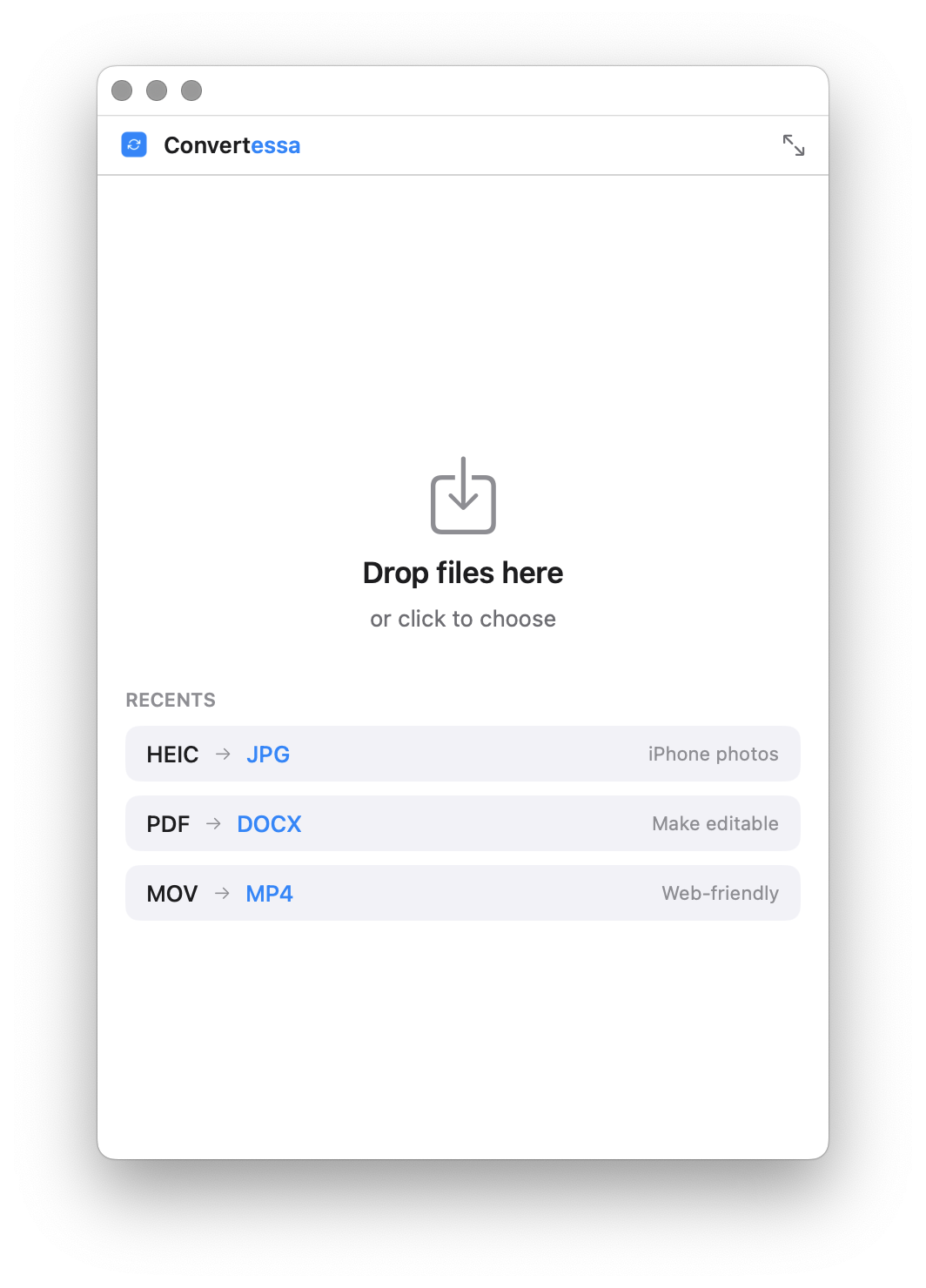
Convertessa in compact mode — a small window with a drop area and recent conversions
Pricing

One price. Yours for good.

Lifetime license
$19
One-time payment
No subscription. No renewals. Ever.
Get the app
  • 1,000+ conversion combinations
  • Lifetime future updates
  • No account required
  • Unlimited devices

macOS 14+ · Apple Silicon & Intel

Changelog

What’s shipped so far.

New formats, new features, and fixes — every release, on the record.

FAQ

Good questions.

Convertessa is a native macOS app that converts your files between formats — images, audio, video, documents, archives and eBooks — entirely on your Mac. Drop a file in, choose an output, and it’s done. No uploads, no account, no subscription.
Convertessa is an orchestrator. Under the hood it relies on best-in-class open-source engines — FFmpeg for audio & video, Pandoc for documents, libvips for images, LibreOffice for office formats, and Calibre for eBooks. It installs them for you with a click, then calls the right tool, or chain of tools, in the right order for whatever you’re converting. You get one clean native interface instead of a tangle of command-line flags. These binaries aren’t bundled with the app and are never installed without your approval — Convertessa simply calls them in a terminal session on your behalf.
Popular ones include JPEG, PNG, HEIC, WebP and AVIF; MP3, AAC, FLAC and WAV; MP4, MOV and MKV; PDF, DOCX and EPUB; ZIP, TAR and 7z — and many more. See exactly what converts to what in the conversion explorer →
Email us and we’ll add it in an upcoming release. Convertessa’s format coverage grows with what people actually need, so your request genuinely helps shape the app.
Your files? Never. Every conversion happens locally on your Mac. Your files are never uploaded, and nothing you convert is ever sent anywhere. Our Privacy Policy spells out exactly what limited data the app does store.
No analytics, no tracking, no telemetry. Your files and conversions stay entirely on your Mac — nothing you convert is ever sent anywhere. The app periodically checks for software updates in the background; like any web request, that check reveals only standard request metadata (your IP and app/OS version) to our update server — never your files, name, email, or license — and updates are always user-approved. Separately, on the website only, our purchase-confirmation page reports a completed sale to Google Ads so we can measure our own ad performance — it never runs while you’re browsing or converting, only after checkout. Our Privacy Policy spells out exactly what’s stored — and what isn’t.
Yes. Convertessa is a universal app and runs natively on Intel Macs. It requires macOS 14 or later.
Yes. It’s tuned for Apple Silicon (M-series) and runs natively — fast and energy-efficient. macOS 14 or later.
Yes — your license works on an unlimited number of your own Macs. Buy once and install it everywhere you work.
You get a genuinely useful, private, native Mac app for a single $19 payment — no subscription, ever. And your purchase directly supports a small independent developer and the app’s ongoing updates and new formats.
There’s no separate trial, but every purchase is backed by a 14-day money-back guarantee. If Convertessa isn’t right for you, contact your payment processor within 14 days to request a full refund — no questions asked. You can also email us and we’ll help route it.
Quite possibly — just email us. If you’re a student, run a non-profit, or have another good reason, reach out and we’ll sort you out.
Convertessa was built by Daler Azimov — a developer who needed a fast, private, native file converter for his own work, and decided to make the one he wished existed. Connect on LinkedIn →

Because a PDF carries its own typesetting. The EPUB was a ZIP of compressed XHTML that a reader laid out on the fly; the PDF stores every glyph position, embeds the fonts it needed and holds re-encoded images. A 400 KB novel routinely becomes several megabytes, and an illustrated title far more. Lowering the quality value shrinks the image data, but embedded fonts and layout objects are a floor you cannot get below.

There are none to keep. An EPUB stores no pages at all — your reader generated "page 214 of 480" from your screen dimensions and font size, and changing either renumbers the whole book. The PDF gets its own pagination, created during typesetting, and it will not match your Kindle, your Kobo, your phone or the printed edition. When the source is an ebook, cite by chapter and section rather than by page.

Check them before trusting them. EPUB 3 encodes maths as MathML, and rendering support for MathML is uneven, so a formula-dense textbook can come through with misplaced fractions, missing operators or fallback glyphs. Equations the publisher supplied as images convert reliably, since they are simply artwork. If you are converting a technical title, open the most formula-heavy chapter of the PDF first — that is where breakage shows.

Two causes cover nearly every case. First, DRM: a store-encrypted book cannot be decoded by any converter. Second, and more common than people expect, the file is not a book — an .acsm is an Adobe fulfilment token of a few kilobytes that tells a reader app to download the real book. Check the size in Finder: anything under about 20 KB is a token or a stub, not an EPUB.

More predictably than reflowable ones. A fixed-layout EPUB already declares page dimensions and positions its content absolutely, so its pages map to PDF pages roughly one to one instead of being invented. Because those books are essentially full-bleed artwork, the quality value matters far more than it does for a novel: keep it high, and expect a PDF several times the size of the EPUB. Guided panel-by-panel reading is a reader feature and does not carry over.

Calibre files books in per-author, per-title subdirectories, so point the CLI at the library and send the results somewhere flat:

convertessa ~/Calibre\ Library --to pdf --quality high -o ~/Documents/PDF

Or drop the folder onto the window. Output names follow the source filenames rather than the titles in Calibre's database, so a tidily named library converts into tidily named PDFs.

Yes. The text is written as real text objects with embedded fonts, so Preview, Acrobat and Books can select it, search it and attach highlights and notes exactly as they would on any born-digital PDF. No OCR is involved, because nothing was flattened into an image — this is not a scan. The one wrinkle is copying from justified, hyphenated text, where line-break hyphens sometimes come along for the ride.

We’d love to hear from you. Email us and you’ll get a reply from a real person — the one who made the app.