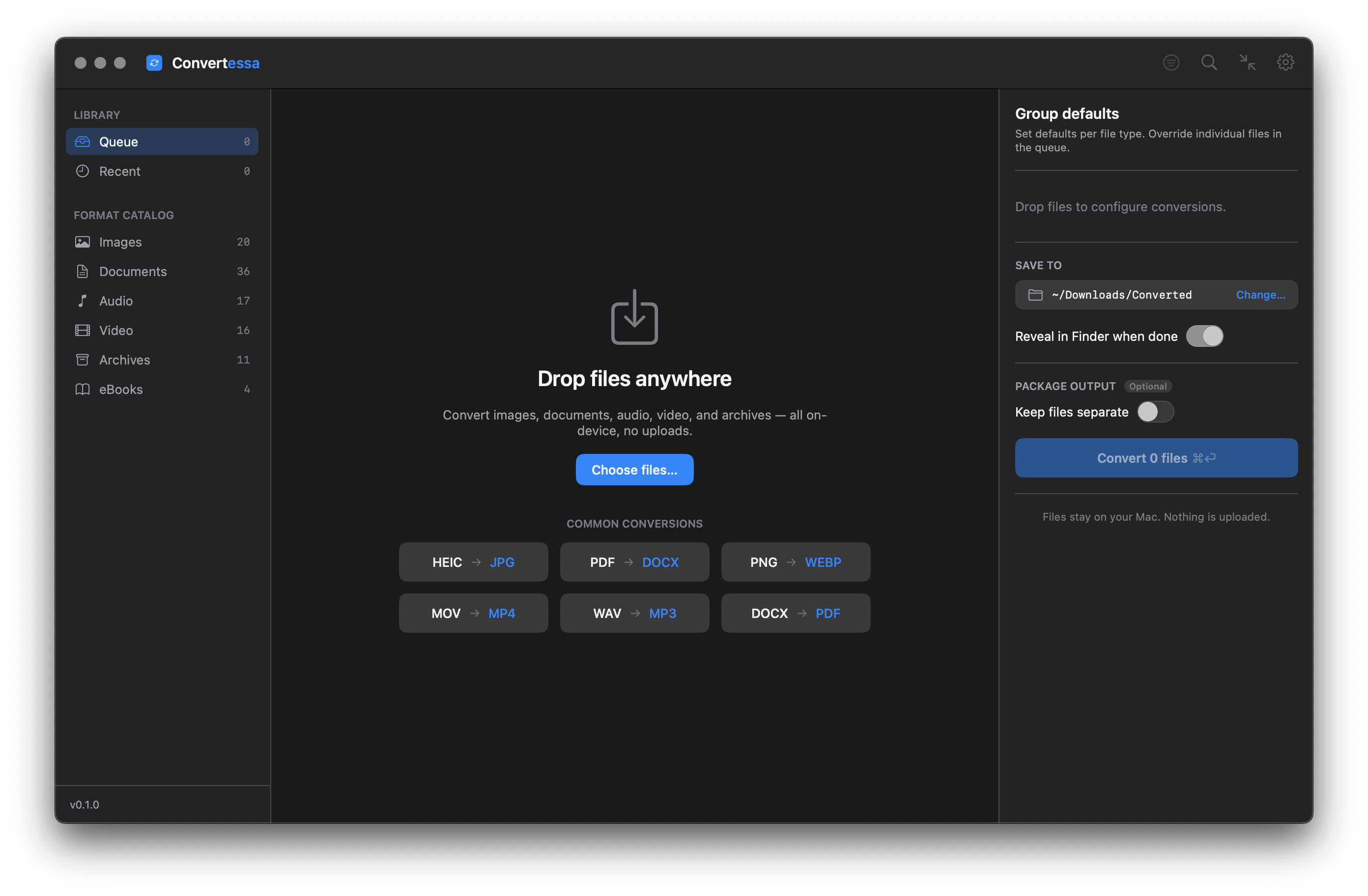
Your files stay on your Mac.
Phase One backs are wonderful and their files are a logistics problem: hundreds of megabytes each, readable in Capture One and little else. Convertessa decodes .iiq files on your Mac — XF, XT, IQ backs and Leaf Credo included — and writes JPGs at full pixel dimensions with a quality you set. A day's take becomes something you can send, review on a laptop, or hand to an assistant.
Numbers first, because they explain why this page exists. An IIQ L file from an IQ4 150MP runs 150 to 200 MB. A comfortable day's shooting is several hundred of them. Capture One opens them, most other software does not, the art director certainly will not, and emailing one is out of the question. Converting a take to JPG is a logistics decision at least as much as a photographic one.
The format belongs to Phase One — XF and XT bodies, IQ backs, and the Leaf Credo line all write .iiq. Two flavours exist: IIQ L keeps the full raw payload under lossless compression, while IIQ S discards data to roughly halve the size before the file is even written. If you shot S, that loss is already baked in, and JPG encoding adds a second, separate loss on top of it.
An IIQ is not only a sensor mosaic. It carries per-back calibration — defect maps, and on technical cameras the lens cast calibration you shot against a white reference. Capture One applies that as part of opening the file, which is precisely why it is easy to forget it exists. The decode here, done by libvips and the open-source raw decoder behind it, does not. On a shifted XT frame with a wide lens, expect the magenta-and-green corner cast to reappear in the JPG, the one Capture One was quietly removing. On studio work with an XF you will not notice a thing.
Everything else is predictable: pixel dimensions are unchanged, 16-bit tonality becomes 8-bit, and the highlight latitude you rely on in raw is gone the moment the file is a JPG. Treat the JPGs as the review copy and keep the IIQ as the negative — when you need a better version, go back to the raw rather than re-encoding a JPG.
Drop the capture folder onto Convertessa. Several hundred IIQ files queue at once, and the run is bound by demosaic work rather than disk, so it is a job you start and walk away from.
Choose JPG and set the quality: around 80 for selects that only need looking at, 92 or higher when the JPG is going to a retoucher or into a layout. The value applies to every file in the batch.
Send output to its own folder, in the app or with -o on the CLI, so JPGs never mix with raws. The .iiq files are read only and stay exactly where your backup expects to find them.
Images, audio, video, documents, archives, eBooks and fonts — all converted natively, right on your Mac.
Pick a format you have — see everything Convertessa can turn it into.
Convert hundreds of files at once with per-type group defaults and individual overrides.
First-class support for HEIC, AVIF and WebP — encode and decode, both ways. Read JPEG XL and a dozen more modern formats too.
Drop files anywhere on the window. Native, instant, and exactly what you’d expect on a Mac.
Dial in compression, resolution and bitrate. Keep originals pristine or shrink for sharing.
Never overwrite a file by accident. Convertessa appends safe suffixes automatically.
Every job is logged locally. Re-run a previous conversion or revisit recent outputs in a click.
Bundle your converted files straight into a single ZIP, TAR or 7z — packaged and ready to share the moment a job finishes.
Right-click any file in Finder and choose Convert. A Quick Action handles it on the spot — no need to open the app first.
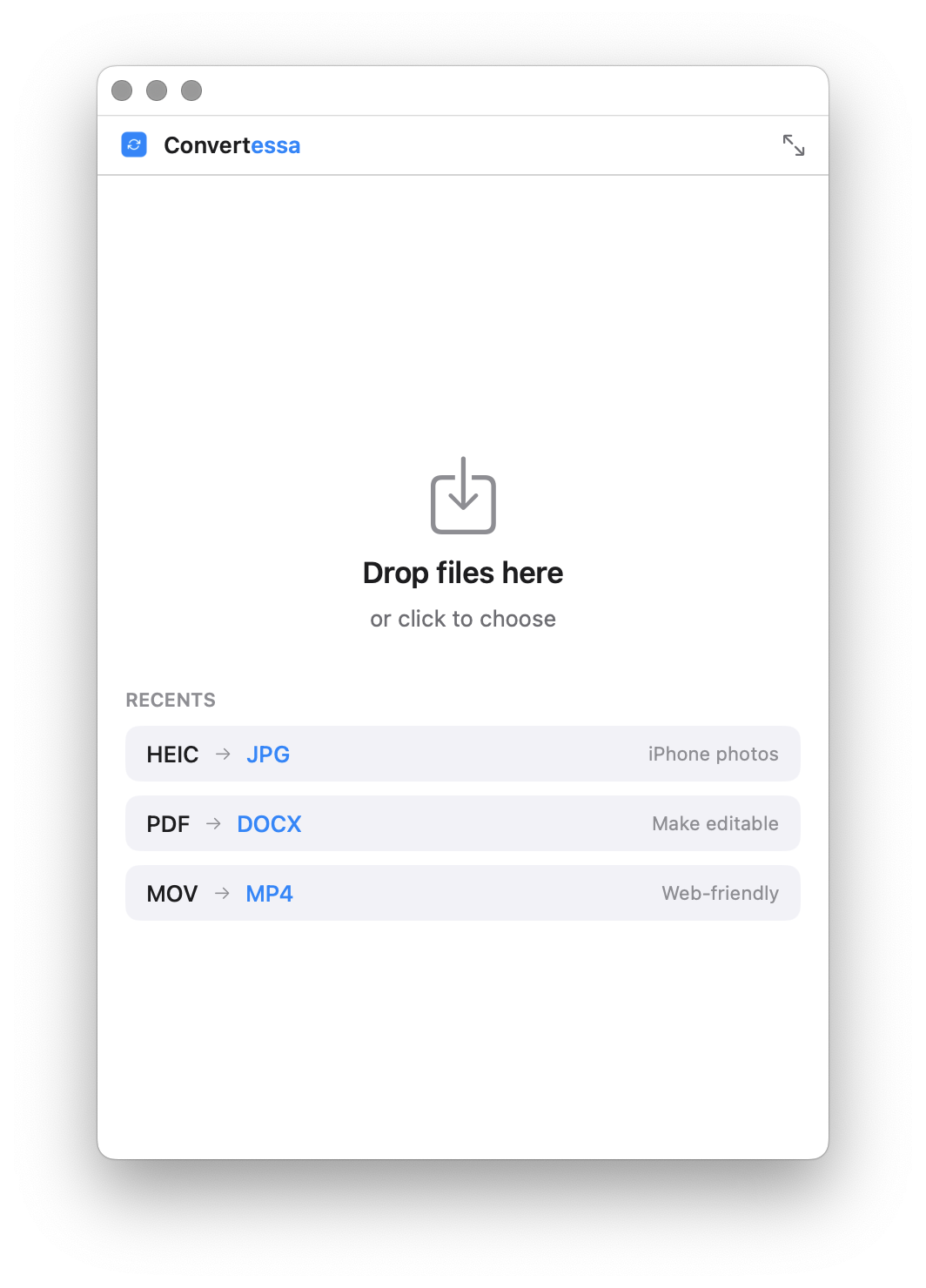
Shrink Convertessa to a tidy mini window that tucks into a corner — just a drop zone and a format picker for quick, one-off conversions.
No cloud. No account. No upload. Every conversion happens entirely on-device, using the power already in your Mac. What you convert is nobody’s business but yours.
Script conversions, wire them into your build, or batch a folder from the terminal. The same engine, no GUI required.
Read the full CLI documentation →Shrink Convertessa down to a small, focused window — drop, convert, done, with your recent conversions one click away.
macOS 14+ · Apple Silicon & Intel
New formats, new features, and fixes — every release, on the record.
Because Capture One applies the calibration stored with the file — the back's defect map and, on technical cameras, the lens cast calibration you shot against a white reference. An open-source decoder does not read that pipeline. On a shifted XT frame with a wide lens the magenta-and-green corner cast reappears in the JPG. For that frame, render it in Capture One and convert the export instead.
It matters, though not to the mechanics of the conversion. IIQ L keeps the full raw payload under lossless compression; IIQ S discards data to roughly halve the file before it is written. Converting an S file to JPG stacks a second, independent loss on top of the first, so it is worth using a higher quality setting there than for an L file from the same shoot.
Yes. Credo backs write .iiq just as Phase One IQ backs do, and they take the same path through the decoder. The same goes for files from XF bodies, the XT, and older P and P+ backs — same extension, same decode. What differs is file size, and with it how long a batch takes to work through.
No. Frame Averaging happens inside the back: it composites the exposures and writes one ordinary IIQ. By the time the file reaches your Mac there is nothing unusual left to handle, so it converts like any other capture. The same is true of Automated Frame Averaging and Dual Exposure+ output — one file in, one JPG out.
Far less than the originals. A 150-megapixel IIQ of around 180 MB typically becomes 10 to 30 MB as a JPG, so a 400-frame day drops from roughly 70 GB to something that fits on a memory stick. For a review set, go lower:
convertessa ./Capture/ --to jpg -o ~/Selects --quality 80
Only in the ways a JPG can carry. Resolution, per-pixel detail and the lens's rendering all survive; 16-bit tonality does not, because JPG is 8 bits per channel regardless of what fed it. A long, clean gradient off a Phase One back can still band in an 8-bit file. What medium format buys you here is detail, not tonal headroom.
Yes, and you should. The .iiq files are only ever read, so nothing stops you running the same folder again at a higher quality when a select turns into a delivery. Always go back to the raw for that second pass — re-saving an existing JPG re-encodes something already lossy and compounds the damage.