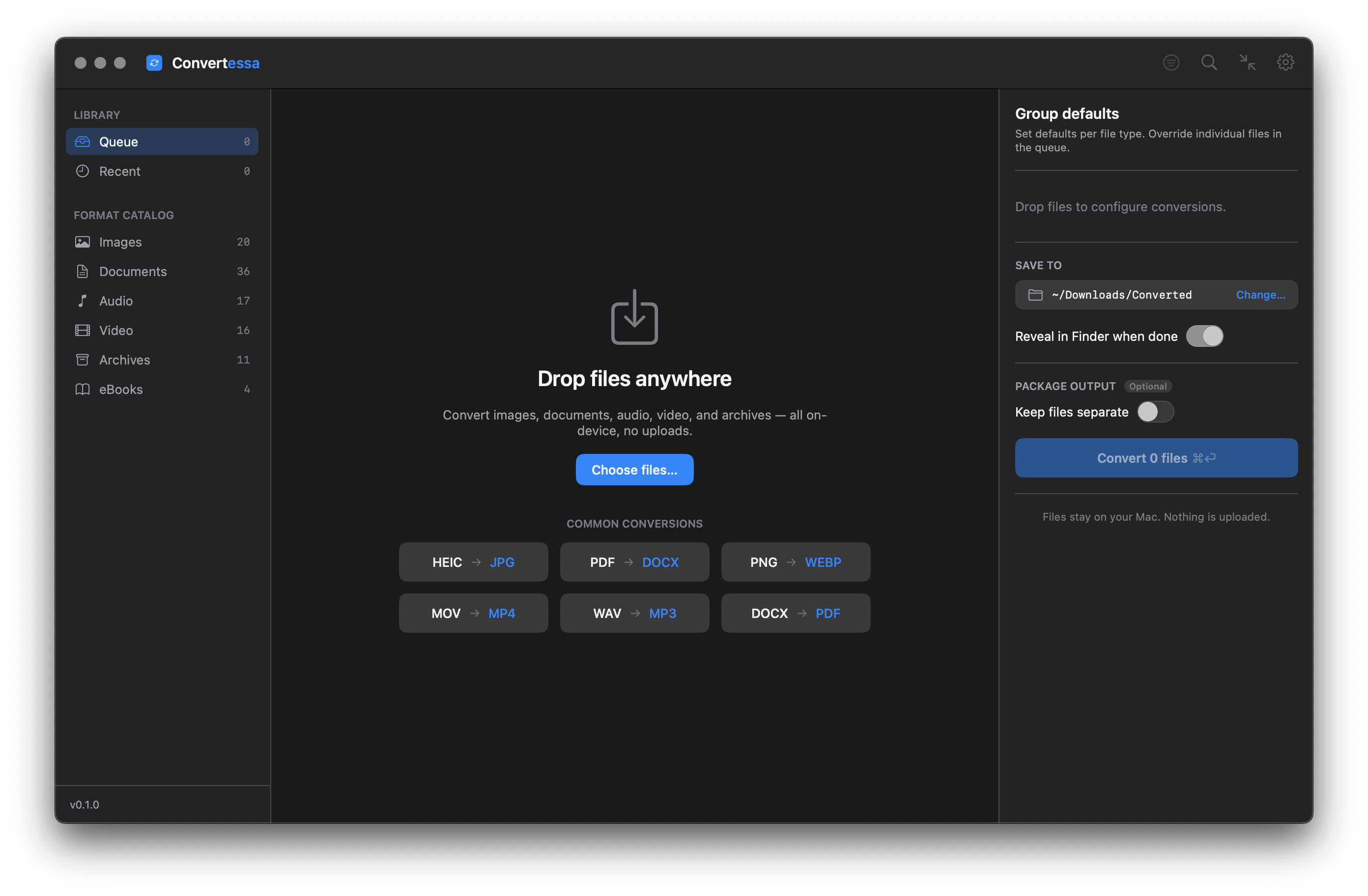
Your files stay on your Mac.
Convertessa decodes each JPEG with libvips and rewrites it as PNG on your Mac, pixel for pixel. The output is compressed with deflate, which is lossless, so nothing further is discarded — what the JPEG decoded to is exactly what the PNG stores, and every save from then on is byte-exact. Drop one photo or a folder of hundreds; the app writes new files where you point it and leaves the JPEGs alone.
This is the one image conversion people most often expect to be an upgrade. It is not, and understanding why saves a great deal of confusion later. JPEG discards detail permanently at the moment the file is first written — the eight-by-eight blocks, the softened colour, the halos around hard edges. PNG then stores whatever it is handed with perfect fidelity, which means it preserves those artifacts just as faithfully as it preserves the photograph.
What you actually gain is real, only different:
PNG compresses by finding repetition. Sensor noise and JPEG's own block texture give it almost nothing to repeat, so a 3 MB photograph routinely becomes a 15 to 25 MB PNG. That is normal, not a sign that something went wrong.
JPEG records rotation as an EXIF Orientation tag rather than rotating pixels, and PNG has no equivalent that readers reliably honour, so confirm one output is upright before batching a folder. And a CMYK JPEG from a print workflow has to be rendered into RGB, because PNG has no CMYK mode — rich blacks and saturated inks shift visibly. PNG is lossless, so no quality slider appears anywhere in this conversion; libvips writes back exactly the pixels it decoded.
Drop one photo or a folder of them onto the window. Convertessa lists everything it found, reads baseline, progressive, greyscale and CMYK JPEGs alike, and leaves the originals exactly where they sit.
Pick PNG as the output. Because PNG is lossless there is nothing to trade off and no quality slider appears, so the only decision left is which folder the finished files should land in.
Run the queue. Each PNG will typically be five to ten times the size of the JPEG it came from, which is the price of a format that records every pixel exactly rather than approximating it.
Images, audio, video, documents, archives, eBooks and fonts — all converted natively, right on your Mac.
Pick a format you have — see everything Convertessa can turn it into.
Convert hundreds of files at once with per-type group defaults and individual overrides.
First-class support for HEIC, AVIF and WebP — encode and decode, both ways. Read JPEG XL and a dozen more modern formats too.
Drop files anywhere on the window. Native, instant, and exactly what you’d expect on a Mac.
Dial in compression, resolution and bitrate. Keep originals pristine or shrink for sharing.
Never overwrite a file by accident. Convertessa appends safe suffixes automatically.
Every job is logged locally. Re-run a previous conversion or revisit recent outputs in a click.
Bundle your converted files straight into a single ZIP, TAR or 7z — packaged and ready to share the moment a job finishes.
Right-click any file in Finder and choose Convert. A Quick Action handles it on the spot — no need to open the app first.
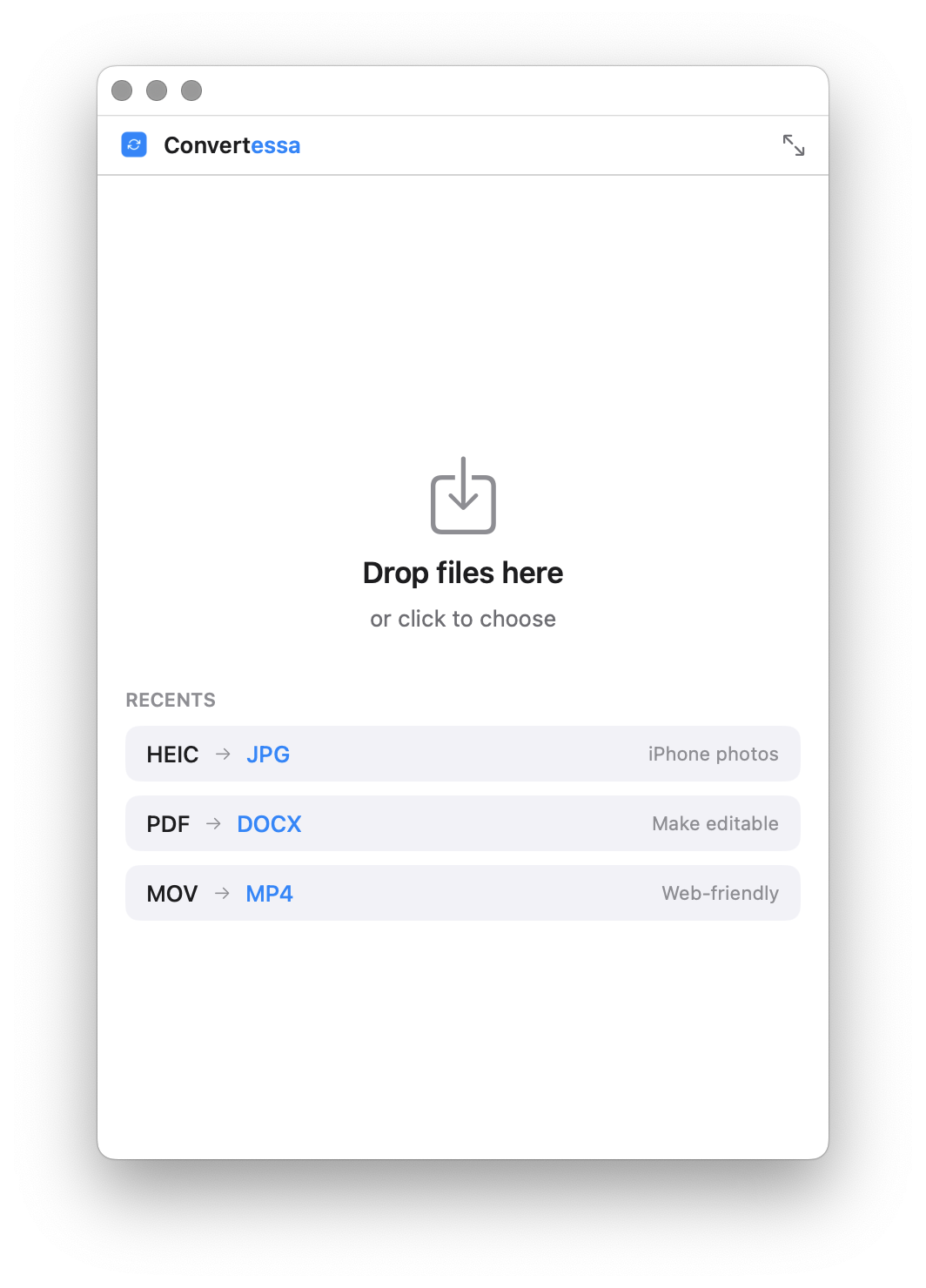
Shrink Convertessa to a tidy mini window that tucks into a corner — just a drop zone and a format picker for quick, one-off conversions.
No cloud. No account. No upload. Every conversion happens entirely on-device, using the power already in your Mac. What you convert is nobody’s business but yours.
Script conversions, wire them into your build, or batch a folder from the terminal. The same engine, no GUI required.
Read the full CLI documentation →Shrink Convertessa down to a small, focused window — drop, convert, done, with your recent conversions one click away.
macOS 14+ · Apple Silicon & Intel
New formats, new features, and fixes — every release, on the record.
No, and it is worth being blunt about that. The detail JPEG threw away was gone the moment the file was first written, and nothing can reconstruct it. PNG simply records whatever pixels it is handed with perfect accuracy, block edges and halos and smeared colour included. What you genuinely gain is a file that will not degrade any further, however many times it is opened, edited and saved again.
No, and this is the most common misunderstanding about this conversion. PNG supports transparency; converting to it does not create transparency. Your output carries an alpha channel in which every pixel is fully opaque, and the white behind your subject is still ordinary white pixels. Removing it is an editing job: erase or mask the background in an image editor, then save as PNG so the transparency survives. Convertessa converts formats and does not alter image content.
That is expected. PNG compresses losslessly by finding repetition, and a photograph is full of sensor noise and JPEG's own fine block texture, which is near-random data with almost nothing to repeat. Five to ten times the original is the normal range for photographic content, while flat graphics and screenshots behave completely differently and often shrink. Nothing has gone wrong: the image is pixel-identical to what the JPEG decoded to.
Phone and camera JPEGs are often stored in the sensor's native orientation with an EXIF Orientation tag telling viewers to rotate on display. PNG has no tag that readers reliably honour, so an image that looked upright in Photos can land rotated. Fix it at the source: open the JPEG in Preview, rotate it, save, then convert. Checking one file before running a large folder saves redoing the whole batch.
Yes. Drop the folder onto the window, or run:
convertessa ./Photos/*.jpg --to png -o ~/Desktop/PNG
There is deliberately no quality flag here — PNG is lossless, so --quality is ignored for it entirely. Check your free space before starting something large: a few hundred camera JPEGs can easily become several gigabytes of PNG, and the originals stay in place alongside the new files.
It does not travel. Convertessa strips embedded metadata, so the shooting information, timestamps and GPS coordinates in the JPEG are not written into the PNG. That is a privacy win when you are handing a file to someone and a genuine loss when you are cataloguing one. Keep the JPEG if the capture data matters: Photos, Lightroom and exiftool all read it straight from the original.
It converts, but the colour shifts. CMYK JPEGs come out of print workflows, and PNG has no CMYK mode, so the image has to be rendered into RGB. Saturated inks and rich blacks are the obvious casualties, because plenty of CMYK values have no exact RGB equivalent. If the file is headed back to a printer, keep the CMYK original and treat the PNG as a screen proof only.
Rarely. It is lossless, which sounds ideal, but you would be archiving a copy of an already-lossy file at several times the size and without its metadata. For archiving, keep the original JPEG, because it is the true master. PNG earns its place as a working format instead: an intermediate you edit and re-save repeatedly without generation loss, or a deliverable for a pipeline that refuses JPEG.