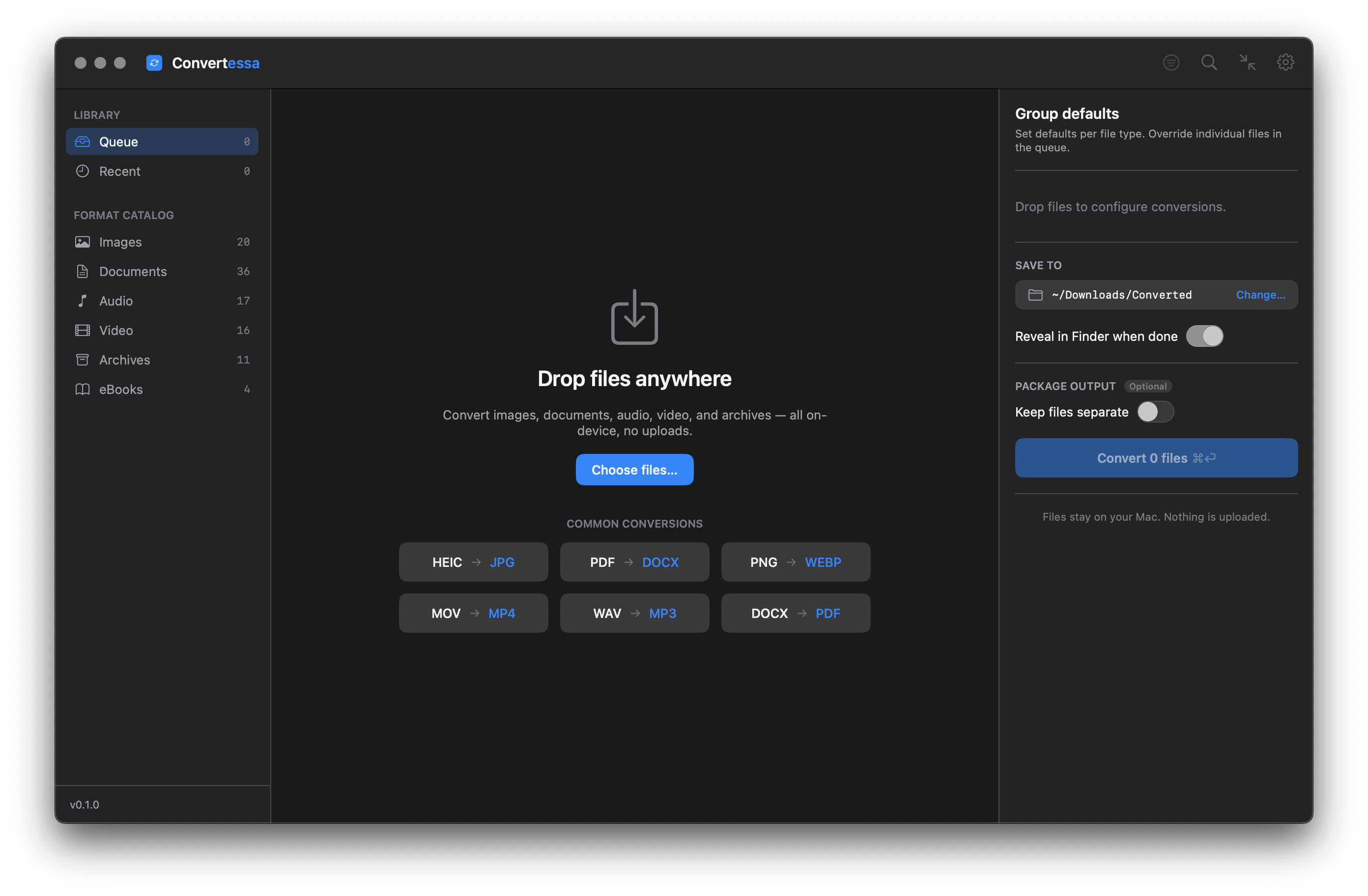
Your files stay on your Mac.
Convertessa decodes each JPG with libvips and re-encodes it as lossy WebP, leaving the pixel grid exactly as it found it. You choose the quality value, which decides how much of the photograph survives its second compression pass, and EXIF follows the image across unless you ask for it to be stripped. Drop one file or a folder of thousands; nothing is uploaded, and the WebP files land wherever you point the output.
Both formats are lossy, and that fact governs everything else here. Your JPG has already been through a discrete cosine transform, quantised, and had detail thrown away for good. Encoding it as WebP decodes those blocks back into pixels and hands them to a completely different encoder — VP8 intra-frame prediction — which cannot tell which edges belong to the photograph and which are JPEG's own 8×8 blocking. It spends bits reproducing both.
The trade is usually still worth making. Google's published comparison puts WebP roughly 25–34% smaller than JPEG at matched visual quality, and ordinary photographs saved at high JPEG quality land somewhere in that range. The exception is the already-battered image: a heavily compressed JPG re-encoded at a very high WebP quality can come out larger than the original, because faithfully reproducing artefacts is expensive work. If an output grows, lower the quality instead of raising it.
--strip-metadata, which is worth remembering before publishing images taken at home.Two hard edges catch people out. WebP cannot exceed 16,383 pixels on a side, so long panoramas and flatbed scans simply refuse to encode. And WebP is RGB only: a CMYK JPG out of a print workflow has to change colour space on the way through, which shifts colours unless the file carried a sensible ICC profile. libvips does the decoding and encoding, which is why a folder of several thousand photographs finishes in one pass without exhausting memory.
Drag a shoot, an export folder or a single image into the queue. Baseline and progressive JPGs are read the same way, and each image's pixel dimensions carry straight through to the WebP.
WebP is lossy, so a quality value applies. Around 80 usually matches a high-quality JPG at a noticeably smaller size; go higher for images headed for further editing, lower for thumbnails and page furniture.
libvips encodes every file locally. Before deleting anything, compare two or three outputs with their originals at full magnification: flat skies and long gradients are where a second lossy pass shows first.
Images, audio, video, documents, archives, eBooks and fonts — all converted natively, right on your Mac.
Pick a format you have — see everything Convertessa can turn it into.
Convert hundreds of files at once with per-type group defaults and individual overrides.
First-class support for HEIC, AVIF and WebP — encode and decode, both ways. Read JPEG XL and a dozen more modern formats too.
Drop files anywhere on the window. Native, instant, and exactly what you’d expect on a Mac.
Dial in compression, resolution and bitrate. Keep originals pristine or shrink for sharing.
Never overwrite a file by accident. Convertessa appends safe suffixes automatically.
Every job is logged locally. Re-run a previous conversion or revisit recent outputs in a click.
Bundle your converted files straight into a single ZIP, TAR or 7z — packaged and ready to share the moment a job finishes.
Right-click any file in Finder and choose Convert. A Quick Action handles it on the spot — no need to open the app first.
Shrink Convertessa to a tidy mini window that tucks into a corner — just a drop zone and a format picker for quick, one-off conversions.
No cloud. No account. No upload. Every conversion happens entirely on-device, using the power already in your Mac. What you convert is nobody’s business but yours.
Script conversions, wire them into your build, or batch a folder from the terminal. The same engine, no GUI required.
Read the full CLI documentation →Shrink Convertessa down to a small, focused window — drop, convert, done, with your recent conversions one click away.
macOS 14+ · Apple Silicon & Intel
New formats, new features, and fixes — every release, on the record.
Go back to the original whenever you still have one. Every lossy generation compounds: the JPG discarded detail at export, and WebP discards more on top of a picture that already carries JPEG's blocking. Exporting WebP from a RAW or a lossless master gives a visibly cleaner result at the same file size. Converting existing JPGs is the right move when the JPG is your master — archives, downloads, client deliveries, anything shot years ago.
Usually the quality is set too high for the source. WebP is faithfully reproducing JPEG's compression artefacts, and noise costs more bits than clean detail does. Very small images also carry fixed overhead that a few kilobytes of picture cannot amortise. Drop the quality and re-run:
convertessa ~/Pictures/web/*.jpg --to webp --quality 78 -o ~/Pictures/webp
Compare at that setting before assuming you need to go higher.
No. Both scales run 0–100, and they mean different things because they drive different encoders. As a working rule, WebP in the high seventies to low eighties tends to look like a JPG saved in the high eighties, at a substantially smaller size. Treat the numbers as controls to test rather than values to translate: take one image with skin tones and one with a broad gradient, encode each at two settings, and judge with your eyes.
Yes, unless you strip them. WebP can store an EXIF block, so location, camera body and capture time follow the photograph into the output. For images going onto a public site that is often not what you want, since coordinates from a phone can be accurate to the doorstep. Pass --strip-metadata to leave all of it behind:
convertessa holiday.jpg --to webp --quality 80 --strip-metadata
Not from a JPG. WebP genuinely supports an alpha channel, but JPEG has never stored one, so there is no transparency in the source to preserve — the white behind your subject is ordinary opaque pixels. You would need an editor to cut the subject out first and save that as PNG or as a WebP with alpha; the transparency then survives future conversions. Encoding alone cannot invent an alpha channel that was never recorded.
Yes. Safari has supported WebP since version 14, and macOS has rendered it system-wide — Preview, Quick Look, Finder thumbnails — since Big Sur, so Quick Look on a converted file behaves exactly as it does on a JPG. Chrome, Firefox and Edge have supported it for years. Older software is the real risk: some print workflows and legacy design tools still reject WebP outright, which is a good reason to keep the JPGs.
No, and nothing can. That detail was discarded when the JPG was written, and a different encoder cannot reconstruct what is not in the file. WebP will reproduce the softness faithfully at a smaller size, which is genuinely useful for the web, but the picture will never look better than its source. Convertessa keeps the pixel grid as it found it and does not alter an image's dimensions in either direction.