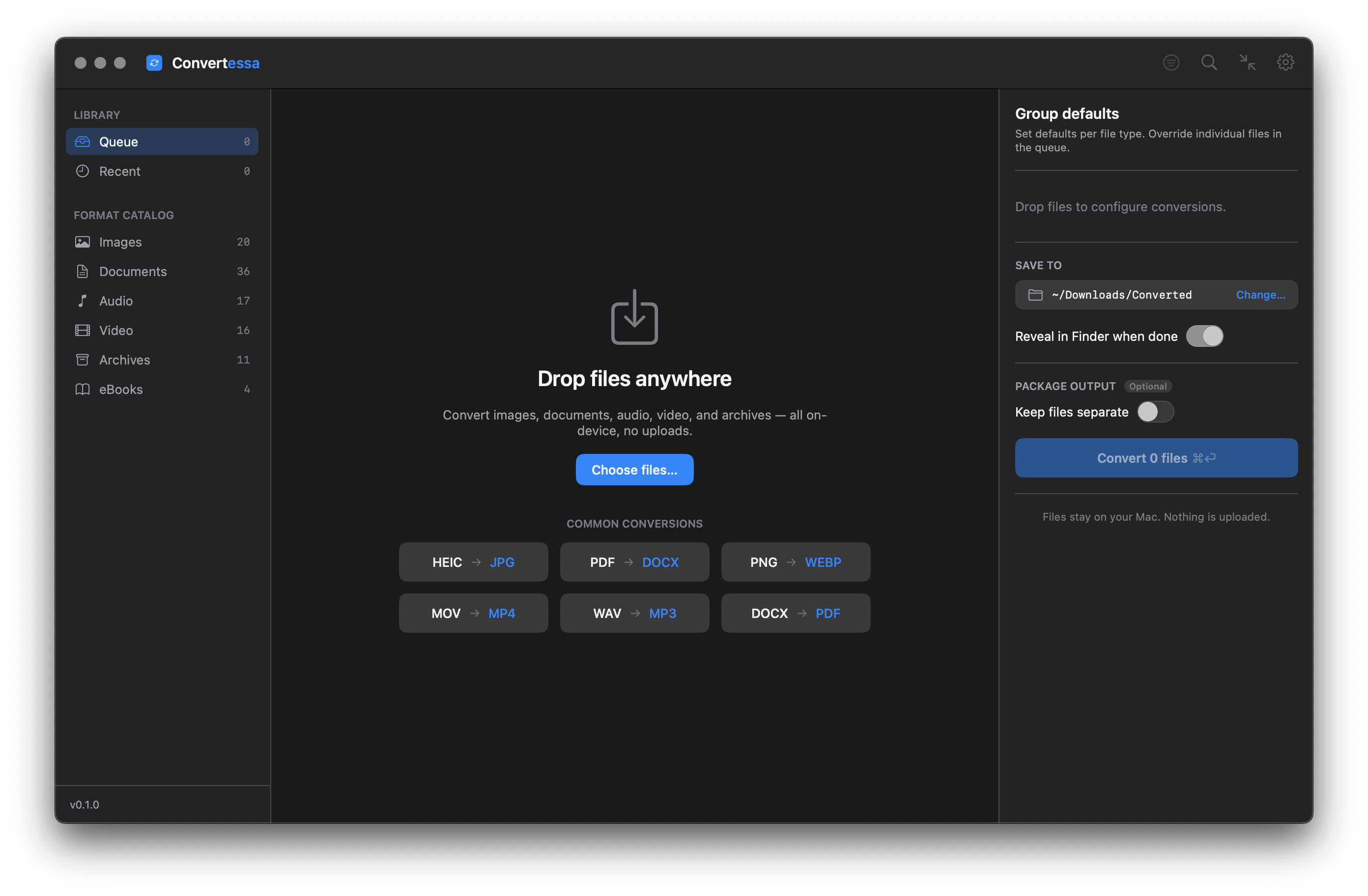
Your files stay on your Mac.
An M4V is an MP4 wearing a different name badge, so this conversion is mostly about making the file honest. Convertessa runs it through FFmpeg and writes a standard MP4 that editors, smart TVs, browsers and upload forms accept without argument. Choose a quality value, drop in a whole season folder at once, and everything happens on your Mac. DRM-protected purchases are the one exception.
M4V and MP4 are the same container. Both are the ISO Base Media File Format: the same boxes, the same layout, the same rules. Apple simply chose a different extension for video sold through the iTunes Store so its own apps could treat those files specially. Look at the start of an unprotected .m4v and you will find an ftyp box declaring an MP4-family brand, exactly as a plain .mp4 does.
Video bought or rented from the iTunes Store or the Apple TV app is wrapped in FairPlay DRM. The music store dropped DRM in 2009; the video store never did. FFmpeg cannot decode a protected stream, and Convertessa does not remove DRM, so the conversion stops with a decode error rather than producing a broken file. If your M4V came out of iMovie, Final Cut, QuickTime, HandBrake or a camera workflow, it is unprotected and converts normally.
Because the containers overlap so heavily, renaming an unprotected file to .mp4 frequently plays fine. It is still a gamble: plenty of TVs, NLEs, web players and upload validators inspect the file's internal boxes rather than its extension, and a real pass through FFmpeg gives you a structure they accept. MP4 is a lossy target, so a quality value is available. Keep it high, since you are compressing already-compressed video a second time.
Try opening the M4V in something other than the TV app. If only Apple's player will touch it, the file is FairPlay-protected and no converter can read it. iMovie, HandBrake and camera exports are fine.
Drop in one video or an entire folder of episodes. Everything converts in a single pass and each output keeps its source filename, so numbered episodes stay in order in Finder afterwards.
Pick MP4 and set the quality value on the high side. The source is already compressed video, and a low setting on a second encode is what makes film grain smear and fast motion turn blocky.
Images, audio, video, documents, archives, eBooks and fonts — all converted natively, right on your Mac.
Pick a format you have — see everything Convertessa can turn it into.
Convert hundreds of files at once with per-type group defaults and individual overrides.
First-class support for HEIC, AVIF and WebP — encode and decode, both ways. Read JPEG XL and a dozen more modern formats too.
Drop files anywhere on the window. Native, instant, and exactly what you’d expect on a Mac.
Dial in compression, resolution and bitrate. Keep originals pristine or shrink for sharing.
Never overwrite a file by accident. Convertessa appends safe suffixes automatically.
Every job is logged locally. Re-run a previous conversion or revisit recent outputs in a click.
Bundle your converted files straight into a single ZIP, TAR or 7z — packaged and ready to share the moment a job finishes.
Right-click any file in Finder and choose Convert. A Quick Action handles it on the spot — no need to open the app first.
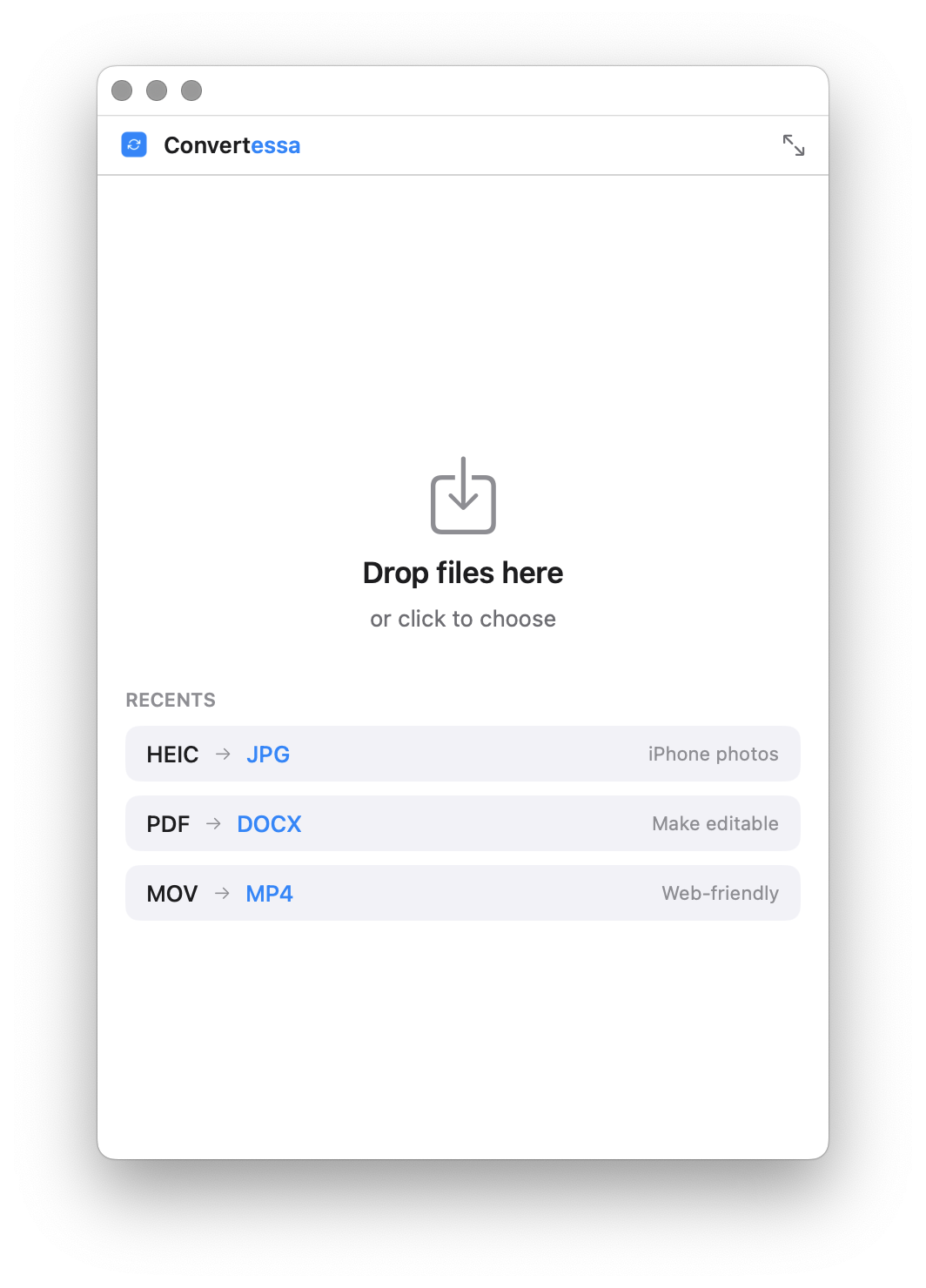
Shrink Convertessa to a tidy mini window that tucks into a corner — just a drop zone and a format picker for quick, one-off conversions.
No cloud. No account. No upload. Every conversion happens entirely on-device, using the power already in your Mac. What you convert is nobody’s business but yours.
Script conversions, wire them into your build, or batch a folder from the terminal. The same engine, no GUI required.
Read the full CLI documentation →Shrink Convertessa down to a small, focused window — drop, convert, done, with your recent conversions one click away.
macOS 14+ · Apple Silicon & Intel
New formats, new features, and fixes — every release, on the record.
Two quick checks. First, where did it come from? Anything bought or rented from the iTunes Store or the Apple TV app is protected; anything you exported yourself is not. Second, try opening it in VLC or QuickTime Player. A protected file will refuse to play outside Apple's own app on an authorised Mac. If it plays everywhere, it will convert. If Convertessa reports a decode failure on the very first frame, that is DRM, not a corrupt file.
Often yes, and it costs nothing to try, because the byte layout inside is already MP4. It fails when something inspects the file rather than the name: some smart TVs and set-top boxes, several editing suites, and most upload validators check the brand and box structure. It also fails outright on a protected file, where the extension was never the problem. A real conversion gives you a file that survives that inspection.
Chapters in an M4V live in their own track alongside video and audio, and MP4 supports the same idea, so they can carry across. What they will not do is behave identically everywhere: QuickTime, VLC, Plex and Infuse each read chapter tracks slightly differently, and a player that ignores the track shows one continuous timeline. If chapter navigation matters to you, check the converted file in your actual player before converting the rest of the library.
AC-3 is legal inside MP4, so a 5.1 track is not inherently a problem for the container. The problem is the far end: Safari, Chrome and most browsers cannot decode AC-3, and many phones will play the video with no sound at all. If the MP4 is destined for the web or a phone, an AAC stereo track is the safe choice; if it is going to a home-theatre setup, keeping the surround track is the point.
It depends which kind you have. Apple's timed-text subtitle tracks are ordinary MP4 subtitle tracks and travel well. CEA-608 captions are different: they are encoded inside the video stream's user data rather than as a track of their own, and they are easy to lose in a re-encode. If your subtitles matter, play the converted file and toggle the subtitle menu before running a whole batch.
Point the CLI at the folder's files and send the results somewhere clean:
convertessa ~/Movies/Season\ 1/*.m4v --to mp4 --quality 90 -o ~/Movies/Converted
Escape the space in the folder name, as above, or quote the whole path. Every episode converts in one pass and keeps its filename, so S01E04.m4v becomes S01E04.mp4 and the episode order in Finder survives.
Because a store-delivered M4V was encoded once, slowly and carefully, at a size target chosen for downloads. Your conversion re-encodes that already-compressed picture at whatever quality value you asked for, and a high value on a second pass can easily produce a larger file than the tuned original. Lower the quality value if size matters more than fidelity, and expect the trade to be visible on grain and fast motion first.