Your files stay on your Mac.
MKV is the container that says yes to everything; MP4 is the one Apple hardware actually plays. Convertessa uses FFmpeg to rebuild a Matroska file as an MP4 entirely on your Mac, re-encoding whatever MP4 cannot carry, at a quality you choose. Expect the picture and the sound to arrive intact, and expect the exotic extras, subtitles above all, to need handling of their own.
Matroska arrived in 2002 as a deliberately open, deliberately maximal container. It will hold any codec, any number of tracks, chapters, tags, cover art and even font files. That generosity is why it is the format of choice for disc rips, fansubs and screen recordings, and precisely why moving one to MP4 involves decisions rather than a straight copy.
OBS Studio is the common case. It records to MKV because Matroska can be written progressively: pull the power cord mid-session and the file still plays. An MP4 wants its index written at the end, so a crashed recording is often unrecoverable. The recommended workflow is therefore to record MKV and convert afterwards. Apple's side of the world is the other half of the story, because QuickTime Player, Safari, Photos, Final Cut, iPhones and Apple TV all decline Matroska outright.
MKV usually carries subtitles as ASS or SSA, styled text with positioning, karaoke timing and attached fonts, or as PGS, the bitmap format lifted from Blu-ray. MP4 supports neither. Its only real text track is 3GPP timed text, which knows nothing about styling. In practice those tracks do not come across; if a release depends on them, extract them to a sidecar file with a Matroska tool first and keep it beside the MP4.
Audio is the second decision. Rips often carry DTS, TrueHD, FLAC or Vorbis, none of which MP4 has a home for, so FFmpeg re-encodes to AAC. A surround mix generally stays multi-channel, but a lossless HD master stops being lossless. Chapters, tags and attachments are container-level extras that MP4 either drops or represents badly. Video is the easy part: H.264 and HEVC map across cleanly, and you choose the quality of the MP4 that Convertessa writes.
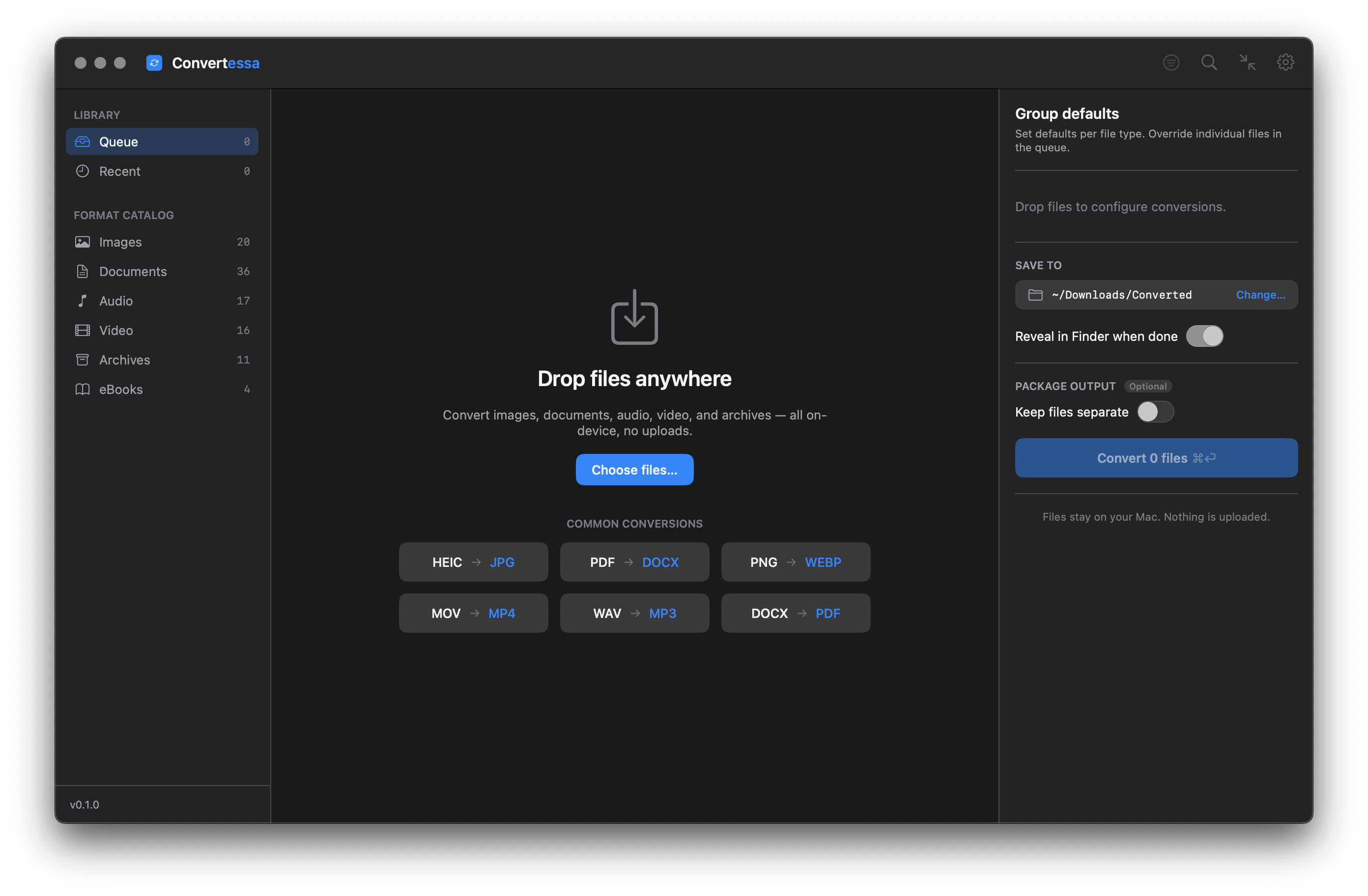
Drag one recording or a whole season folder onto the window. Files stay where they are and nothing is uploaded, so a twelve-gigabyte Blu-ray rip queues as fast as a two-minute clip does.
Choose MP4 and set the quality level. This is a genuine re-encode rather than a rename, so give a disc rip a high setting and a long screen recording something more moderate to keep the file manageable.
FFmpeg writes the MP4 into your destination folder. Play a few seconds from the middle: audio that was DTS, FLAC or TrueHD is now AAC, and that is the change most worth confirming by ear.
Images, audio, video, documents, archives, eBooks and fonts — all converted natively, right on your Mac.
Pick a format you have — see everything Convertessa can turn it into.
Convert hundreds of files at once with per-type group defaults and individual overrides.
First-class support for HEIC, AVIF and WebP — encode and decode, both ways. Read JPEG XL and a dozen more modern formats too.
Drop files anywhere on the window. Native, instant, and exactly what you’d expect on a Mac.
Dial in compression, resolution and bitrate. Keep originals pristine or shrink for sharing.
Never overwrite a file by accident. Convertessa appends safe suffixes automatically.
Every job is logged locally. Re-run a previous conversion or revisit recent outputs in a click.
Bundle your converted files straight into a single ZIP, TAR or 7z — packaged and ready to share the moment a job finishes.
Right-click any file in Finder and choose Convert. A Quick Action handles it on the spot — no need to open the app first.
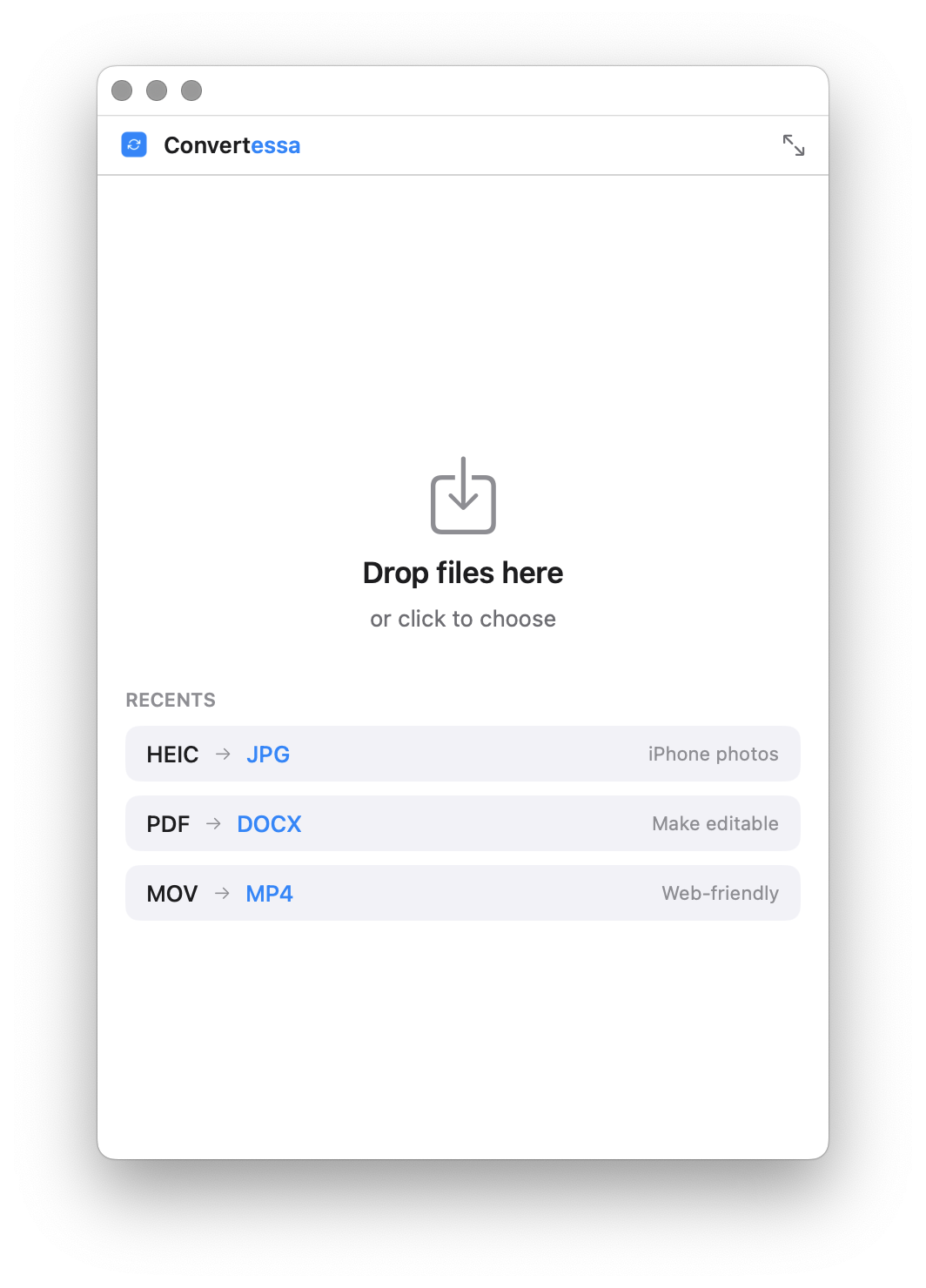
Shrink Convertessa to a tidy mini window that tucks into a corner — just a drop zone and a format picker for quick, one-off conversions.
No cloud. No account. No upload. Every conversion happens entirely on-device, using the power already in your Mac. What you convert is nobody’s business but yours.
Script conversions, wire them into your build, or batch a folder from the terminal. The same engine, no GUI required.
Read the full CLI documentation →Shrink Convertessa down to a small, focused window — drop, convert, done, with your recent conversions one click away.
macOS 14+ · Apple Silicon & Intel
New formats, new features, and fixes — every release, on the record.
Apple has never shipped a Matroska demuxer. The codecs inside, typically H.264 or HEVC with AAC, are fine; it is the container that QuickTime Player, Safari, Photos and Final Cut cannot parse. VLC and IINA bundle their own demuxer, which is why the same file plays perfectly there. Converting to MP4 hands Apple's stack a wrapper it recognises, and hardware-accelerated playback comes back with it.
Usually not in usable form. Styled ASS and SSA tracks, PGS bitmap tracks from Blu-ray and attached font files have no MP4 equivalent at all. Plain SRT is the only kind that maps at all cleanly, and even then it lands as unstyled timed text. If subtitles matter, pull them out with mkvextract first and keep the .srt next to the MP4, where VLC, IINA and most media servers pick it up.
It is re-encoded, because MP4 has no standard slot for either. FFmpeg decodes the track and writes AAC, which every Apple device plays. A surround mix generally stays multi-channel, but a lossless TrueHD track is not lossless once it is AAC. For a home-theatre archive the sensible pattern is to keep the MKV as the master and treat the MP4 as the travelling copy.
The first track in the file, in practice, and MP4 players rarely offer a switcher even when more than one is present. Multi-language releases are the awkward case: if you need the other language, use a Matroska tool to remove the tracks you do not want, then convert what is left. Convertessa does not select tracks for you.
Mostly not. Matroska chapters are a rich container feature with names, nesting and even ordered playback for some releases, whereas MP4's chapter support is thin and read inconsistently by players. Assume the converted file plays as one continuous timeline. If chapter navigation genuinely matters, a recorded lecture or a concert, keep the MKV and use the MP4 only where MKV cannot go.
Often yes, and this is exactly why OBS defaults to Matroska. Because MKV is written progressively, a recording cut short by a crash usually still holds valid data up to the last written frame, and FFmpeg will read it. Point Convertessa at the file: convertessa stream-2026-08-25.mkv --to mp4 --quality 90. A truncated MP4, by contrast, is often missing its index entirely and simply will not open.
It depends on the resolution and on your Mac. On Apple Silicon, FFmpeg encoding 1080p H.264 typically runs several times faster than real time, so a feature lands in the tens of minutes; 4K HEVC is considerably slower. Files in a batch are processed one after another, so a whole season is a background job. Start it, do something else, check the destination folder later.
No, and renaming the extension is the classic mistake, because the byte layout inside is completely different and a renamed file simply fails to open. Matroska is built on EBML, a binary XML-like structure; MP4 is built on ISO base media boxes. Every track has to be read out of one structure and written into the other, which is what FFmpeg spends the progress bar doing.