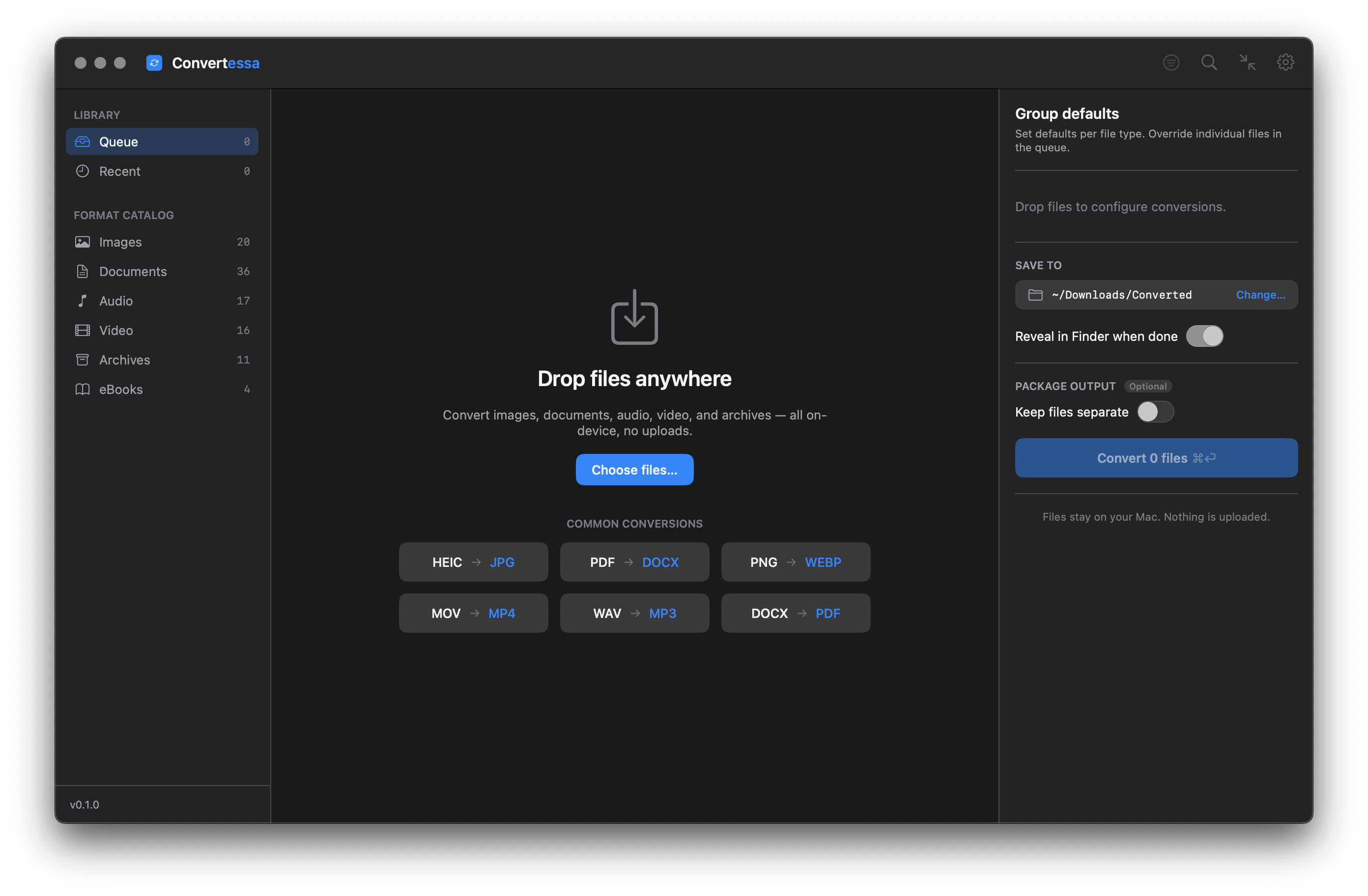
Your files stay on your Mac.
A QuickTime MOV and an MP4 are built from the same box structure, which makes this the gentlest conversion in video. Convertessa passes the file to FFmpeg, writes an MP4 at the quality you choose, and keeps resolution and frame rate as recorded. The payoff is reach: the same footage now opens on Windows, on Android, in PowerPoint and in every upload form that quietly rejects a .mov.
QuickTime's MOV container, shipped by Apple in 1991, is the direct ancestor of MP4. When ISO standardised the base media file format at the turn of the century it took QuickTime's atom layout almost wholesale, which is why both files are a tree of boxes: moov for the index, mdat for the media itself. Structurally they are close relatives with different surnames.
That closeness is why this conversion is undramatic, and it is still worth doing. An iPhone MOV already holds H.264 or HEVC video with AAC audio, exactly what MP4 expects. What changes is the wrapper, the extension and the set of things that will accept it: Android phones, Windows machines, PowerPoint, most upload forms and most content systems treat .mov as suspect and .mp4 as normal. FFmpeg does the work, and since MP4 is a lossy target you choose the quality. A re-encode is a generation of loss, so keep the original if the footage still has to go through an editor.
tmcd track that most players quietly ignore, and QuickTime text tracks generally do not map across at all.The other practical snag is rotation. Portrait iPhone video is recorded as landscape frames plus a ninety-degree display matrix in the header. Well-behaved players honour it, some Windows and web players do not, and that is where the sideways-video complaint comes from. Re-encoding to MP4 applies the orientation to the picture, so the clip plays upright everywhere.
Drop a QuickTime file, a Final Cut export or a folder of iPhone clips onto the window. Convertessa queues each one for FFmpeg, whatever is inside it: H.264, HEVC, ProRes or older QuickTime codecs.
Select MP4 as the output and set the quality. Higher settings hold on to fine motion detail in grass, water, smoke and skin; lower settings make a clip small enough for email and messaging apps.
FFmpeg writes the MP4 with the recorded orientation applied, so portrait clips stop arriving sideways. Play the result before deleting anything, especially for ProRes sources or files with several audio tracks.
Images, audio, video, documents, archives, eBooks and fonts — all converted natively, right on your Mac.
Pick a format you have — see everything Convertessa can turn it into.
Convert hundreds of files at once with per-type group defaults and individual overrides.
First-class support for HEIC, AVIF and WebP — encode and decode, both ways. Read JPEG XL and a dozen more modern formats too.
Drop files anywhere on the window. Native, instant, and exactly what you’d expect on a Mac.
Dial in compression, resolution and bitrate. Keep originals pristine or shrink for sharing.
Never overwrite a file by accident. Convertessa appends safe suffixes automatically.
Every job is logged locally. Re-run a previous conversion or revisit recent outputs in a click.
Bundle your converted files straight into a single ZIP, TAR or 7z — packaged and ready to share the moment a job finishes.
Right-click any file in Finder and choose Convert. A Quick Action handles it on the spot — no need to open the app first.
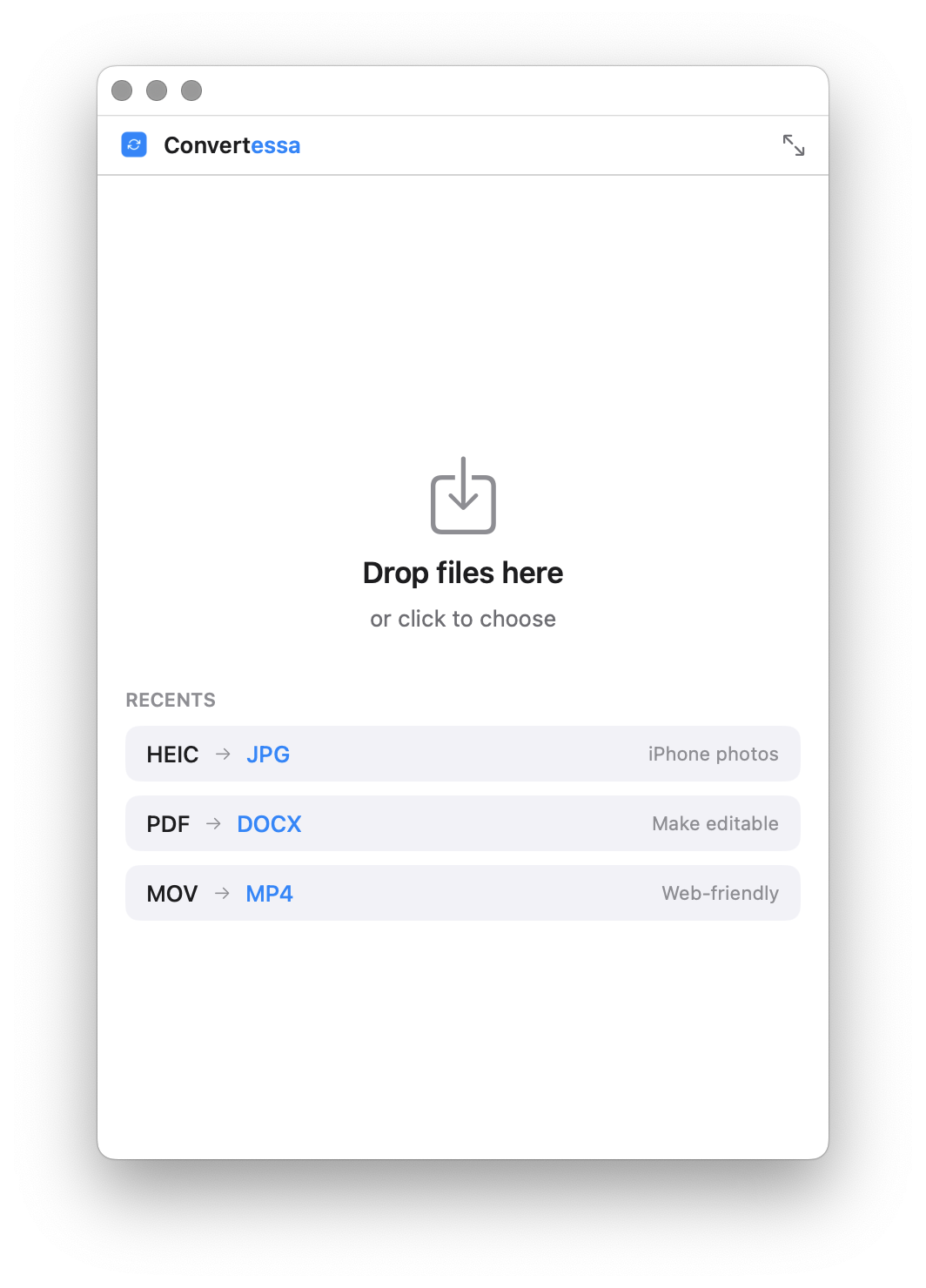
Shrink Convertessa to a tidy mini window that tucks into a corner — just a drop zone and a format picker for quick, one-off conversions.
No cloud. No account. No upload. Every conversion happens entirely on-device, using the power already in your Mac. What you convert is nobody’s business but yours.
Script conversions, wire them into your build, or batch a folder from the terminal. The same engine, no GUI required.
Read the full CLI documentation →Shrink Convertessa down to a small, focused window — drop, convert, done, with your recent conversions one click away.
macOS 14+ · Apple Silicon & Intel
New formats, new features, and fixes — every release, on the record.
Less than people fear, but it is not free. Re-encoding H.264 into H.264 discards detail the first encoder already thinned out and adds a little of its own, worst in noise, film grain, smoke and moving water. At a high quality setting the difference is invisible at normal playback and obvious only when you pause and compare frames. The rule: convert once, from the best source you have, and never chain conversions.
It gets re-encoded. ProRes is an editing codec, intra-frame and ten to twenty times the size of delivery H.264, and MP4 carries it in no widely playable way. Expect a dramatic reduction in file size, and expect ProRes 4444's alpha channel to vanish, since MP4 has no standard transparent video. Keep the ProRes master if the footage still has to go back into an editor.
No. iPhones record portrait clips as landscape frames plus a rotation matrix in the file header, and it is players that ignore that matrix which produce sideways video. FFmpeg reads it and writes the MP4 the right way up, so the clip is upright in QuickTime Player, on Windows and in a browser. The picture is not cropped or padded to get there; it is the same frame, correctly oriented.
MP4 can technically hold several audio tracks, but most players expose only the first and give the viewer no way to switch. If the tracks matter, separate lavalier mics, a music stem, a commentary, mix them down in an editor before converting, or convert once per version and deliver them as separate files. Convertessa does not choose tracks for you or merge them.
Yes. Screen recordings from Command-Shift-5 and from QuickTime Player are MOV files with H.264 video and AAC audio, usually at a variable frame rate that follows on-screen activity. Converting to MP4 gives you something steadier to edit and share. Small text is the hardest thing to encode in lossy video, so use a high quality setting or the type will smear during scrolling.
Two reasons, usually. The extension itself, since Windows Media Player and many web tools refuse .mov without asking what is inside. And HEVC: an iPhone set to High Efficiency records H.265, which many Windows installs cannot decode without a codec purchased from the Microsoft Store. Converting to MP4 fixes the first outright, and the re-encode replaces HEVC with far more broadly supported H.264.
Yes. Point the CLI at the folder and name a destination: convertessa ./*.mov --to mp4 --quality 90 -o ~/Deliverables. Each clip is converted in turn and written with its original name and an .mp4 extension, so numbered camera files stay in order. A single file is simply convertessa A001C003.mov --to mp4.