Your files stay on your Mac.
Convertessa opens your PDF with LibreOffice, recovers the text and the images, and writes a .docx you can edit in Word, Pages or Google Docs. It happens on your Mac, which matters for the documents people most often need back in editable form — contracts, letters, statements, a report whose original file is long gone. Drop a folder and the whole stack is rebuilt in a single pass.
A PDF does not contain a document. It contains instructions for painting glyphs at coordinates on a fixed canvas: place this character in this font at this position on this page. There are no paragraphs, no heading styles, no guaranteed reading order. Word is the opposite kind of file — a flowing model of paragraphs, styles, tables and numbering. Going backwards is a reconstruction, not a translation, and that one fact explains every surprise below.
Convertessa runs the job through LibreOffice, which imports the PDF's drawing model and writes .docx from it. Text becomes selectable and editable, images come across, and a plain single-column report usually arrives in good shape. What you get is content laid into positioned frames rather than one continuous flow, which makes it excellent for lifting paragraphs out and awkward if you expected to press Return and watch the rest of the page reflow.
Tables are the coin toss. A table drawn with visible rules usually rebuilds as a Word table; one that was only aligned with tab stops and white space comes back as loose lines of text, because in the PDF that is all it ever was.
Open it in Preview and try to select a sentence. If the text highlights, there is a real text layer and the rebuild will go well. If nothing selects, the page is an image and there is nothing to recover.
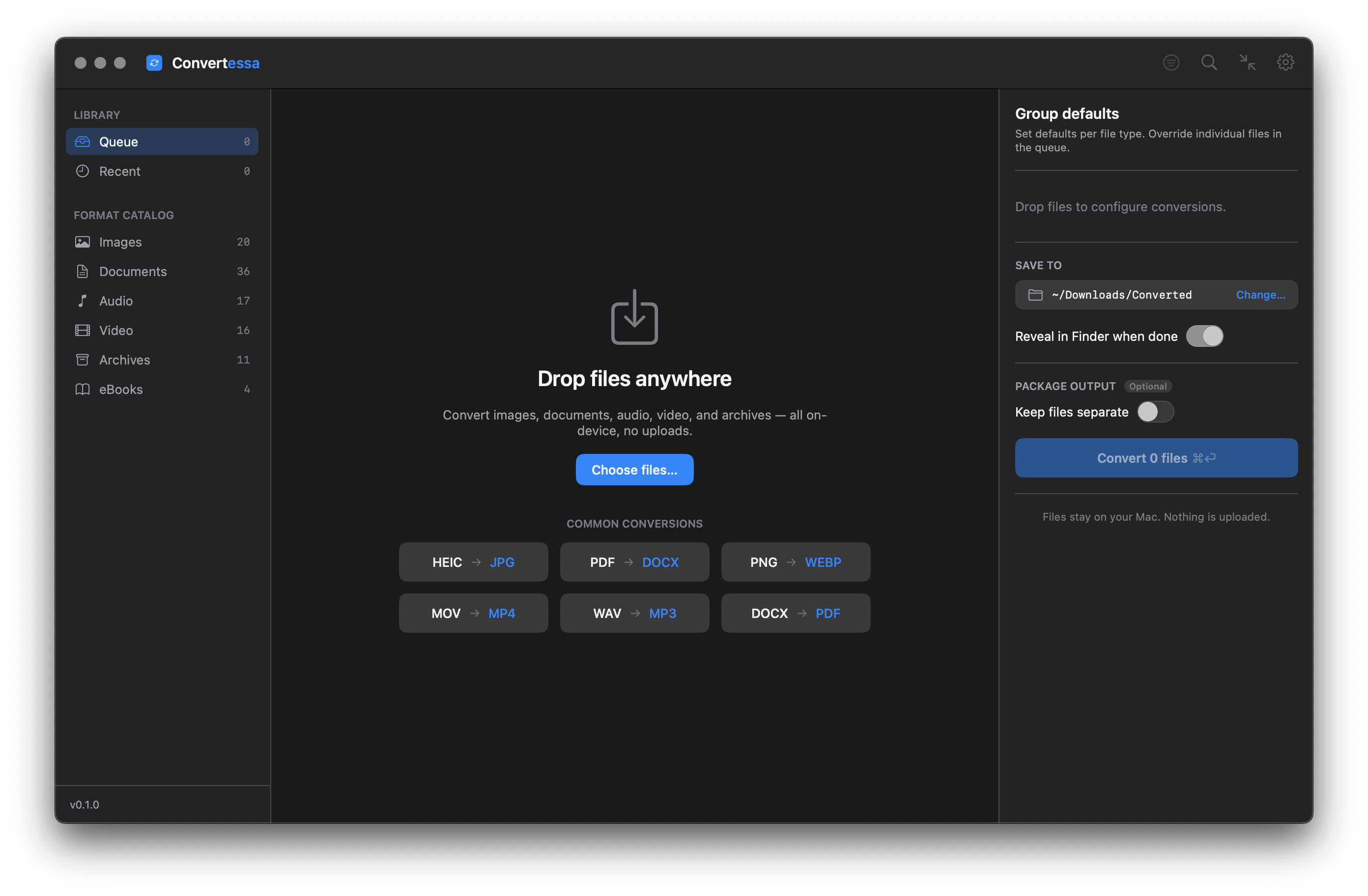
Drag one PDF or a folder of them onto the queue and pick Word as the output. Images pulled out of the PDF are re-encoded on the way in, so the quality setting governs how they land.
Run the batch and open a result. Budget a few minutes of cleanup on a long document: rejoining hyphenated words, reapplying heading styles, and checking any table that had no visible borders.
Images, audio, video, documents, archives, eBooks and fonts — all converted natively, right on your Mac.
Pick a format you have — see everything Convertessa can turn it into.
Convert hundreds of files at once with per-type group defaults and individual overrides.
First-class support for HEIC, AVIF and WebP — encode and decode, both ways. Read JPEG XL and a dozen more modern formats too.
Drop files anywhere on the window. Native, instant, and exactly what you’d expect on a Mac.
Dial in compression, resolution and bitrate. Keep originals pristine or shrink for sharing.
Never overwrite a file by accident. Convertessa appends safe suffixes automatically.
Every job is logged locally. Re-run a previous conversion or revisit recent outputs in a click.
Bundle your converted files straight into a single ZIP, TAR or 7z — packaged and ready to share the moment a job finishes.
Right-click any file in Finder and choose Convert. A Quick Action handles it on the spot — no need to open the app first.
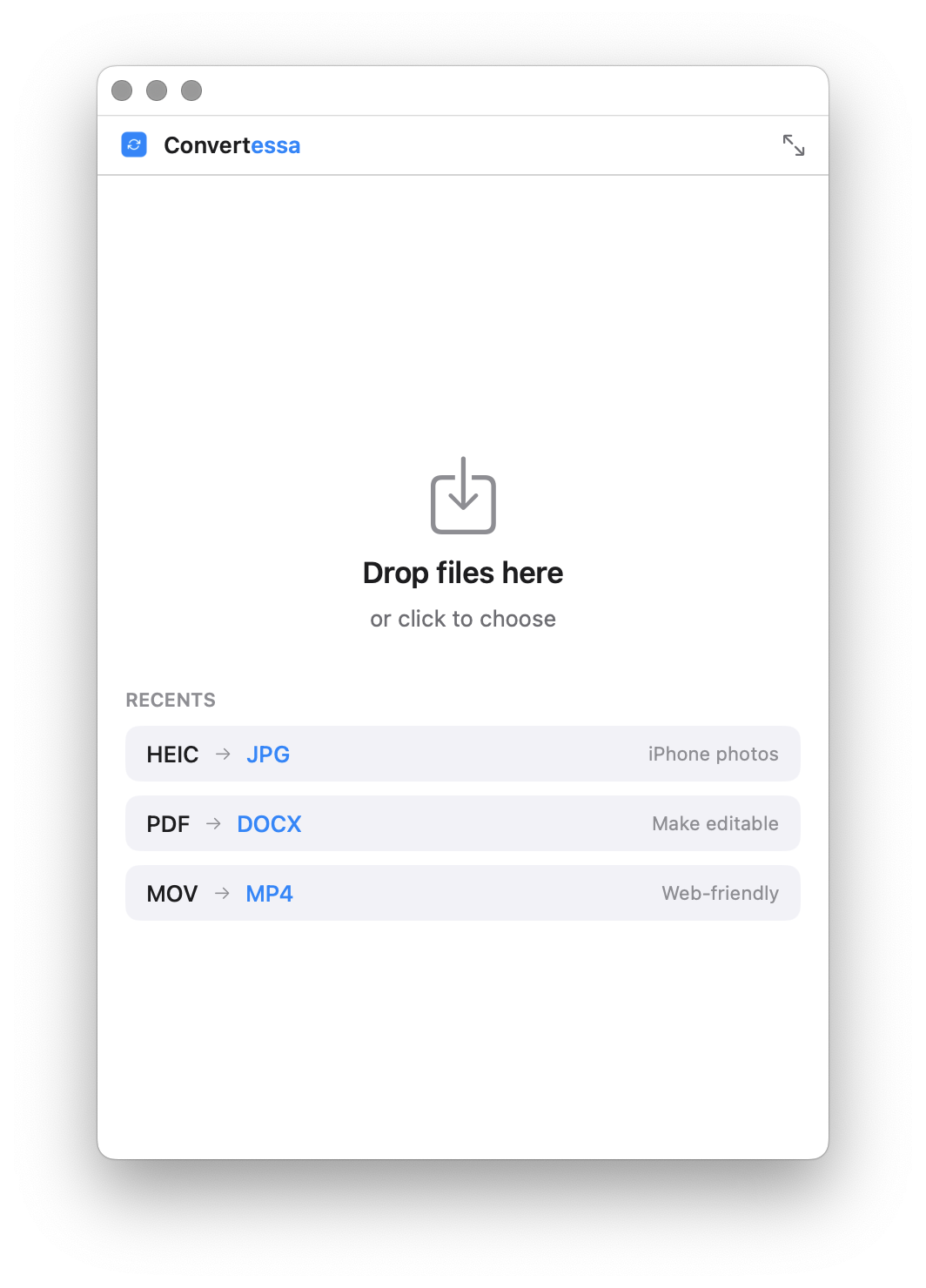
Shrink Convertessa to a tidy mini window that tucks into a corner — just a drop zone and a format picker for quick, one-off conversions.
No cloud. No account. No upload. Every conversion happens entirely on-device, using the power already in your Mac. What you convert is nobody’s business but yours.
Script conversions, wire them into your build, or batch a folder from the terminal. The same engine, no GUI required.
Read the full CLI documentation →Shrink Convertessa down to a small, focused window — drop, convert, done, with your recent conversions one click away.
macOS 14+ · Apple Silicon & Intel
New formats, new features, and fixes — every release, on the record.
No. A scanned PDF is a stack of photographs with no characters stored anywhere in the file, and Convertessa does not run OCR — it converts what is in the file rather than trying to read pictures of words. The .docx you get back contains the page images. If you need the words, track down the document the scan was made from, or use a dedicated text-recognition tool first and convert its output.
That is LibreOffice's PDF import doing what the PDF permits. Since the source has positions rather than paragraphs, each block of text is placed in a frame at the coordinates it occupied on the page, which is the only way to keep the layout recognisable. To get flowing text instead, select everything in Word and paste it into a fresh document as unformatted text, then apply your own styles.
Sometimes. If the table has drawn rules — visible lines around cells — the importer can see the grid and rebuild a genuine Word table you can edit cell by cell. If the columns were only lined up with tab stops or spaces, there is no grid in the file to find, and the rows come back as separate lines of text. Financial statements and invoices are usually the ruled kind and do well.
Close, not identical. The rebuilt document uses whatever fonts your Mac actually has, and substituted fonts have slightly different letter widths, so lines and page breaks can shift. Treat the result as editable content that broadly resembles the original rather than a pixel-exact copy. If page-perfect fidelity is the goal, the PDF you already have is the better artefact — keep it and edit a copy.
If the file needs a password just to open, it cannot be read and the conversion stops — the content is encrypted and there is no key on your Mac. Open it in Preview with the password, export a fresh unprotected copy, then convert that. Files with only owner restrictions, such as no-printing flags, are a different thing and generally convert normally.
Hyperlinks usually come across as clickable text. The PDF outline — the bookmark tree in the sidebar of Preview — has no place to live in Word and is dropped; Word builds its navigation pane from heading styles instead, and those are exactly what a PDF does not store. A table of contents inside the page arrives as ordinary text, so rebuild it as a field once you have applied styles.
Yes, and it is much cleaner. Plain text and Markdown skip the frame-rebuilding entirely and give you the words in reading order: convertessa report.pdf --to txt, or convertessa report.pdf --to md if you want headings marked up. For a whole directory: convertessa ~/Papers/*.pdf --to txt -o ~/Notes. Use .docx only when you genuinely need the pages to look like the original.