
Convert Pentax RAW to JPG. Offline.

Your files stay on your Mac.
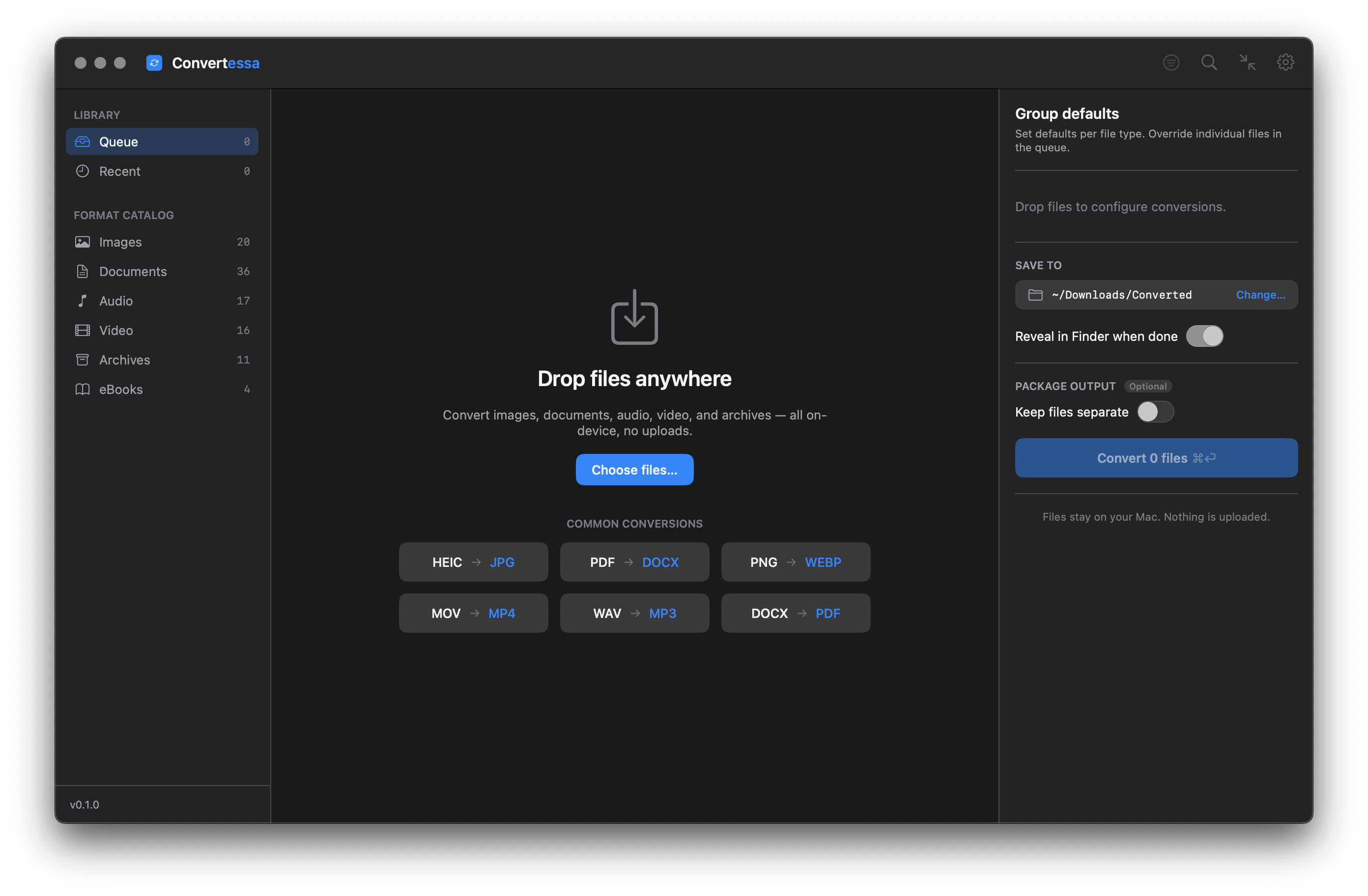
Convertessa app window showing the format catalog and drop area
What it does

What PEF-to-JPG conversion does

A .pef is fine until it has to leave your desk. Upload forms reject it, browsers will not render it, and a client on Windows opens nothing. Convertessa decodes each file locally and writes a JPG at the same pixel dimensions, at a quality you choose for the run. K-mount and 645 medium-format files take the same path, and the originals are read but never rewritten.

Pentax PEF, honestly

Your Pentax may not need PEF at all

Before anything else, check your camera's file-format menu. Pentax bodies let you write DNG instead of PEF, and most owners never touch that setting. PEF is Pentax's own TIFF-based container with a losslessly compressed payload; DNG is Adobe's open format, and everything that reads raw reads it. Converting a backlog of .pef files is a perfectly good reason to be here — but you can stop producing new ones tomorrow.

For the files you already have: macOS will show you a .pef in Quick Look, and that is roughly where the format's welcome ends. Upload forms reject it, browsers ignore it, and a colleague on Windows is stuck. Convertessa hands the image work to libvips, whose raw decoder reads the Bayer mosaic, applies the white balance the camera recorded, and writes sRGB. That last part deserves its own sentence: Pentax sensors capture colour well outside sRGB, and the JPG boundary clips it, so a saturated maple or a deep cyan sky can come back a shade duller than the same file in Digital Camera Utility.

Pixel Shift Resolution files

A Pixel Shift PEF is four exposures, each offset by a single photosite, stored together so every pixel receives real red, green and blue instead of interpolated values. General-purpose decoders typically render the first sub-frame and leave the other three alone. The JPG is then an ordinary demosaiced image at normal resolution — correct and usable, but without the colour accuracy that made you turn the mode on. When a Pixel Shift frame matters, merge it in Pentax's own software first and convert that export.

Also left behind: the Custom Image profile (Bright, Natural, Monochrome, Reversal Film), in-camera distortion and vignetting correction, and 14-bit tonality flattened to 8. The PEF decode itself is lossless — every bit of loss in this conversion happens at the JPG encode, which is the part the quality setting governs.

How it works

Three steps. No upload required.

1

Drop the shoot folder

Drag a folder of .pef files onto Convertessa; K-series and 645Z files can share one queue. Approve the image engine install on first run and it is there for every batch after that.

2

JPG, then the quality

Pick JPG and set the quality for the run. One value applies to the whole batch, so split web exports and print-grade exports into two passes when you need different numbers.

3

Run it, keep the PEFs

Convert. Each file is demosaiced, encoded to an sRGB JPG and written beside the original or into the output folder you name, while the .pef files stay exactly as the camera wrote them.

Format catalog

From everyday files to pro media.

Images, audio, video, documents, archives, eBooks and fonts — all converted natively, right on your Mac.

Conversion explorer

What do you want to convert?

Pick a format you have — see everything Convertessa can turn it into.

conversion combinations
I have a
can be converted to
From MP4

Features

Built for real work.

Batch conversion

Convert hundreds of files at once with per-type group defaults and individual overrides.

Modern image formats

First-class support for HEIC, AVIF and WebP — encode and decode, both ways. Read JPEG XL and a dozen more modern formats too.

Drag & drop

Drop files anywhere on the window. Native, instant, and exactly what you’d expect on a Mac.

Quality control

Dial in compression, resolution and bitrate. Keep originals pristine or shrink for sharing.

Collision-safe naming

Never overwrite a file by accident. Convertessa appends safe suffixes automatically.

Conversion history

Every job is logged locally. Re-run a previous conversion or revisit recent outputs in a click.

Archive the output

Bundle your converted files straight into a single ZIP, TAR or 7z — packaged and ready to share the moment a job finishes.

Convert from Finder

Right-click any file in Finder and choose Convert. A Quick Action handles it on the spot — no need to open the app first.

Compact mode

Shrink Convertessa to a tidy mini window that tucks into a corner — just a drop zone and a format picker for quick, one-off conversions.

Your files never leave your Mac.

No cloud. No account. No upload. Every conversion happens entirely on-device, using the power already in your Mac. What you convert is nobody’s business but yours.

On-device processing Zero telemetry No file uploads
For power users

There’s a command line, too.

Script conversions, wire them into your build, or batch a folder from the terminal. The same engine, no GUI required.

Read the full CLI documentation
zsh — convertessa
# Convert a single file
$ convertessa input.pef --to jpg
photo.jpg · 1.2 MB · 0.4s
 
# Batch a whole folder
$ convertessa ./*.pef --to jpg -o ~/Exports
14 files converted · 4.1s
Made to fit

And a compact mode.

Shrink Convertessa down to a small, focused window — drop, convert, done, with your recent conversions one click away.
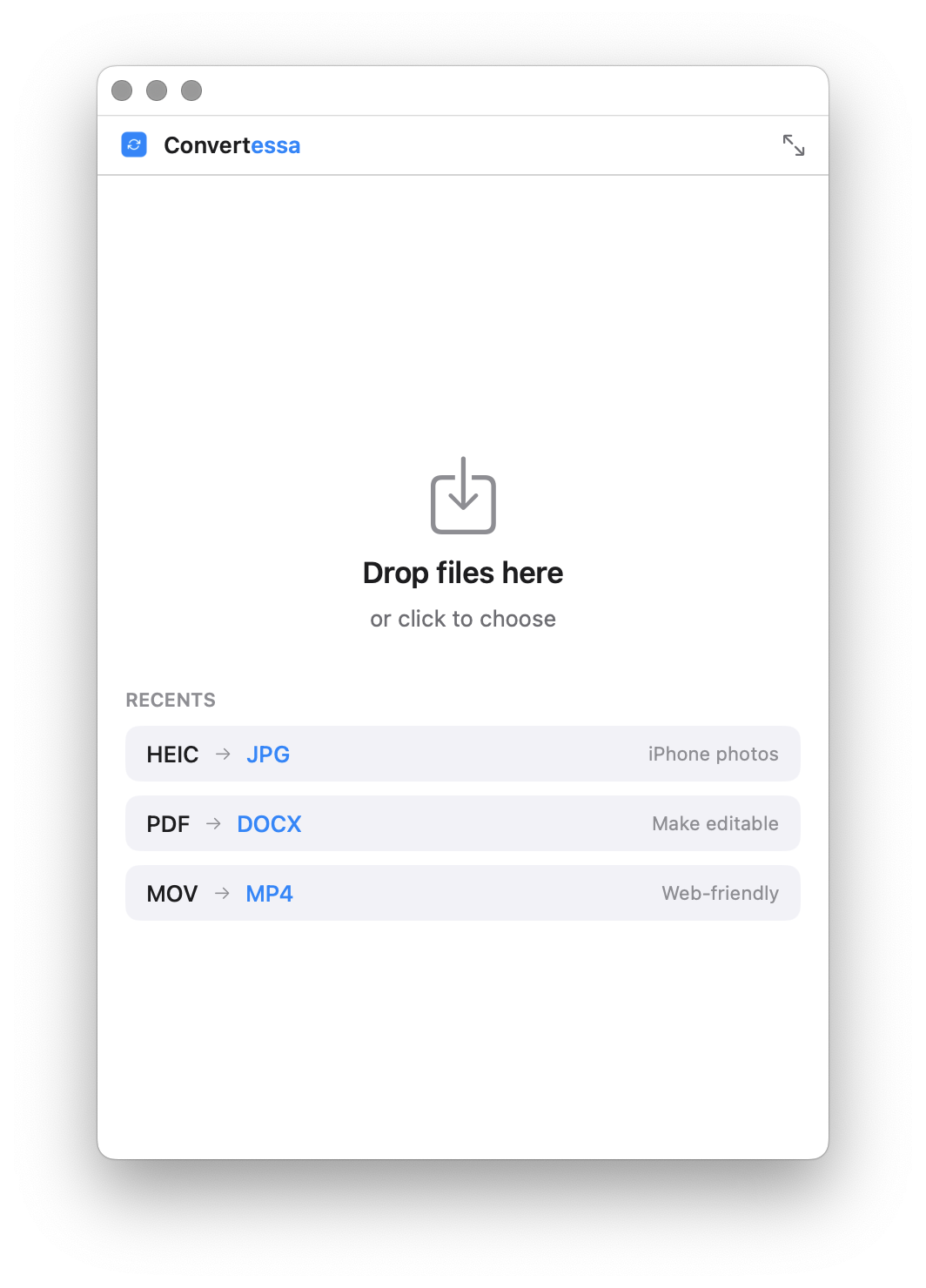
Convertessa in compact mode — a small window with a drop area and recent conversions
Pricing

One price. Yours for good.

Lifetime license
$19
One-time payment
No subscription. No renewals. Ever.
Get the app
  • 1,000+ conversion combinations
  • Lifetime future updates
  • No account required
  • Unlimited devices

macOS 14+ · Apple Silicon & Intel

Changelog

What’s shipped so far.

New formats, new features, and fixes — every release, on the record.

FAQ

Good questions.

Convertessa is a native macOS app that converts your files between formats — images, audio, video, documents, archives and eBooks — entirely on your Mac. Drop a file in, choose an output, and it’s done. No uploads, no account, no subscription.
Convertessa is an orchestrator. Under the hood it relies on best-in-class open-source engines — FFmpeg for audio & video, Pandoc for documents, libvips for images, LibreOffice for office formats, and Calibre for eBooks. It installs them for you with a click, then calls the right tool, or chain of tools, in the right order for whatever you’re converting. You get one clean native interface instead of a tangle of command-line flags. These binaries aren’t bundled with the app and are never installed without your approval — Convertessa simply calls them in a terminal session on your behalf.
Popular ones include JPEG, PNG, HEIC, WebP and AVIF; MP3, AAC, FLAC and WAV; MP4, MOV and MKV; PDF, DOCX and EPUB; ZIP, TAR and 7z — and many more. See exactly what converts to what in the conversion explorer →
Email us and we’ll add it in an upcoming release. Convertessa’s format coverage grows with what people actually need, so your request genuinely helps shape the app.
Your files? Never. Every conversion happens locally on your Mac. Your files are never uploaded, and nothing you convert is ever sent anywhere. Our Privacy Policy spells out exactly what limited data the app does store.
No analytics, no tracking, no telemetry. Your files and conversions stay entirely on your Mac — nothing you convert is ever sent anywhere. The app periodically checks for software updates in the background; like any web request, that check reveals only standard request metadata (your IP and app/OS version) to our update server — never your files, name, email, or license — and updates are always user-approved. Separately, on the website only, our purchase-confirmation page reports a completed sale to Google Ads so we can measure our own ad performance — it never runs while you’re browsing or converting, only after checkout. Our Privacy Policy spells out exactly what’s stored — and what isn’t.
Yes. Convertessa is a universal app and runs natively on Intel Macs. It requires macOS 14 or later.
Yes. It’s tuned for Apple Silicon (M-series) and runs natively — fast and energy-efficient. macOS 14 or later.
Yes — your license works on an unlimited number of your own Macs. Buy once and install it everywhere you work.
You get a genuinely useful, private, native Mac app for a single $19 payment — no subscription, ever. And your purchase directly supports a small independent developer and the app’s ongoing updates and new formats.
There’s no separate trial, but every purchase is backed by a 14-day money-back guarantee. If Convertessa isn’t right for you, contact your payment processor within 14 days to request a full refund — no questions asked. You can also email us and we’ll help route it.
Quite possibly — just email us. If you’re a student, run a non-profit, or have another good reason, reach out and we’ll sort you out.
Convertessa was built by Daler Azimov — a developer who needed a fast, private, native file converter for his own work, and decided to make the one he wished existed. Connect on LinkedIn →

Worth considering. Pentax bodies offer both in the file-format menu; DNG is read by essentially every raw-capable application, while PEF sometimes needs a decoder that specifically knows the format. PEF files are usually a little smaller, and Pentax's own software is happiest with them. Either way it changes nothing about the .pef files already on your drive — those still need converting, and both formats convert the same way here.

Pixel Shift stores four exposures offset by one photosite each. General-purpose raw decoders normally render the first sub-frame and ignore the rest, so the JPG arrives as a normal demosaiced image at normal resolution — perfectly usable, but without the true per-pixel colour that Pixel Shift exists to produce. If that particular frame matters, merge it in Pentax Digital Camera Utility and convert the export it gives you.

Because Custom Image profiles — Bright, Natural, Monochrome, Reversal Film — are instructions the camera applies to its own JPEG, stored as a tag alongside the raw data. A neutral decode reads the sensor and skips the instruction. The converted file is therefore in colour and unstyled, closer to what the sensor actually recorded than to the preview you saw on the rear screen.

No. Distortion, lateral chromatic aberration and vignetting correction for DA and D FA lenses are applied by the camera to its JPEG, or by Pentax's software when it renders the PEF. The open-source decoder used here does not read those profiles, so the JPG shows the uncorrected optics. On a well-behaved prime you will never notice; on a wide zoom you might.

No. PEF's payload is losslessly compressed, so the decode recovers exactly what the sensor wrote. All of the loss in this conversion happens in one place — the JPG encode — which is why the quality setting is the only knob that changes the outcome. The other unavoidable change is depth: 14 bits per channel in the PEF become 8 in the JPG.

Yes, only the extension changes: IMGP0247.PEF becomes IMGP0247.jpg. Send the output somewhere separate so raws and JPGs never share a folder:

convertessa ./*.pef --to jpg -o ~/Exports --quality 92

Originals are read, never rewritten, so the sequence numbering your camera assigned survives intact and the JPG sitting next to a PEF is obviously the same frame. If two cards produced overlapping numbers, convert them into separate output folders.

Yes — the medium-format bodies write PEF through the same container, so the path is identical. The practical difference is scale: a 51-megapixel 645Z file is roughly twice the size of a K-3 III file and takes proportionally longer to demosaic. Large batches are still worth starting and walking away from, since the queue keeps every core busy while it works.

We’d love to hear from you. Email us and you’ll get a reply from a real person — the one who made the app.