Your files stay on your Mac.
Convertessa reads the flattened composite that Photoshop saves inside a PSD and writes it out as a JPEG through libvips: layers resolved, colour delivered as RGB, one image per file. JPEG is lossy, so you set the quality that suits the job before the run starts. Drop a single document or a folder of them; the work happens on your Mac, with nothing uploaded.
Photoshop's format stores a project: layers and groups, masks, adjustment layers, smart objects, live text, paths, spot channels — plus a flattened preview of what all of it adds up to. That preview, the composite, is what every non-Adobe reader actually converts, and it is where the surprises live.
Photoshop writes the composite only when Maximize PSD and PSB File Compatibility is enabled under Preferences, File Handling. Turn it off to save disk space and the document still opens perfectly in Photoshop, while everything else in the world sees a stale composite or none at all. When a converted JPEG shows an older version of the artwork, that setting is the first thing to check; re-saving with it on repairs the source for good.
Two things go better than expected. Text is already rendered into the composite, so no fonts need to be installed and nothing can be substituted — a designer's file with licensed type converts identically on a machine that has never seen those fonts. And libvips streams large documents instead of loading them whole, which is why a folder of 400 MB posters does not bring the Mac to its knees.
JPEG is lossy, so you set the quality. Photographic artwork holds up around 85; flat colour, logos and type want more, because chroma subsampling is unkind to hard edges. Whatever you export, keep the PSD — flattening runs one way only.
Drag one document or a folder of them onto the queue. Convertessa reads each file's saved composite, so nothing needs Photoshop to be installed, running or licensed on this machine.
Pick JPG as the output and set the quality: around 85 for photographic artwork, into the low 90s when the piece contains type, logos or large areas of flat colour.
Click Convert. Each JPEG lands in your destination folder as flattened RGB with no alpha channel. Archive the PSD anyway — once the layers are gone from a file, they are gone.
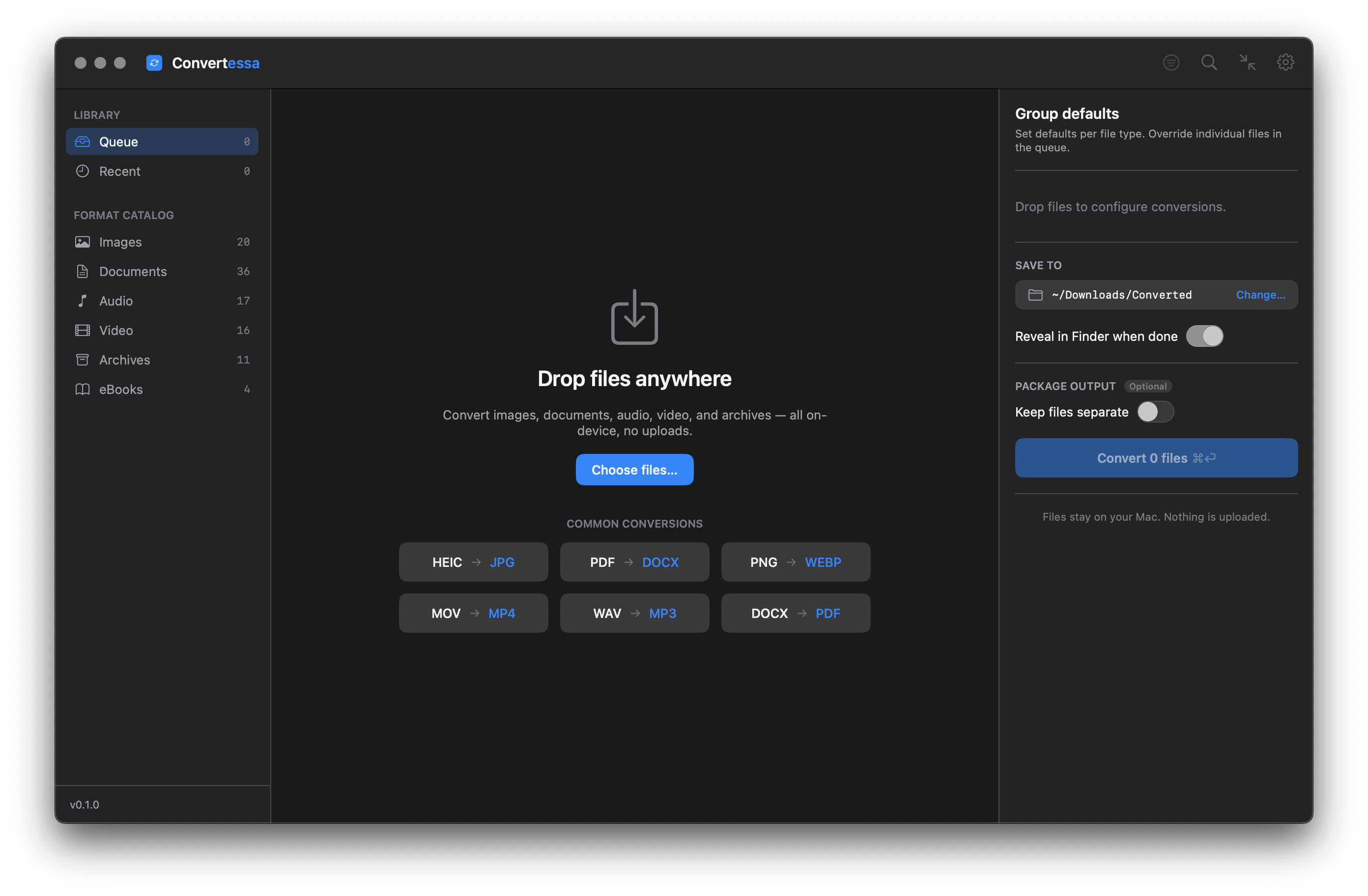
Images, audio, video, documents, archives, eBooks and fonts — all converted natively, right on your Mac.
Pick a format you have — see everything Convertessa can turn it into.
Convert hundreds of files at once with per-type group defaults and individual overrides.
First-class support for HEIC, AVIF and WebP — encode and decode, both ways. Read JPEG XL and a dozen more modern formats too.
Drop files anywhere on the window. Native, instant, and exactly what you’d expect on a Mac.
Dial in compression, resolution and bitrate. Keep originals pristine or shrink for sharing.
Never overwrite a file by accident. Convertessa appends safe suffixes automatically.
Every job is logged locally. Re-run a previous conversion or revisit recent outputs in a click.
Bundle your converted files straight into a single ZIP, TAR or 7z — packaged and ready to share the moment a job finishes.
Right-click any file in Finder and choose Convert. A Quick Action handles it on the spot — no need to open the app first.
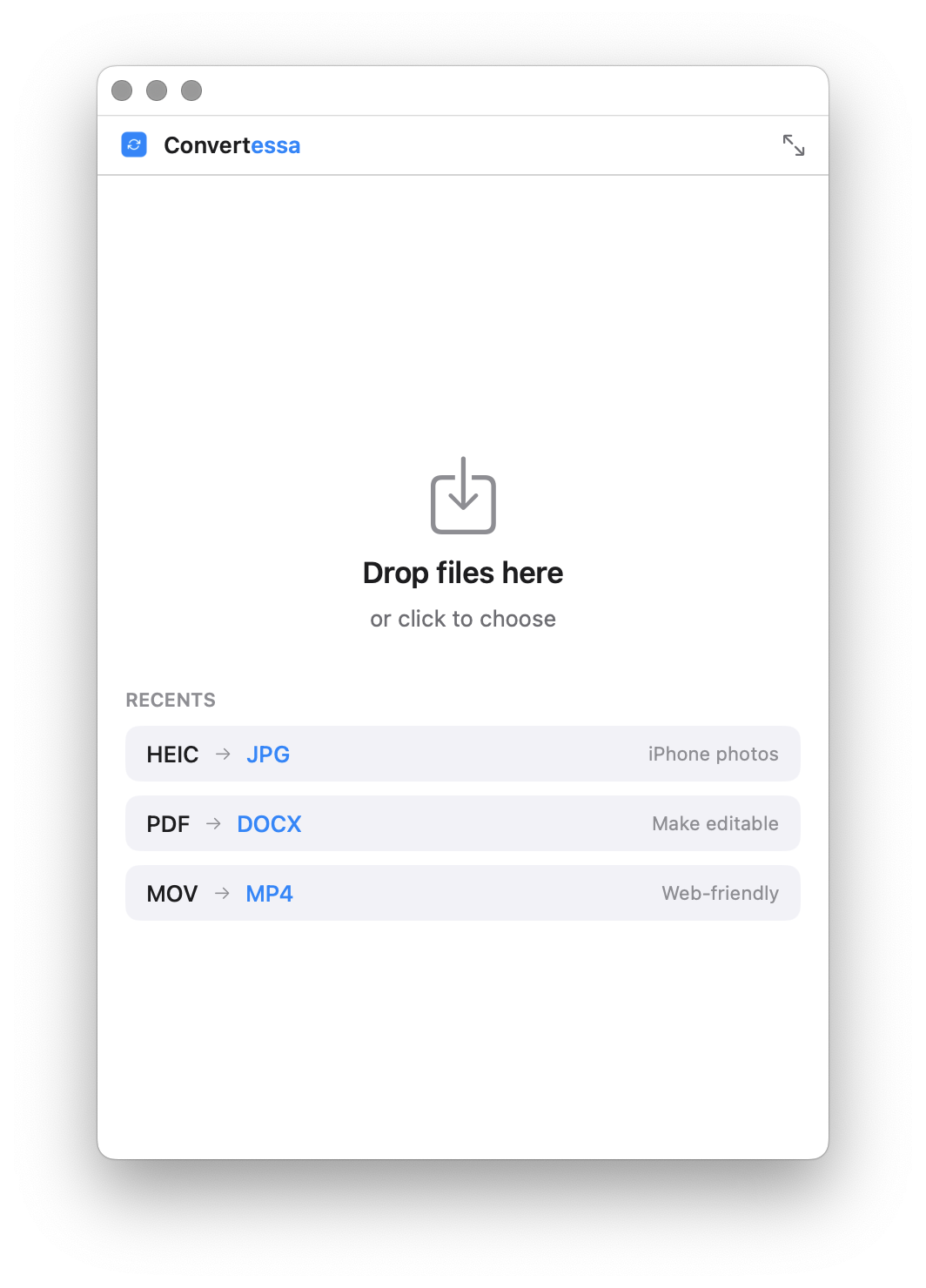
Shrink Convertessa to a tidy mini window that tucks into a corner — just a drop zone and a format picker for quick, one-off conversions.
No cloud. No account. No upload. Every conversion happens entirely on-device, using the power already in your Mac. What you convert is nobody’s business but yours.
Script conversions, wire them into your build, or batch a folder from the terminal. The same engine, no GUI required.
Read the full CLI documentation →Shrink Convertessa down to a small, focused window — drop, convert, done, with your recent conversions one click away.
macOS 14+ · Apple Silicon & Intel
New formats, new features, and fixes — every release, on the record.
That is the composite problem. Photoshop stores a flattened preview beside the layers only when Maximize PSD and PSB File Compatibility is enabled; with it off, non-Adobe readers fall back on whatever composite the file happens to hold, which may be stale or missing. Open the PSD, turn the setting on under Preferences, File Handling, save again, and convert the re-saved file. Quick Look and Finder thumbnails start behaving at the same time.
JPEG has no alpha channel, so transparency cannot survive in any form. Transparent pixels are composited against a solid background — typically white — and what looked like a floating logo arrives on a rectangle. If the artwork is going onto a coloured page, choose PNG or WebP. If JPEG is mandatory, put the intended background colour on its own layer in Photoshop before saving, so the composite already contains it.
No, and it is worth being blunt. Flattening runs one way: adjustment layers are applied, masks are resolved, smart objects are rendered, blend modes are calculated, and the result is a single grid of pixels. Nothing reconstructs that, whatever tool you try. Treat the PSD as the master and the JPEG as a delivery copy, and never let the JPEG become the only surviving version of a piece of artwork.
Expected. CMYK describes ink on paper; a JPEG for screens is delivered as RGB, and the conversion has to map colours ink can produce that a display cannot, and the reverse. The drift shows up in the deepest blacks and in saturated cyans and oranges. For circulating an approval proof this is usually fine, but never judge print colour from a converted JPEG — judge it from a press proof or from the PSD in a colour-managed application.
No. Text layers are already rendered into the composite Photoshop saved, so the conversion is reading finished pixels and no substitution can occur. This is one of the few places where flattening works in your favour: a file built with licensed fonts converts identically on a machine that has never had them. The flip side is that a typo cannot be fixed in the JPEG — that has to go back to the PSD.
Higher than you would use for a photograph. JPEG discards colour detail through chroma subsampling, and hard edges — text, logos, thin rules, boundaries between flat colours — are exactly where that surfaces as fringing. Around 85 is comfortable for photographic work; move into the low 90s once type is involved.
convertessa ./Artwork/*.psd --to jpg --quality 92 -o ~/Deliverables
No. The composite reflects the document as it looked at the moment it was saved, so layers switched off stay off, and layer opacity, blend modes and clipping masks are all resolved into that one rendered result. To get a version with a hidden layer showing, toggle it in Photoshop, save, and convert again. Convertessa reads the file as it was written; it has no way to reach inside and pick different layers.
It is reduced to eight bits per channel, because JPEG has no other option. For most images that passes unnoticed. Where it shows is in long, smooth gradients — a clear sky, a soft vignette, a studio backdrop — as faint banding between tonal steps. If a gradient is central to the piece, adding a small amount of noise in Photoshop before export hides those steps far more effectively than any encoder setting.