
Convert Sony RAW (SR2) to JPG. Offline.

Your files stay on your Mac.
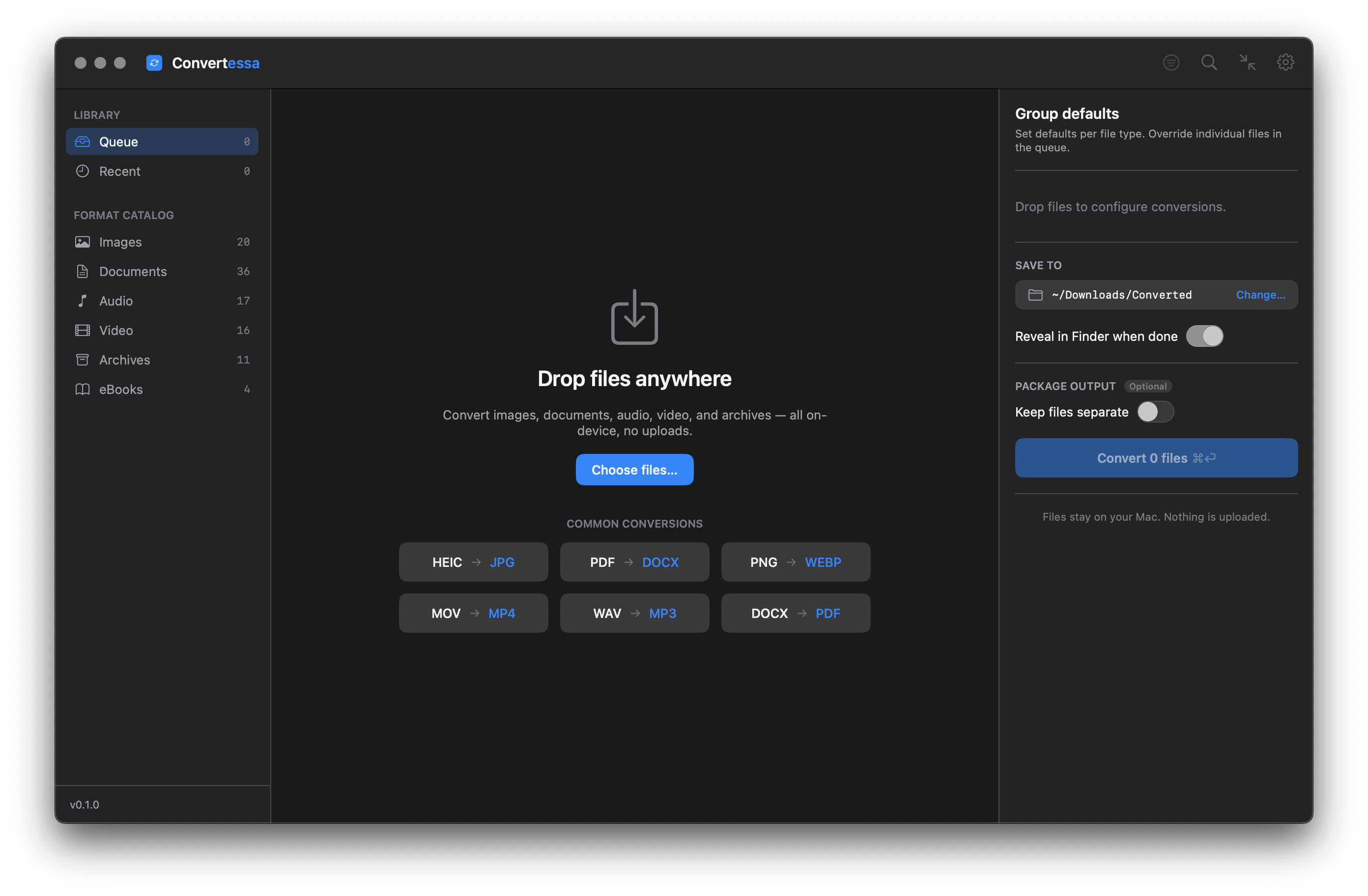
Convertessa app window showing the format catalog and drop area
What it does

What SR2-to-JPG conversion does

Old Sony RAW files do not need old Sony software. Convertessa decodes .sr2 through LibRaw and writes a standard JPG with libvips, at the capture's own pixel count and the quality you choose. A folder of DSC-R1 or Cyber-shot files converts in a single pass, entirely on your Mac — including files that stall in applications that only ever learned ARW.

Sony RAW, 2005 vintage

SR2 is not ARW, and that matters

Sony has shipped three RAW extensions. .srf came first, with the DSC-F828 in 2003. .sr2 followed on the DSC-R1 and a few late Cyber-shots in 2005. .arw arrived with the Alpha line in 2006 and never left. Everything Sony has written since is ARW — which is why an .sr2 folder is so often the one directory nothing on a modern Mac will open. The application supports Sony RAW. It does not support this Sony RAW.

There is an obfuscated block inside the file

SR2 is TIFF-derived, but Sony did not leave all of it in the clear: the tags carrying white balance and calibration data are scrambled behind a simple cipher. Independent decoders read those files at all only because the cipher was reverse-engineered years ago and folded into dcraw, and from there into LibRaw. Convertessa's image engine, libvips, links against LibRaw, so the decode follows that well-tested path rather than falling back on the embedded preview.

What changes on the way to JPG

  • The R1's sensor records 12 bits per channel. JPG stores 8, and a tone curve is applied to get there — the extra headroom is spent, not carried.
  • You get the full 10.3-megapixel frame at 3888 x 2592, not the small preview JPEG that file browsers display.
  • Sony's in-camera picture settings were metadata, not pixels. A neutral decode ignores them, so the JPG can look flatter than the back-of-camera image did.
  • JPG has no alpha channel and no 16-bit mode, but a RAW capture has neither, so nothing is lost there that the .sr2 ever had.

None of it is reversible. Treat the JPGs as output and keep the .sr2 files: they are the only copy of the unrendered capture you will ever have.

How it works

Three steps. No upload required.

1

Drop the SR2 files

Drag one .sr2 or the whole folder your old Cyber-shot cards were dumped into. Convertessa reads the RAW payload through LibRaw, so no Sony application has to be installed or licensed first.

2

Select JPG

Choose JPG and set the quality. For archive copies of 10-megapixel captures, high or max is worth the extra megabytes; there is not much file size to save at this resolution anyway.

3

Convert the folder

Start the run. Each SR2 is demosaiced and written as a full-resolution JPG into the destination you picked, with the .sr2 files left in place as the masters you keep.

Format catalog

From everyday files to pro media.

Images, audio, video, documents, archives, eBooks and fonts — all converted natively, right on your Mac.

Conversion explorer

What do you want to convert?

Pick a format you have — see everything Convertessa can turn it into.

conversion combinations
I have a
can be converted to
From MP4

Features

Built for real work.

Batch conversion

Convert hundreds of files at once with per-type group defaults and individual overrides.

Modern image formats

First-class support for HEIC, AVIF and WebP — encode and decode, both ways. Read JPEG XL and a dozen more modern formats too.

Drag & drop

Drop files anywhere on the window. Native, instant, and exactly what you’d expect on a Mac.

Quality control

Dial in compression, resolution and bitrate. Keep originals pristine or shrink for sharing.

Collision-safe naming

Never overwrite a file by accident. Convertessa appends safe suffixes automatically.

Conversion history

Every job is logged locally. Re-run a previous conversion or revisit recent outputs in a click.

Archive the output

Bundle your converted files straight into a single ZIP, TAR or 7z — packaged and ready to share the moment a job finishes.

Convert from Finder

Right-click any file in Finder and choose Convert. A Quick Action handles it on the spot — no need to open the app first.

Compact mode

Shrink Convertessa to a tidy mini window that tucks into a corner — just a drop zone and a format picker for quick, one-off conversions.

Your files never leave your Mac.

No cloud. No account. No upload. Every conversion happens entirely on-device, using the power already in your Mac. What you convert is nobody’s business but yours.

On-device processing Zero telemetry No file uploads
For power users

There’s a command line, too.

Script conversions, wire them into your build, or batch a folder from the terminal. The same engine, no GUI required.

Read the full CLI documentation
zsh — convertessa
# Convert a single file
$ convertessa input.sr2 --to jpg
photo.jpg · 1.2 MB · 0.4s
 
# Batch a whole folder
$ convertessa ./*.sr2 --to jpg -o ~/Exports
14 files converted · 4.1s
Made to fit

And a compact mode.

Shrink Convertessa down to a small, focused window — drop, convert, done, with your recent conversions one click away.
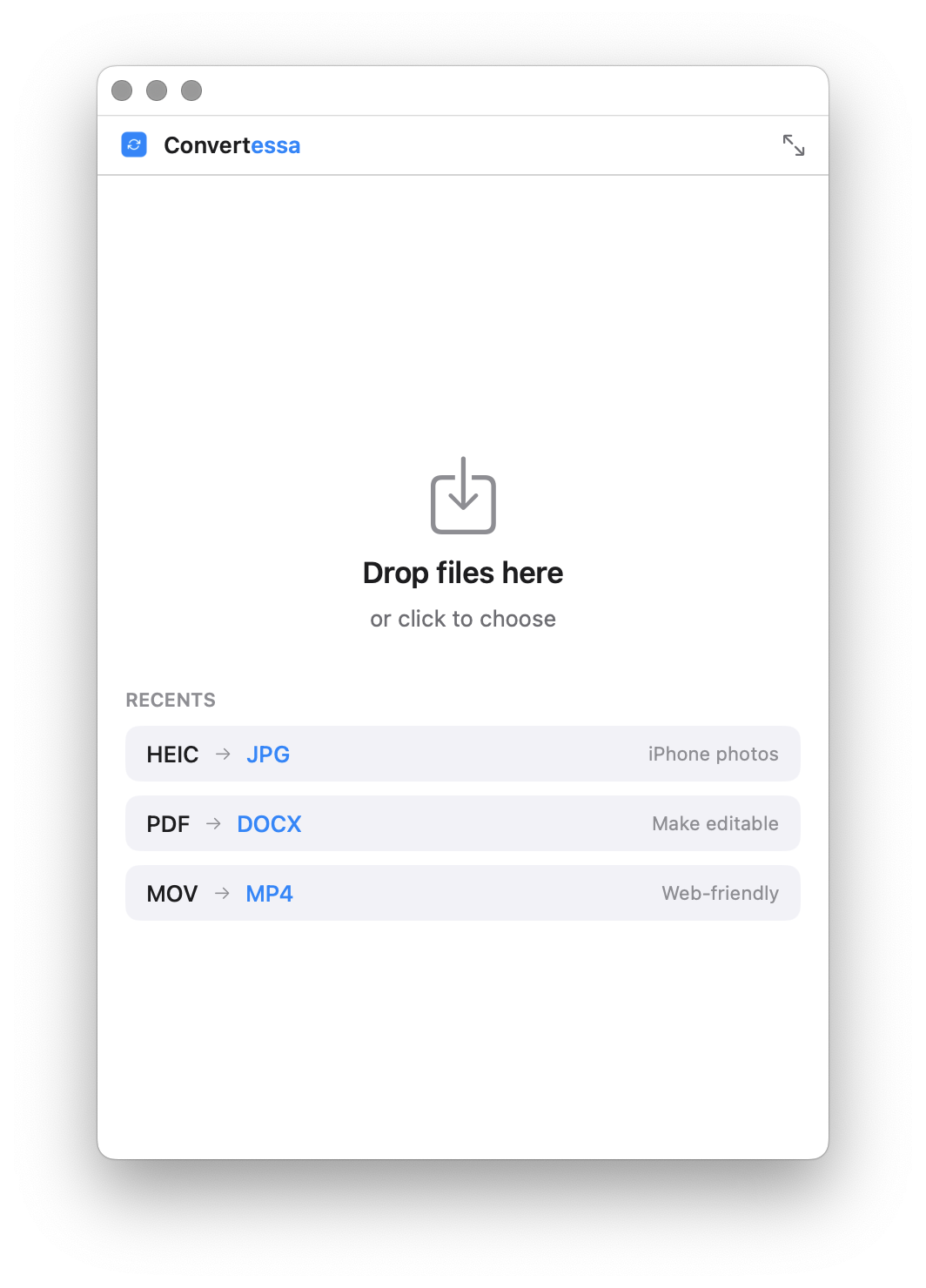
Convertessa in compact mode — a small window with a drop area and recent conversions
Pricing

One price. Yours for good.

Lifetime license
$19
One-time payment
No subscription. No renewals. Ever.
Get the app
  • 1,000+ conversion combinations
  • Lifetime future updates
  • No account required
  • Unlimited devices

macOS 14+ · Apple Silicon & Intel

Changelog

What’s shipped so far.

New formats, new features, and fixes — every release, on the record.

FAQ

Good questions.

Convertessa is a native macOS app that converts your files between formats — images, audio, video, documents, archives and eBooks — entirely on your Mac. Drop a file in, choose an output, and it’s done. No uploads, no account, no subscription.
Convertessa is an orchestrator. Under the hood it relies on best-in-class open-source engines — FFmpeg for audio & video, Pandoc for documents, libvips for images, LibreOffice for office formats, and Calibre for eBooks. It installs them for you with a click, then calls the right tool, or chain of tools, in the right order for whatever you’re converting. You get one clean native interface instead of a tangle of command-line flags. These binaries aren’t bundled with the app and are never installed without your approval — Convertessa simply calls them in a terminal session on your behalf.
Popular ones include JPEG, PNG, HEIC, WebP and AVIF; MP3, AAC, FLAC and WAV; MP4, MOV and MKV; PDF, DOCX and EPUB; ZIP, TAR and 7z — and many more. See exactly what converts to what in the conversion explorer →
Email us and we’ll add it in an upcoming release. Convertessa’s format coverage grows with what people actually need, so your request genuinely helps shape the app.
Your files? Never. Every conversion happens locally on your Mac. Your files are never uploaded, and nothing you convert is ever sent anywhere. Our Privacy Policy spells out exactly what limited data the app does store.
No analytics, no tracking, no telemetry. Your files and conversions stay entirely on your Mac — nothing you convert is ever sent anywhere. The app periodically checks for software updates in the background; like any web request, that check reveals only standard request metadata (your IP and app/OS version) to our update server — never your files, name, email, or license — and updates are always user-approved. Separately, on the website only, our purchase-confirmation page reports a completed sale to Google Ads so we can measure our own ad performance — it never runs while you’re browsing or converting, only after checkout. Our Privacy Policy spells out exactly what’s stored — and what isn’t.
Yes. Convertessa is a universal app and runs natively on Intel Macs. It requires macOS 14 or later.
Yes. It’s tuned for Apple Silicon (M-series) and runs natively — fast and energy-efficient. macOS 14 or later.
Yes — your license works on an unlimited number of your own Macs. Buy once and install it everywhere you work.
You get a genuinely useful, private, native Mac app for a single $19 payment — no subscription, ever. And your purchase directly supports a small independent developer and the app’s ongoing updates and new formats.
There’s no separate trial, but every purchase is backed by a 14-day money-back guarantee. If Convertessa isn’t right for you, contact your payment processor within 14 days to request a full refund — no questions asked. You can also email us and we’ll help route it.
Quite possibly — just email us. If you’re a student, run a non-profit, or have another good reason, reach out and we’ll sort you out.
Convertessa was built by Daler Azimov — a developer who needed a fast, private, native file converter for his own work, and decided to make the one he wished existed. Connect on LinkedIn →

No. They are two generations of Sony's RAW work: SR2 belongs to the 2005 Cyber-shot era, ARW arrived with the Alpha line in 2006 and became the format Sony has used ever since. Both descend from TIFF, but the tag layouts and the sensor data differ enough that software written for one does not necessarily read the other. That mismatch is usually why an old .sr2 folder stalls in an application handling every modern Sony file you own.

The DSC-R1 is the one most people still have — Sony's 2005 fixed-lens bridge camera with an APS-sized 10.3-megapixel CMOS sensor, unusual at the time for offering live view from that sensor. A few late Cyber-shot models of the same period wrote SR2 as well. The earlier DSC-F828 used .srf, a related but separate format. Files from an Alpha body are ARW, whatever the folder happens to be called.

The camera applied contrast, saturation and sharpening while writing its JPEG. The .sr2 stored the sensor data from before any of that. A LibRaw decode gives you a neutral rendering with white balance as recorded and a standard tone curve — deliberately conservative, because adding contrast later is easy and recovering a clipped highlight is not. Plan on an editing pass if you want the camera's look back.

No, and the difference is visible. Most RAW files carry a small baked JPEG so file browsers have something to display; extracting that is fast and gives you a fraction of the resolution. Convertessa runs the real decode — demosaicing the sensor array through LibRaw, encoding the result with libvips — so a DSC-R1 frame lands as a full 3888 x 2592 image rather than a thumbnail-sized one.

If these JPGs are standing in for files nothing can open, go high. convertessa ./sr2/*.sr2 --to jpg --quality max -o ~/Sony_JPG writes the least-compromised JPG the format allows, at the cost of size. The high preset (90) is very close and noticeably smaller; web (60) suits images that will be looked at once in a browser. Either way, keep the .sr2 originals — a JPG cannot be turned back into one.

Converting the .sr2 once is a single lossy step. Opening that JPG and saving it again is a second, and JPG re-encoding compounds: edges soften, and blocking creeps into flat areas like sky. If you expect to edit, convert the RAW to a lossless target such as PNG or TIFF, do the work there, and export the JPG at the very end. One encode, as late as possible.

We’d love to hear from you. Email us and you’ll get a reply from a real person — the one who made the app.