Your files stay on your Mac.
Convertessa opens each TIFF with libvips, reads whatever compression scheme and bit depth the file's tags declare, and writes a standard baseline JPG at the quality you set. The full pixel grid is preserved, high-bit-depth data is reduced to eight bits per channel, EXIF is stripped, and every step runs on your Mac — a 400 MB archival scan never waits on an upload.
A TIFF is less a picture format than a filing cabinet. The 1986 specification defines a set of numbered tags, and everything about the image — how the pixels are compressed, how many channels there are, how deep each channel is — is written into those tags rather than fixed by the format. That is why two files ending in .tif can be completely different animals: an uncompressed 8-bit RGB scan, a bilevel Group 4 fax page, a 16-bit-per-channel drum scan, or a TIFF whose tiles are themselves JPEG-compressed.
The pixel grid, at its original size. A 9,600 by 12,800 archival scan comes out as a 9,600 by 12,800 JPG. libvips does the decoding and the encoding, and because it streams the image in tiles instead of loading the whole raster at once, a gigapixel scan converts without filling memory.
One gotcha catches print people every time: prepress TIFFs are frequently CMYK, and a JPG destined for a browser or a phone is sRGB. Strongly saturated colours shift in that move — rich cyans and warm oranges especially — because they sit outside what sRGB can describe. And the direction is one-way. LZW and Deflate TIFF compression are lossless; JPEG compression is not. If the TIFF is your master, keep it.
Drag a single .tif or a whole folder of scanned pages onto the queue. Uncompressed, LZW, Deflate and Group 4 TIFFs all read the same way, so a mixed folder needs no sorting first.
Pick JPG as the target and set the quality value. Around 90 keeps fine detail in text edges on document scans; 80 is plenty for a reference copy of a photographic original.
Start the queue. Each TIFF is decoded and re-encoded locally, EXIF is dropped from the result, and the JPGs land beside the originals or in whatever output folder you named.
Images, audio, video, documents, archives, eBooks and fonts — all converted natively, right on your Mac.
Pick a format you have — see everything Convertessa can turn it into.
Convert hundreds of files at once with per-type group defaults and individual overrides.
First-class support for HEIC, AVIF and WebP — encode and decode, both ways. Read JPEG XL and a dozen more modern formats too.
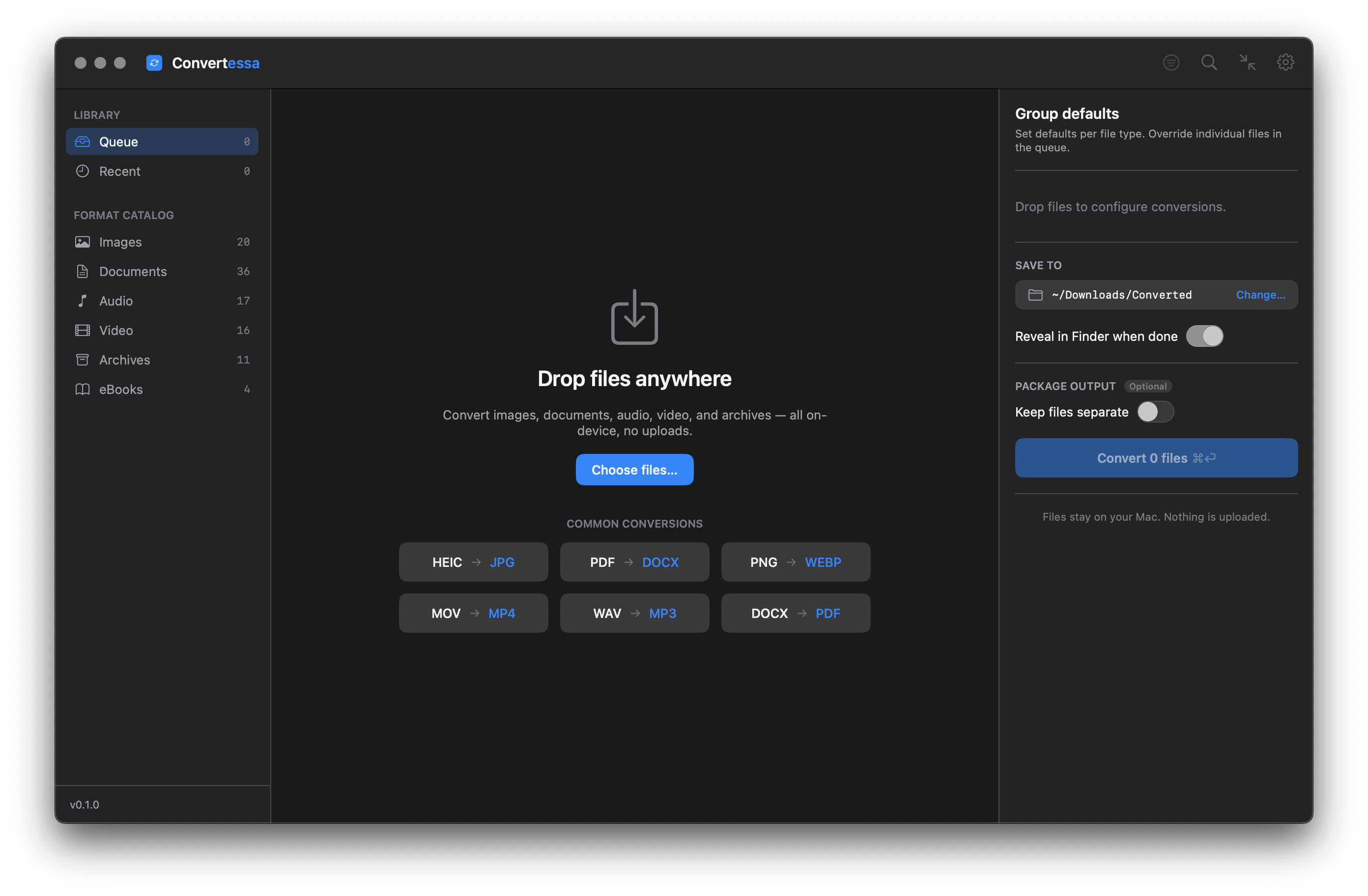
Drop files anywhere on the window. Native, instant, and exactly what you’d expect on a Mac.
Dial in compression, resolution and bitrate. Keep originals pristine or shrink for sharing.
Never overwrite a file by accident. Convertessa appends safe suffixes automatically.
Every job is logged locally. Re-run a previous conversion or revisit recent outputs in a click.
Bundle your converted files straight into a single ZIP, TAR or 7z — packaged and ready to share the moment a job finishes.
Right-click any file in Finder and choose Convert. A Quick Action handles it on the spot — no need to open the app first.
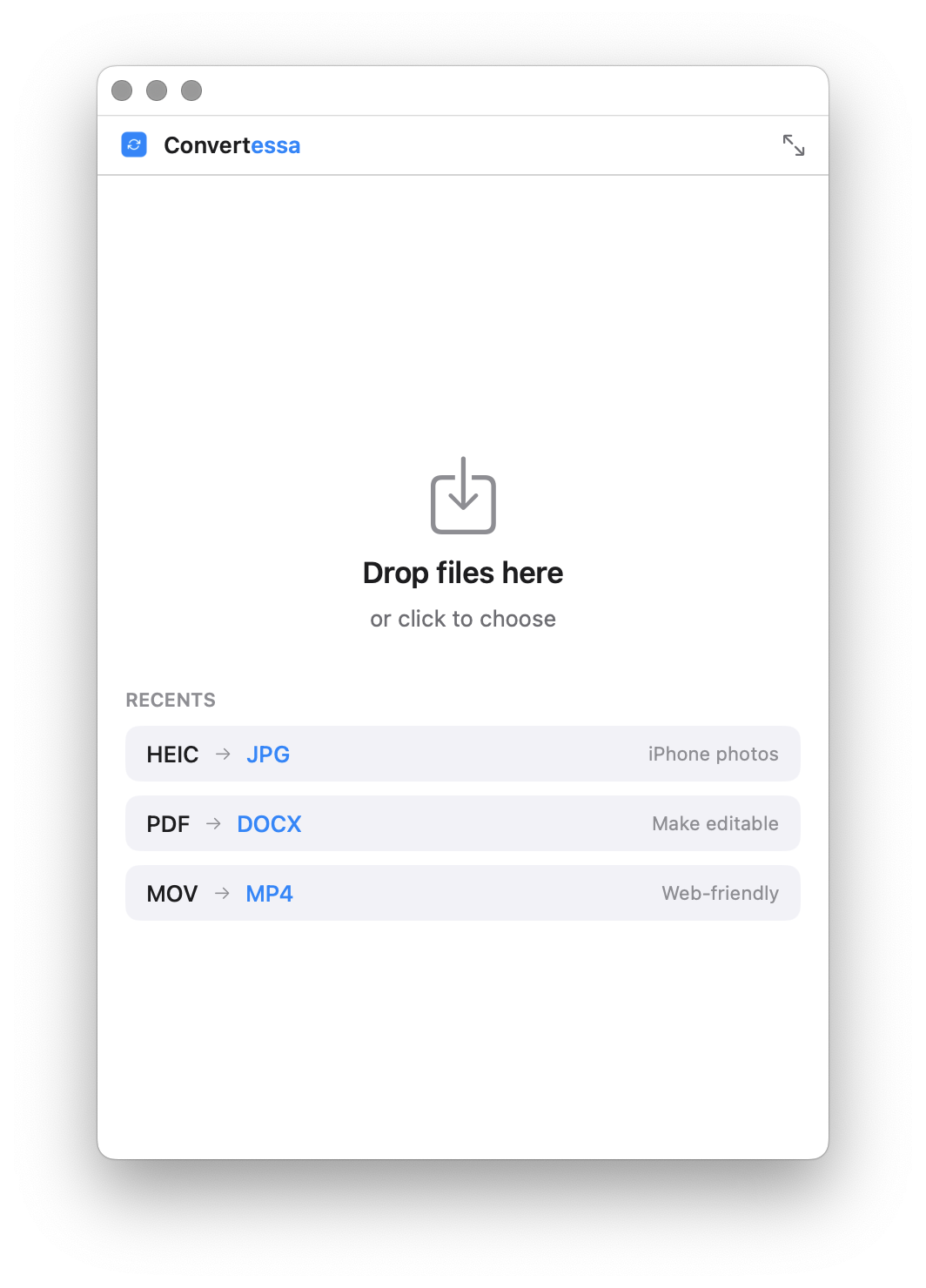
Shrink Convertessa to a tidy mini window that tucks into a corner — just a drop zone and a format picker for quick, one-off conversions.
No cloud. No account. No upload. Every conversion happens entirely on-device, using the power already in your Mac. What you convert is nobody’s business but yours.
Script conversions, wire them into your build, or batch a folder from the terminal. The same engine, no GUI required.
Read the full CLI documentation →Shrink Convertessa down to a small, focused window — drop, convert, done, with your recent conversions one click away.
macOS 14+ · Apple Silicon & Intel
New formats, new features, and fixes — every release, on the record.
JPG holds exactly one image, so a multi-page TIFF cannot survive intact as a single JPG. Multi-page files come mostly from document scanners and fax software, which use TIFF as a lightweight page container. If the pages matter as a set, convert to a format that has pages; if you only need the artwork, a single-image TIFF is the cleaner input.
No — that ratio is normal. An uncompressed TIFF stores every pixel literally, roughly three bytes per pixel for 8-bit RGB and six for 16-bit. JPEG throws away detail the eye is poor at noticing and entropy-codes the rest, so 20:1 or 30:1 at a high quality value is routine for photographic content. Flat graphics compress even harder.
Most often the TIFF was CMYK, from a print or prepress workflow, and the JPG is sRGB. Colours that live outside the sRGB gamut have to be mapped inward, so the most saturated areas lose punch. A second cause is bit depth: a 16-bit gradient rendered into 8 bits can show faint banding that was not in the original file.
No. Both extensions mean the same format — the three-letter form is a leftover from DOS filename limits. Convertessa treats them identically, and a folder containing both converts in one pass. What actually varies between two TIFF files is the compression tag recorded inside them, not the letters after the dot.
Higher than you would for a photograph. JPEG works on 8 by 8 blocks of frequency data, and hard black-on-white glyph edges are exactly the high-frequency content it struggles with, producing faint halos around letterforms. 92 or above keeps that under control. For pure bilevel scans — black text, white paper, no greys — a lossless target suits the material better than JPG does.
Yes. The CLI takes a glob and an output directory:
convertessa ~/Scans/*.tif --to jpg --quality 92 -o ~/Exports
Each file is written into ~/Exports under the same base name. Add a second run for *.tiff if the folder mixes both extensions, or pass the folder path itself to catch everything inside it.
No. Convertessa never resizes or crops — the output has the same width and height in pixels as the source TIFF, down to the last row. What changes is how those pixels are stored: eight bits per channel, sRGB, and JPEG's lossy encoding at the quality value you chose.
JPG has no transparency at all, so the alpha channel is not carried over; transparent and semi-transparent areas are composited against a solid background during conversion. If the cut-out edge matters — a product shot with no background, a logo, a UI asset — a format that keeps alpha is the right target and JPG is not.