
Convert WAV to MP3. Offline.

Your files stay on your Mac.
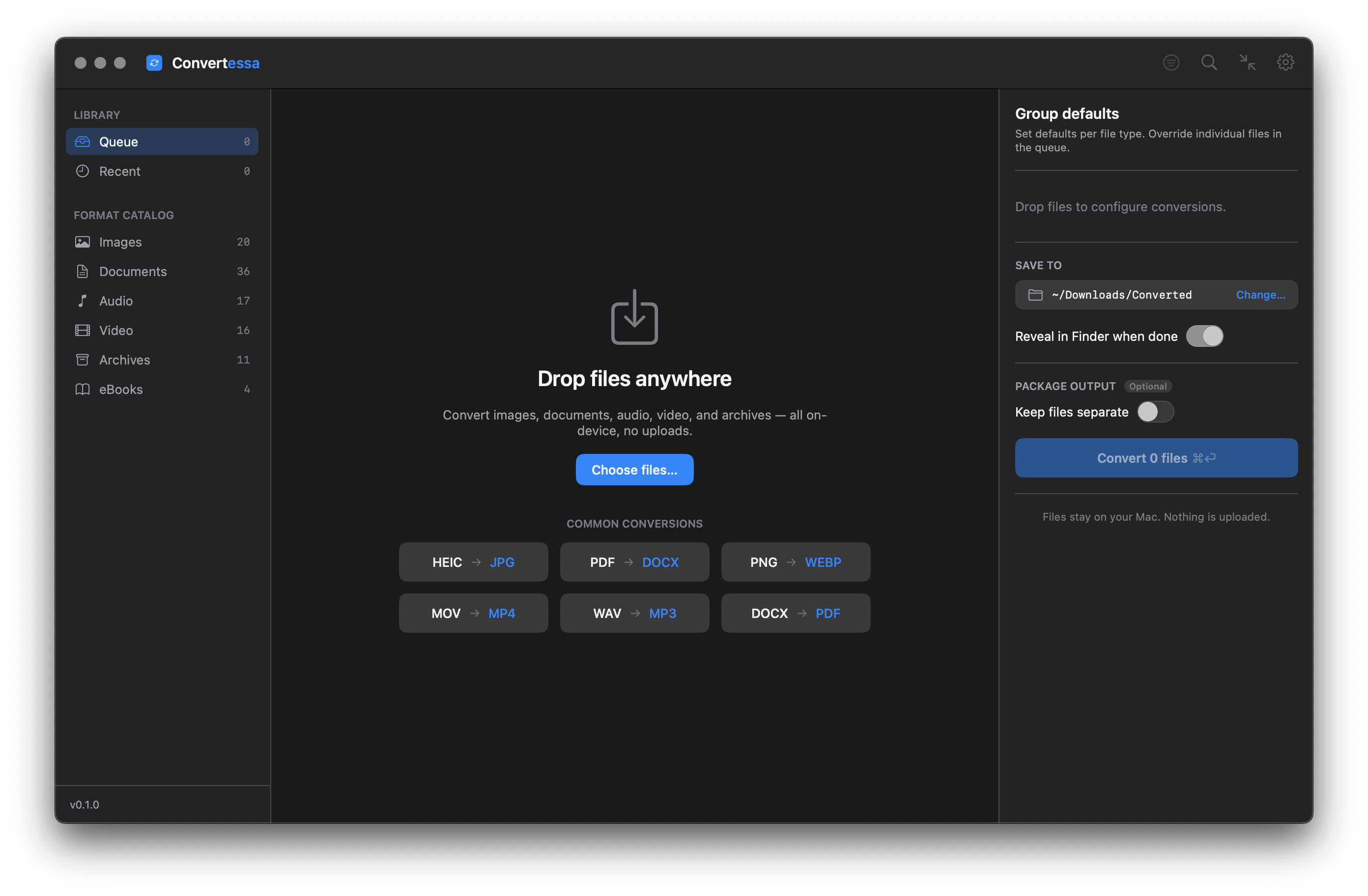
Convertessa app window showing the format catalog and drop area
What it does

What WAV-to-MP3 conversion does

Convertessa hands WAV files to FFmpeg's LAME encoder and writes MP3s on your Mac at the quality you set. Sample rates MP3 cannot express are resampled first, tags with an ID3 equivalent come across, and mono stays mono rather than being doubled into stereo. A folder of session bounces, interview takes or CD rips converts as one queue instead of one file at a time.

Before you encode

What MP3 cannot carry over from WAV

WAV is a container with almost nothing in it: a RIFF header, then raw PCM samples exactly as the recorder or the DAW produced them. That is why one stereo minute at 44.1 kHz and 16-bit costs about 10 MB, and why a field recorder can fill a card in an afternoon. MP3, encoded here by FFmpeg driving LAME, turns that minute into roughly a tenth of the size by discarding what a psychoacoustic model predicts you will not hear. Unlike the file size, that decision cannot be undone later.

Three properties of the source decide whether the encode is uneventful or surprising:

  • Sample rate. MP3 supports 32, 44.1 and 48 kHz, plus the half-rate MPEG-2 modes. A 96 kHz or 192 kHz master — routine for field recording and archival transfers — has to be resampled on the way in.
  • Bit depth. 24-bit and 32-bit float WAVs are everywhere in production. MP3 has no concept of bit depth at all; the extra headroom is used during encoding and then stops existing.
  • Channel count. The encoder handles mono and stereo. A four- or six-channel WAV out of a multitrack recorder is folded down, not preserved as separate channels.

Metadata is the quieter loss. WAV keeps notes in RIFF LIST and INFO chunks, and broadcast WAVs add a bext chunk holding the originator and a sample-accurate timestamp used to sync sound to camera. MP3 carries ID3 tags, which have artist, title and album but nowhere to put a timecode. If you are converting production sound, the MP3 is a listening copy — the WAV stays the master.

Last, gapless. Every MP3 opens with a short run of encoder-added silence, which players only skip if they read the LAME header. Rip a continuous live set track by track and you may hear a tick between songs on anything that ignores it.

How it works

Three steps. No upload required.

1

Drop the whole session

Drag in a folder of .wav bounces, rips or takes. Files queue individually, so a 96 kHz interview and a 44.1 kHz music bed sitting side by side each convert on their own terms.

2

Choose MP3 and quality

Pick MP3 and set quality. What suffers first at low settings is predictable: cymbals, applause, room reverb and sibilance, the dense high-frequency material the psychoacoustic model has the hardest time approximating.

3

Convert and keep originals

Convert, then archive the WAVs somewhere safe. Decoding an MP3 back to WAV restores the file size but none of the discarded audio, so the original recording remains your only master copy.

Format catalog

From everyday files to pro media.

Images, audio, video, documents, archives, eBooks and fonts — all converted natively, right on your Mac.

Conversion explorer

What do you want to convert?

Pick a format you have — see everything Convertessa can turn it into.

conversion combinations
I have a
can be converted to
From MP4

Features

Built for real work.

Batch conversion

Convert hundreds of files at once with per-type group defaults and individual overrides.

Modern image formats

First-class support for HEIC, AVIF and WebP — encode and decode, both ways. Read JPEG XL and a dozen more modern formats too.

Drag & drop

Drop files anywhere on the window. Native, instant, and exactly what you’d expect on a Mac.

Quality control

Dial in compression, resolution and bitrate. Keep originals pristine or shrink for sharing.

Collision-safe naming

Never overwrite a file by accident. Convertessa appends safe suffixes automatically.

Conversion history

Every job is logged locally. Re-run a previous conversion or revisit recent outputs in a click.

Archive the output

Bundle your converted files straight into a single ZIP, TAR or 7z — packaged and ready to share the moment a job finishes.

Convert from Finder

Right-click any file in Finder and choose Convert. A Quick Action handles it on the spot — no need to open the app first.

Compact mode

Shrink Convertessa to a tidy mini window that tucks into a corner — just a drop zone and a format picker for quick, one-off conversions.

Your files never leave your Mac.

No cloud. No account. No upload. Every conversion happens entirely on-device, using the power already in your Mac. What you convert is nobody’s business but yours.

On-device processing Zero telemetry No file uploads
For power users

There’s a command line, too.

Script conversions, wire them into your build, or batch a folder from the terminal. The same engine, no GUI required.

Read the full CLI documentation
zsh — convertessa
# Convert a single file
$ convertessa input.wav --to mp3
photo.mp3 · 1.2 MB · 0.4s
 
# Batch a whole folder
$ convertessa ./*.wav --to mp3 -o ~/Exports
14 files converted · 4.1s
Made to fit

And a compact mode.

Shrink Convertessa down to a small, focused window — drop, convert, done, with your recent conversions one click away.
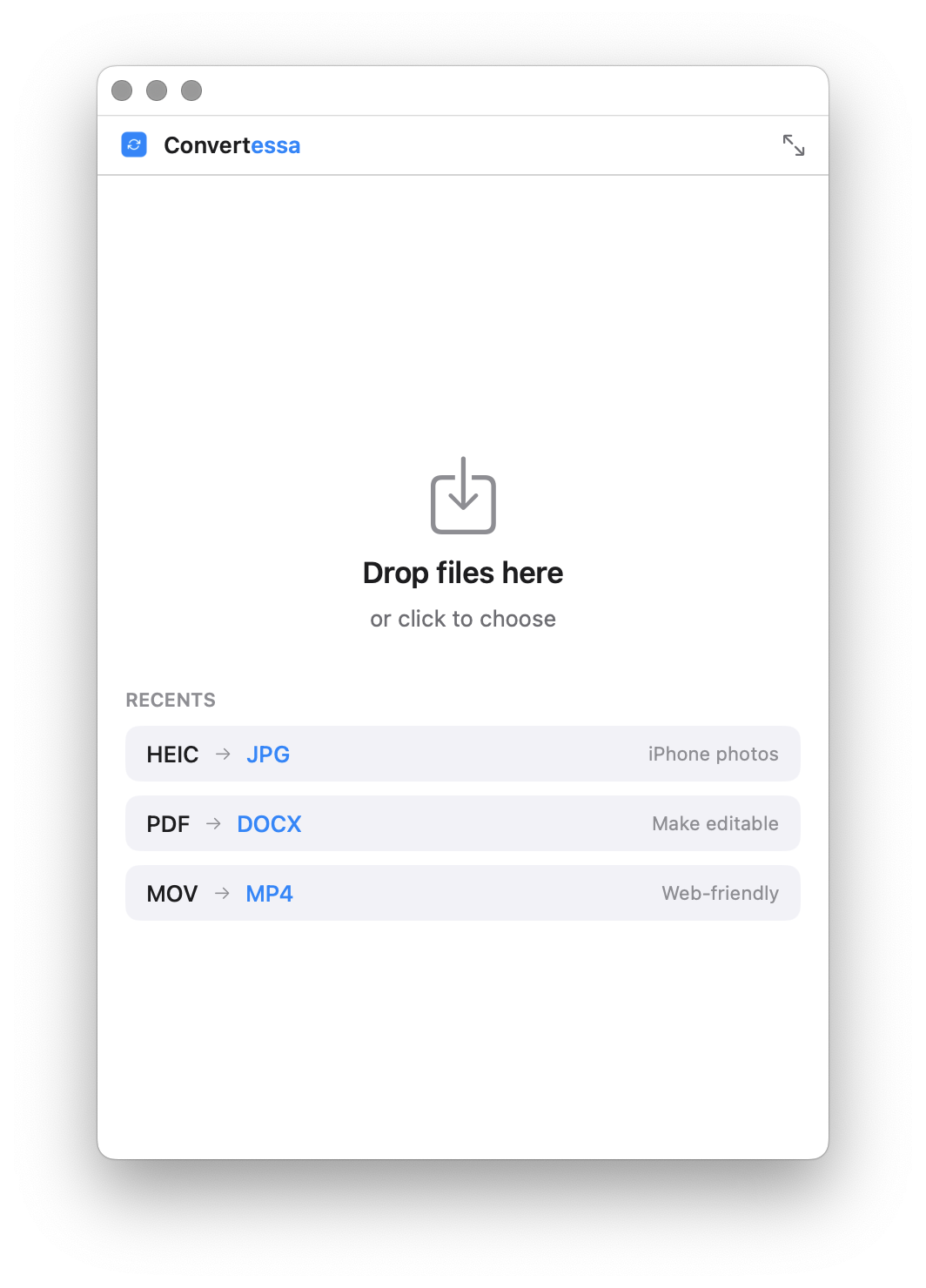
Convertessa in compact mode — a small window with a drop area and recent conversions
Pricing

One price. Yours for good.

Lifetime license
$19
One-time payment
No subscription. No renewals. Ever.
Get the app
  • 1,000+ conversion combinations
  • Lifetime future updates
  • No account required
  • Unlimited devices

macOS 14+ · Apple Silicon & Intel

Changelog

What’s shipped so far.

New formats, new features, and fixes — every release, on the record.

FAQ

Good questions.

Convertessa is a native macOS app that converts your files between formats — images, audio, video, documents, archives and eBooks — entirely on your Mac. Drop a file in, choose an output, and it’s done. No uploads, no account, no subscription.
Convertessa is an orchestrator. Under the hood it relies on best-in-class open-source engines — FFmpeg for audio & video, Pandoc for documents, libvips for images, LibreOffice for office formats, and Calibre for eBooks. It installs them for you with a click, then calls the right tool, or chain of tools, in the right order for whatever you’re converting. You get one clean native interface instead of a tangle of command-line flags. These binaries aren’t bundled with the app and are never installed without your approval — Convertessa simply calls them in a terminal session on your behalf.
Popular ones include JPEG, PNG, HEIC, WebP and AVIF; MP3, AAC, FLAC and WAV; MP4, MOV and MKV; PDF, DOCX and EPUB; ZIP, TAR and 7z — and many more. See exactly what converts to what in the conversion explorer →
Email us and we’ll add it in an upcoming release. Convertessa’s format coverage grows with what people actually need, so your request genuinely helps shape the app.
Your files? Never. Every conversion happens locally on your Mac. Your files are never uploaded, and nothing you convert is ever sent anywhere. Our Privacy Policy spells out exactly what limited data the app does store.
No analytics, no tracking, no telemetry. Your files and conversions stay entirely on your Mac — nothing you convert is ever sent anywhere. The app periodically checks for software updates in the background; like any web request, that check reveals only standard request metadata (your IP and app/OS version) to our update server — never your files, name, email, or license — and updates are always user-approved. Separately, on the website only, our purchase-confirmation page reports a completed sale to Google Ads so we can measure our own ad performance — it never runs while you’re browsing or converting, only after checkout. Our Privacy Policy spells out exactly what’s stored — and what isn’t.
Yes. Convertessa is a universal app and runs natively on Intel Macs. It requires macOS 14 or later.
Yes. It’s tuned for Apple Silicon (M-series) and runs natively — fast and energy-efficient. macOS 14 or later.
Yes — your license works on an unlimited number of your own Macs. Buy once and install it everywhere you work.
You get a genuinely useful, private, native Mac app for a single $19 payment — no subscription, ever. And your purchase directly supports a small independent developer and the app’s ongoing updates and new formats.
There’s no separate trial, but every purchase is backed by a 14-day money-back guarantee. If Convertessa isn’t right for you, contact your payment processor within 14 days to request a full refund — no questions asked. You can also email us and we’ll help route it.
Quite possibly — just email us. If you’re a student, run a non-profit, or have another good reason, reach out and we’ll sort you out.
Convertessa was built by Daler Azimov — a developer who needed a fast, private, native file converter for his own work, and decided to make the one he wished existed. Connect on LinkedIn →

It is resampled to a rate MP3 can express, normally 48 kHz. MP3 as a format only defines 32, 44.1 and 48 kHz for full-rate streams, so there is no way to keep 96 kHz in the container. In practice this is not the loss people fear — the material above 24 kHz was inaudible anyway. The audible change comes from the lossy encoding, not the rate conversion.

Two reasons, both structural. The encoder inserts a short priming run of silence at the start so its filter bank has something to chew on, and the audio is packed into fixed-size frames, so the end is padded out to fill the final frame. The LAME header records both so a good player can trim them. Total added time is a few tens of milliseconds — invisible for a podcast, audible as a tick between gapless album tracks.

No. WAV stores markers in a cue chunk, often with labels in an adjacent list, and MP3 has no equivalent — ID3 was designed for library metadata, not editorial positions. Chapter-style markers are lost, and so is anything a DAW wrote into a custom chunk. Export a marker list from your editor before converting if you need those positions later.

Classic WAV cannot exceed 4 GB, because RIFF stores chunk sizes in 32 bits — roughly six hours of 44.1 kHz stereo, or far less multitrack. Long-form recorders sidestep this by writing RF64 or Wave64 files, often still named .wav. FFmpeg reads those, so a long lecture or concert recording converts normally. A truly malformed oversized WAV, written by a recorder that crashed mid-take, is the case that fails.

Point the CLI at the folder and give it a destination:

convertessa ./takes/*.wav --to mp3 --quality high -o ~/Music/Takes

Named presets map to numbers, so high is the same as --quality 90 and balanced is 80. Filenames are kept, extensions swapped, and nothing is written over your originals.

Yes, sensibly so. A mono WAV encodes as a mono MP3 rather than being duplicated into two identical channels, which keeps the file roughly half the size for the same fidelity. Speech is the ideal case for MP3 in general: a narrow spectrum, no dense cymbal wash, and a psychoacoustic model that has an easy job. Interview archives shrink dramatically with no audible difference.

You can produce a WAV from an MP3, but it is not a recovery. Decoding restores the file size and the sample rate; the frequency content the encoder threw away does not return, and the decoded file inherits every artefact plus the encoder's padding. Treat MP3 as a distribution format in one direction only, and keep the WAV if the recording is irreplaceable.

We’d love to hear from you. Email us and you’ll get a reply from a real person — the one who made the app.