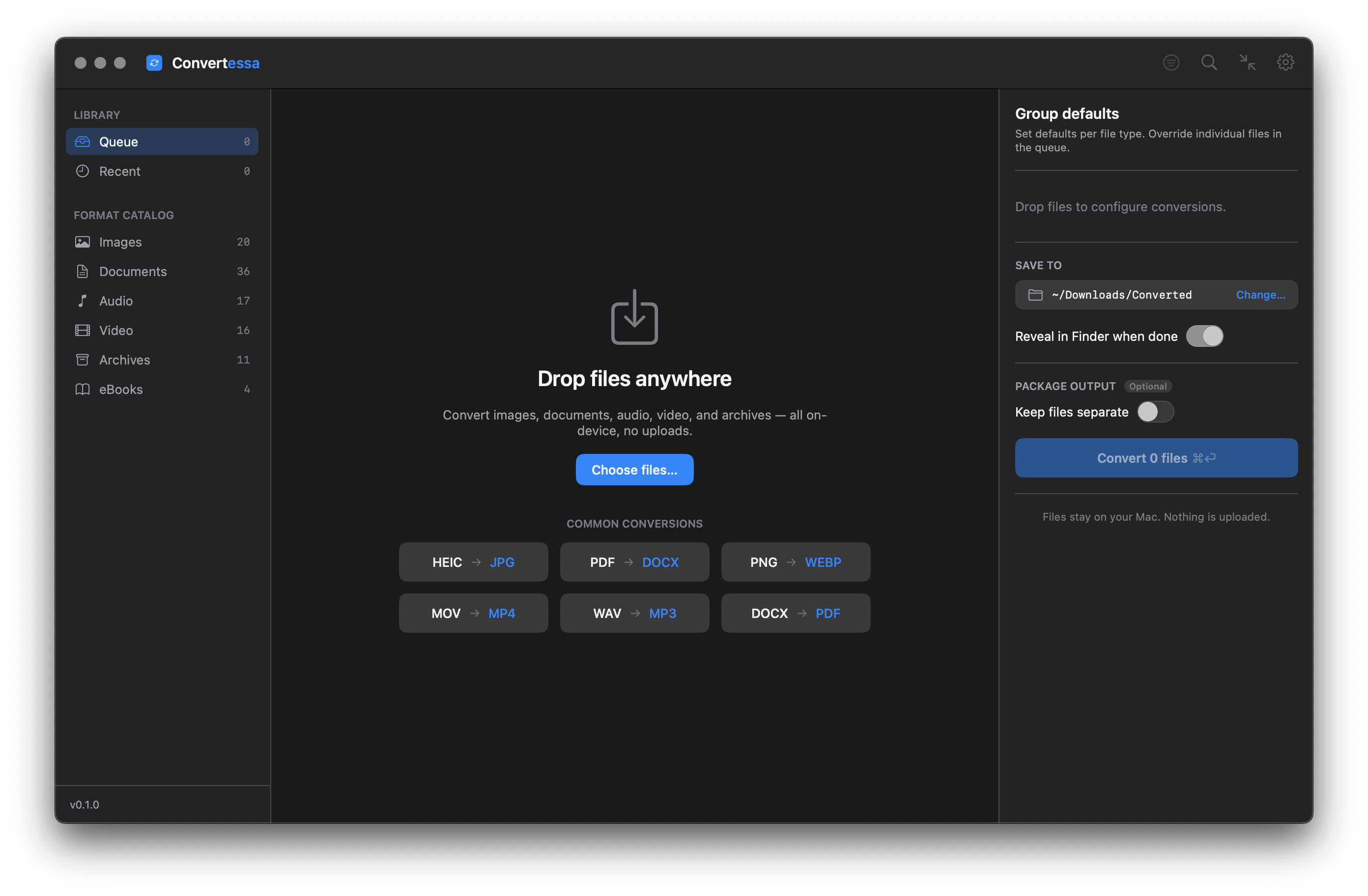
Your files stay on your Mac.
Convertessa hands your WebM files to FFmpeg and writes H.264 video with AAC audio into an MP4 container, entirely on your Mac. Because the codecs differ, every frame is decoded and encoded again rather than copied over, and you set the quality before the run starts. Drop a single clip or a folder of browser recordings; the queue works through the lot and leaves the originals where they were.
WebM is a slimmed-down Matroska container Google published in 2010 around royalty-free codecs. In practice it reaches your Mac from a browser: a Meet recording, a MediaRecorder capture from a web app, an OBS or screen-recorder export, an animated sticker, a download from a site that serves VP9.
Inside, the video is VP8, VP9 or AV1 and the audio is Vorbis or Opus. MP4 is a different lineage — the ISO base media format, built around H.264 and AAC — so this is not a rewrap. FFmpeg decodes every frame and encodes it again. That is why the quality setting earns attention here: the WebM was already lossy, and you are asking for a second lossy pass over the same picture. Keep quality high on anything headed into an editor.
VP8 and VP9 can carry an alpha channel, and animated stickers, lower-thirds and logo overlays usually do. H.264 in MP4 has no broadly supported alpha, so transparent areas are composited onto a solid background — normally black. If the cut-out matters, keep the WebM as your master.
File size can go either way. VP9 is more efficient than H.264, so at a comparable quality the MP4 is often the larger file of the two, even though it plays in more places.
Drag a single clip or a whole folder of browser recordings onto the queue. Convertessa reads what is actually inside each file — VP8, VP9 or AV1 video, Vorbis or Opus audio — and lines the batch up for FFmpeg.
Choose MP4 as the output. MP4 is lossy, so a quality control appears: keep it high for footage going into Final Cut or iMovie, ease it down for a clip you are simply sending to somebody.
Start the conversion. Each file is decoded and re-encoded locally with no network access at any point, then written as an .mp4 beside its source. A long 4K screen capture takes noticeably longer than a short sticker.
Images, audio, video, documents, archives, eBooks and fonts — all converted natively, right on your Mac.
Pick a format you have — see everything Convertessa can turn it into.
Convert hundreds of files at once with per-type group defaults and individual overrides.
First-class support for HEIC, AVIF and WebP — encode and decode, both ways. Read JPEG XL and a dozen more modern formats too.
Drop files anywhere on the window. Native, instant, and exactly what you’d expect on a Mac.
Dial in compression, resolution and bitrate. Keep originals pristine or shrink for sharing.
Never overwrite a file by accident. Convertessa appends safe suffixes automatically.
Every job is logged locally. Re-run a previous conversion or revisit recent outputs in a click.
Bundle your converted files straight into a single ZIP, TAR or 7z — packaged and ready to share the moment a job finishes.
Right-click any file in Finder and choose Convert. A Quick Action handles it on the spot — no need to open the app first.
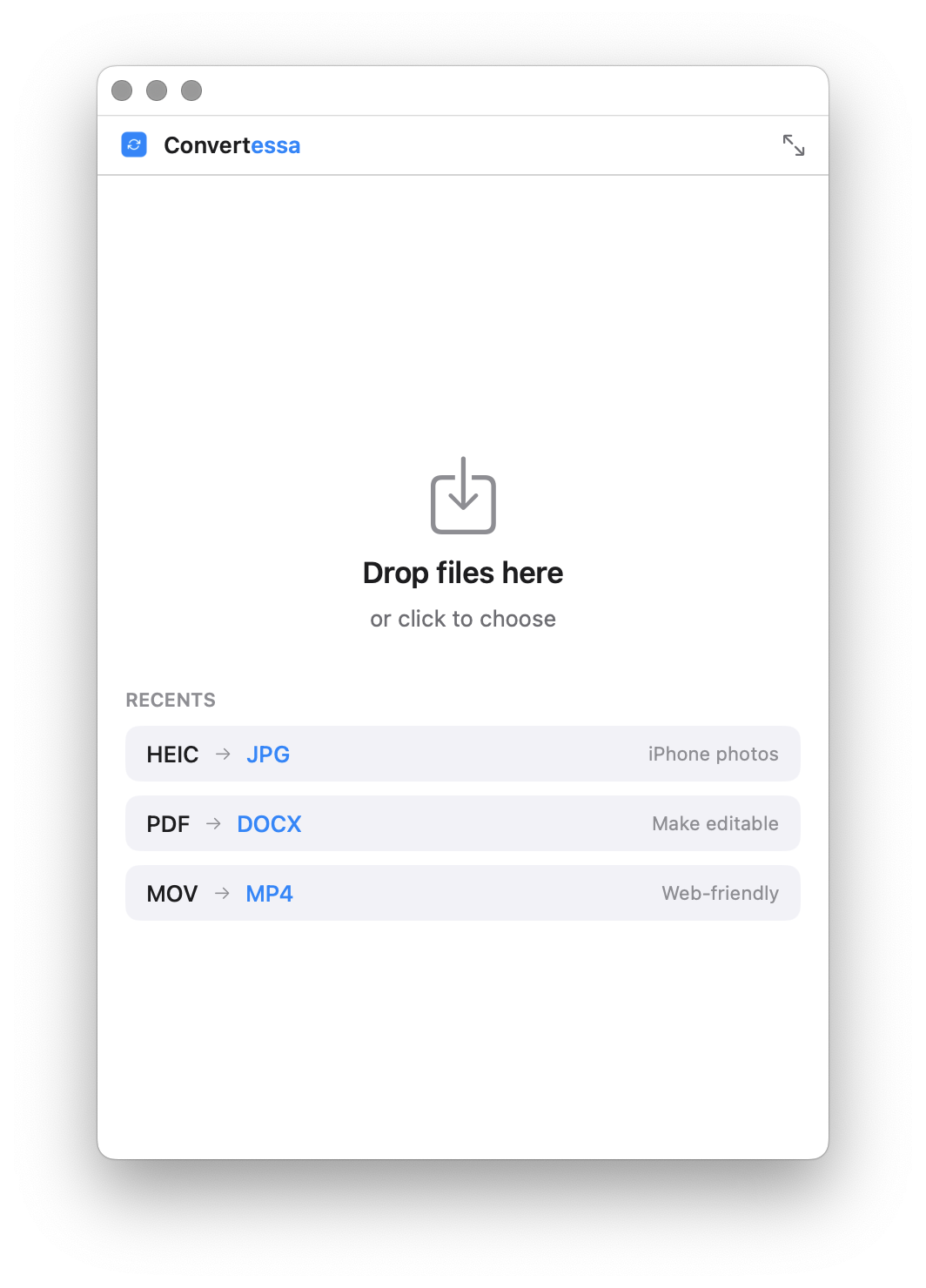
Shrink Convertessa to a tidy mini window that tucks into a corner — just a drop zone and a format picker for quick, one-off conversions.
No cloud. No account. No upload. Every conversion happens entirely on-device, using the power already in your Mac. What you convert is nobody’s business but yours.
Script conversions, wire them into your build, or batch a folder from the terminal. The same engine, no GUI required.
Read the full CLI documentation →Shrink Convertessa down to a small, focused window — drop, convert, done, with your recent conversions one click away.
macOS 14+ · Apple Silicon & Intel
New formats, new features, and fixes — every release, on the record.
Because the streams themselves are the problem, not the box around them. MP4 is defined around H.264, HEVC and AAC; WebM holds VP8, VP9 or AV1 with Vorbis or Opus. There are specifications for putting VP9 and Opus inside MP4, but QuickTime, Photos and Final Cut do not decode those combinations, so the resulting file would be an MP4 your Mac still refuses to play. Re-encoding to H.264 and AAC is what actually buys you compatibility.
The transparency is flattened. VP8 and VP9 store an alpha channel, H.264 in MP4 does not have one that players broadly support, so every transparent pixel is composited onto an opaque background — black unless the source says otherwise. If you need the overlay to sit on top of other footage, feed the original WebM into your editor instead, and export the composite from there.
Usually, yes. Browser recorders stream WebM out live and never go back to write the duration into the header, so players cannot tell how long the file is and scrubbing jumps around or refuses to move. Encoding a fresh MP4 writes a complete timeline with an accurate duration and index, which is why the recording suddenly behaves like a normal video afterwards.
It is decoded and re-encoded as AAC, the audio codec MP4 players expect. Opus is a strong codec, so this is a second lossy generation on the sound as well as the picture — worth remembering on a recorded interview or a music take. Channel layout is kept: stereo stays stereo, and a multichannel Opus track is written as multichannel AAC rather than being folded down.
Yes, the CLI runs the same engine as the app. For one file: convertessa recording.webm --to mp4. For a folder, with an explicit destination and a high quality setting: convertessa ~/Recordings/*.webm --to mp4 --quality 90 -o ~/Exports. The originals are left alone, so you can compare before deleting anything.
Often, yes. VP9 and AV1 are simply more modern than H.264 and get more picture out of the same amount of data, so matching the look of the original usually costs more bytes in the MP4. You can pull the quality setting down to land closer to the original size, at the cost of some detail. The trade you are making is efficiency for compatibility.
VLC plays almost anything, but the software you actually hand files to often does not. Final Cut Pro, iMovie, Photos, Keynote, Messages previews and iPhones all expect H.264 or HEVC in an MP4. If the WebM only ever gets watched on your own machine, keep it. Convert when it needs to be edited, imported, presented, or sent to someone who will not install a player for it.