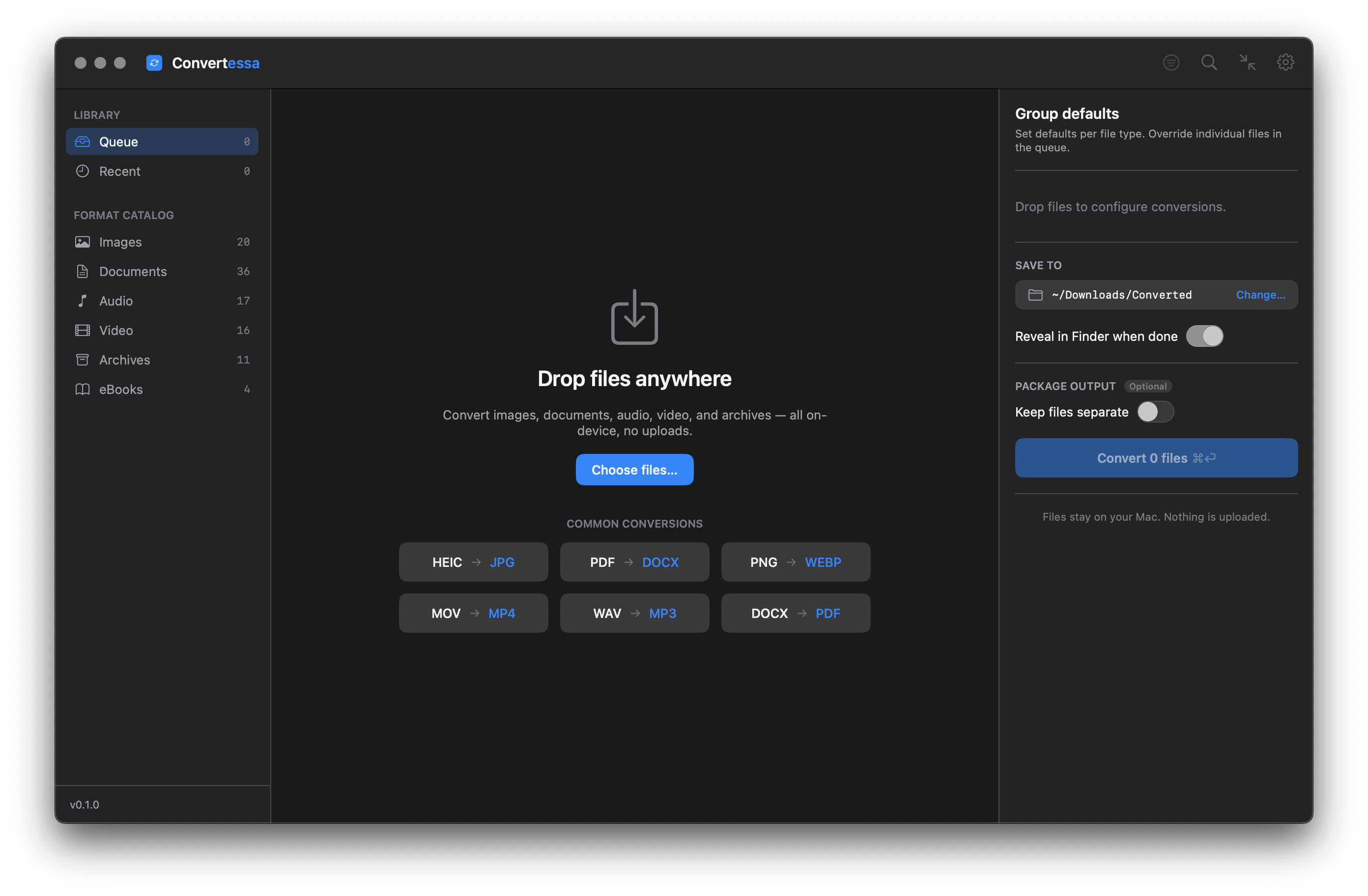
Your files stay on your Mac.
Convertessa decodes each WebP — lossy or lossless, still or animated — and re-encodes the picture as a baseline JPG at the quality you set, keeping the original width and height. Transparency is flattened because JPG has no alpha, animation reduces to a single frame, EXIF is stripped, and an entire Downloads folder can go through in one pass without leaving your Mac.
Nearly every WebP on a Mac arrived from a browser. Google published the format in 2010, it now carries a large share of the images the web serves, and so Save Image As… hands you a .webp that Preview opens happily and plenty of other software refuses: older Photoshop builds, print labs, Office templates, tired CMS uploaders, more e-commerce backends than you would expect.
Underneath, WebP is two different formats sharing a RIFF container. Lossy WebP is a single still frame of VP8 video coding. Lossless WebP is an unrelated entropy-coded scheme built for graphics. Extra chunks alongside carry alpha, animation frames, ICC and EXIF. Which of the two you have decides what this conversion actually costs you.
You are re-encoding data that was already compressed, so this is a second generation of loss. Lossy WebP is always 4:2:0: colour resolution was halved in both directions when the file was made, and JPEG cannot restore what is not there. Keep the quality value high — 90 and up — so JPEG's blocks sit on top of WebP's rather than amplifying them. Expect the JPG to end up larger than the WebP it came from, often by a third. That is not a fault; it is the gap between a 2010 codec and a 1992 one.
Screenshots, logos, UI captures and flat-colour illustrations are usually lossless WebP, and they are close to the worst possible JPEG input. Hard edges against flat fields produce visible ringing around text and lines. If such a file has to leave WebP, PNG is the honest destination; JPG is built for photographs.
Two things never make it across: transparency, because JPG has no alpha channel and transparent areas are flattened during conversion, and animation, because an animated WebP is a frame sequence and a JPG holds exactly one image.
Drag the .webp files straight out of Downloads, or drop the folder itself. Lossy and lossless WebP are read the same way at the input stage, so there is nothing to sort out beforehand.
Choose JPG and set quality to 90 or above. A lossy WebP has already been through one compression pass, and a high value stops the second pass from stacking fresh artefacts onto the old ones.
Run the queue. JPGs appear beside the originals, usually a third larger than the WebP files they came from — expected behaviour, since JPEG needs more bytes for the same picture.
Images, audio, video, documents, archives, eBooks and fonts — all converted natively, right on your Mac.
Pick a format you have — see everything Convertessa can turn it into.
Convert hundreds of files at once with per-type group defaults and individual overrides.
First-class support for HEIC, AVIF and WebP — encode and decode, both ways. Read JPEG XL and a dozen more modern formats too.
Drop files anywhere on the window. Native, instant, and exactly what you’d expect on a Mac.
Dial in compression, resolution and bitrate. Keep originals pristine or shrink for sharing.
Never overwrite a file by accident. Convertessa appends safe suffixes automatically.
Every job is logged locally. Re-run a previous conversion or revisit recent outputs in a click.
Bundle your converted files straight into a single ZIP, TAR or 7z — packaged and ready to share the moment a job finishes.
Right-click any file in Finder and choose Convert. A Quick Action handles it on the spot — no need to open the app first.
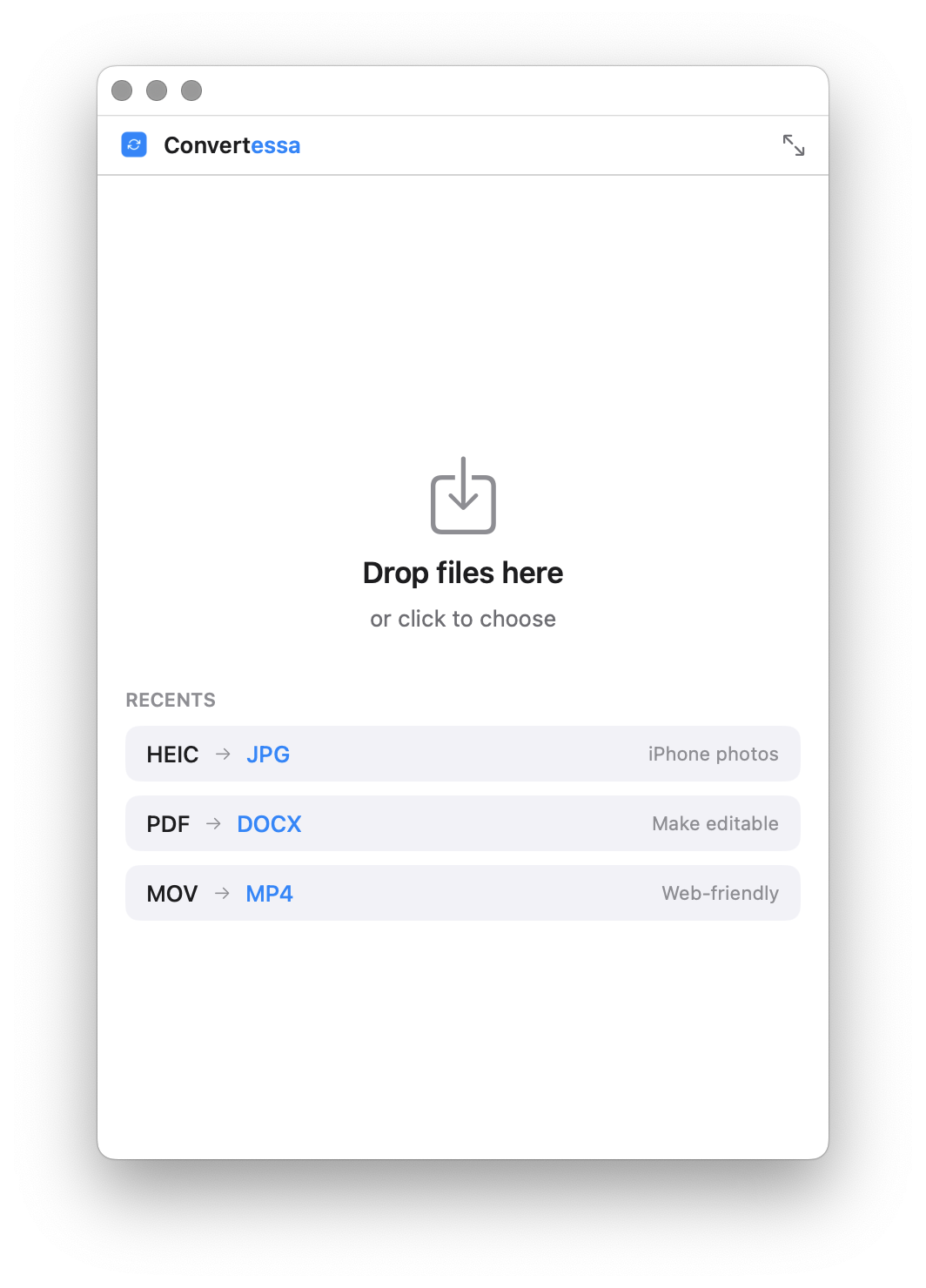
Shrink Convertessa to a tidy mini window that tucks into a corner — just a drop zone and a format picker for quick, one-off conversions.
No cloud. No account. No upload. Every conversion happens entirely on-device, using the power already in your Mac. What you convert is nobody’s business but yours.
Script conversions, wire them into your build, or batch a folder from the terminal. The same engine, no GUI required.
Read the full CLI documentation →Shrink Convertessa down to a small, focused window — drop, convert, done, with your recent conversions one click away.
macOS 14+ · Apple Silicon & Intel
New formats, new features, and fixes — every release, on the record.
Because JPEG is an older, weaker codec. WebP's lossy mode borrows VP8's intra-frame prediction and typically reaches the same visual quality in 25 to 35 percent fewer bytes than JPEG can. Converting trades size for compatibility, which is usually the whole reason for doing it. A lower quality value will shrink the JPG, but on already-compressed input it degrades fast.
Animated WebP stores a frame sequence in ANIM and ANMF chunks — the same idea as a GIF, better compressed. JPG has no frames at all, so the animation cannot survive; you end up with one still image and no timing information. If the movement matters, a video or animated-image target is the right destination and JPG is not.
A solid one. WebP carries alpha in both its lossy and lossless modes, JPG carries none, so transparent and semi-transparent pixels are composited against a background during conversion. Product cut-outs, logos and sticker art all lose their edge treatment this way — for those, keeping alpha matters more than JPG compatibility does.
Usually not. Screenshots are flat colour and sharp text, exactly the content JPEG handles worst: its frequency-based encoding scatters faint halos around every glyph edge, and they worsen each time the file is re-saved. A lossless target keeps the text crisp and often produces a smaller file than JPG for that kind of image. Save JPG for photographs.
Slightly, and unavoidably, if the source was lossy WebP — you are encoding an already-encoded image, so the two sets of artefacts compound. Detail lost by the first pass never comes back. At quality 90 or above the difference is hard to see on a photograph; below about 75 you start seeing WebP's blocks and JPEG's blocks arguing with each other.
Yes, and this is the case the CLI was made for:
convertessa ~/Downloads/*.webp --to jpg --quality 92 -o ~/Pictures/Converted
The originals stay put, the JPGs collect in the output folder, and base names carry over. Drop the folder onto the app window instead if you would rather watch the queue than type a command.
Because the software downstream of you often will not. macOS has decoded WebP system-wide since Big Sur, but photo kiosks, older Photoshop and Illustrator releases, print shop upload forms, e-mail clients and plenty of web CMS uploaders still reject the extension outright. Converting to JPG is about the other end of the pipeline, not about your Mac.
Only on the WebP side. The format caps images at 16,383 pixels on each edge, a constraint inherited from VP8, while baseline JPEG allows up to 65,535. Anything that is a valid WebP therefore fits comfortably inside JPG's limits, and the pixel dimensions carry across unchanged.