
Convert Canon RAW 3 to TIFF. Offline.

Your files stay on your Mac.
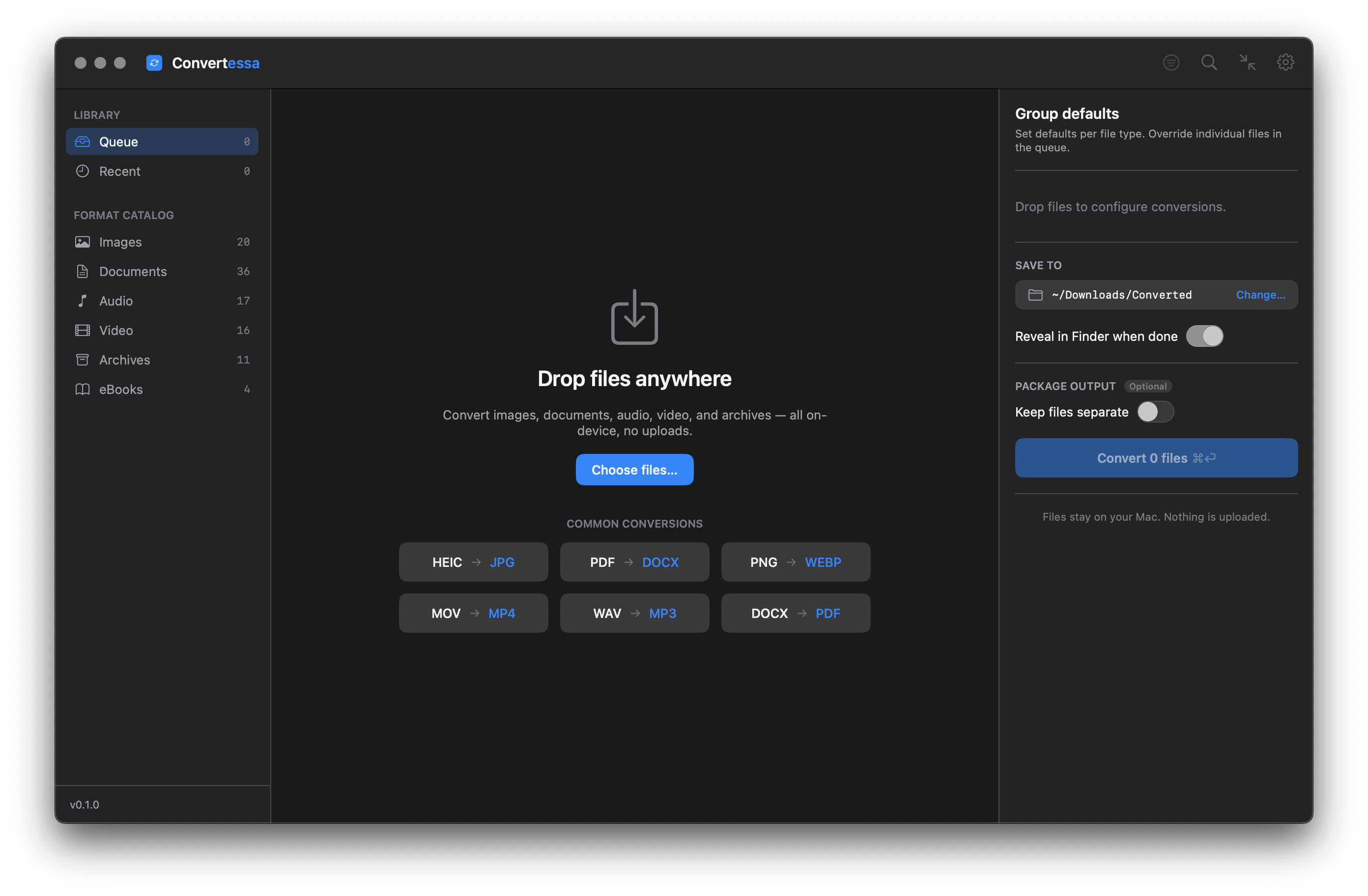
Convertessa app window showing the format catalog and drop area
What it does

Full-resolution, lossless output from every CR3 file

Convertessa decodes each Canon CR3 on your Mac and writes a full-resolution TIFF: every photosite the sensor recorded, demosaiced once and stored losslessly at 16 bits per channel. Drop a card's worth of frames and the whole batch runs in a single pass. Nothing is uploaded, your CR3 files are opened for reading only, and the finished TIFFs land wherever you point the output.

From negative to print

Demosaicing a CR3 into a 16-bit TIFF

CR3 is Canon's third-generation raw format, introduced with the EOS M50 in 2018 and now standard across the R system, the 90D and the 250D. Unlike the CR2 it replaced, it is built on the ISO base media container — the same box structure as MP4 — with sensor data compressed by Canon's CRX codec. One .CR3 is really a bundle:

  • The undemosaiced Bayer mosaic, typically 14 bits per photosite.
  • A full-size JPEG preview, which is what the camera's rear screen and Finder's thumbnail are actually showing you.
  • Maker notes: as-shot white balance, Picture Style, lens correction data, focus points.

This is a rendering, not a repackaging

Turning that mosaic into TIFF means demosaicing: interpolating a full red, green and blue value for every pixel from neighbours that each recorded only one colour. The decision is made once and baked in. What comes out is a rendered image rather than a raw file, so the highlight headroom and the penalty-free white balance you had in the CR3 do not travel with it. Keep the CR3s.

What TIFF gives you in exchange

TIFF is lossless and holds 16 bits per channel, so nothing is discarded in the encode itself and gradients survive further grading without banding. It is also the format that print, scientific and archival pipelines accept without argument. There is no quality slider here, because there is nothing to trade: a TIFF is an exact record of the pixels it was handed.

Two practical surprises

Size is the first. A 45-megapixel R5 frame at 16 bits per channel is roughly 260 MB uncompressed against about 45 MB for the CR3, so budget disk space before batching a card. Colour is the second: Picture Style and Digital Lens Optimizer are camera-side instructions stored in the maker notes, not pixel data, so an independently rendered TIFF often looks flatter and more neutral than the preview you saw on the back of the camera. That is the raw file honestly rendered, not a fault.

How it works

Three steps. No upload required.

1

Drop a shoot folder

Drag your CR3 files, or an entire DCIM folder, onto Convertessa. Frames from the R5, R6, R7, R8, R10, 90D and M50 are all read, and the originals are opened for reading only.

2

Choose TIFF

Select TIFF as the output. Because TIFF is lossless there is no quality slider to weigh up, and every frame is rendered at the full sensor resolution the camera recorded it at.

3

Convert, then watch the disk

Start the queue and aim the output at a volume with room to spare. Each rendered frame typically runs five or six times the size of the CR3 it came from.

Format catalog

From everyday files to pro media.

Images, audio, video, documents, archives, eBooks and fonts — all converted natively, right on your Mac.

Conversion explorer

What do you want to convert?

Pick a format you have — see everything Convertessa can turn it into.

conversion combinations
I have a
can be converted to
From MP4

Features

Built for real work.

Batch conversion

Convert hundreds of files at once with per-type group defaults and individual overrides.

Modern image formats

First-class support for HEIC, AVIF and WebP — encode and decode, both ways. Read JPEG XL and a dozen more modern formats too.

Drag & drop

Drop files anywhere on the window. Native, instant, and exactly what you’d expect on a Mac.

Quality control

Dial in compression, resolution and bitrate. Keep originals pristine or shrink for sharing.

Collision-safe naming

Never overwrite a file by accident. Convertessa appends safe suffixes automatically.

Conversion history

Every job is logged locally. Re-run a previous conversion or revisit recent outputs in a click.

Archive the output

Bundle your converted files straight into a single ZIP, TAR or 7z — packaged and ready to share the moment a job finishes.

Convert from Finder

Right-click any file in Finder and choose Convert. A Quick Action handles it on the spot — no need to open the app first.

Compact mode

Shrink Convertessa to a tidy mini window that tucks into a corner — just a drop zone and a format picker for quick, one-off conversions.

Your files never leave your Mac.

No cloud. No account. No upload. Every conversion happens entirely on-device, using the power already in your Mac. What you convert is nobody’s business but yours.

On-device processing Zero telemetry No file uploads
For power users

There’s a command line, too.

Script conversions, wire them into your build, or batch a folder from the terminal. The same engine, no GUI required.

Read the full CLI documentation
zsh — convertessa
# Convert a single file
$ convertessa input.cr3 --to tiff
photo.tiff · 1.2 MB · 0.4s
 
# Batch a whole folder
$ convertessa ./*.cr3 --to tiff -o ~/Exports
14 files converted · 4.1s
Made to fit

And a compact mode.

Shrink Convertessa down to a small, focused window — drop, convert, done, with your recent conversions one click away.
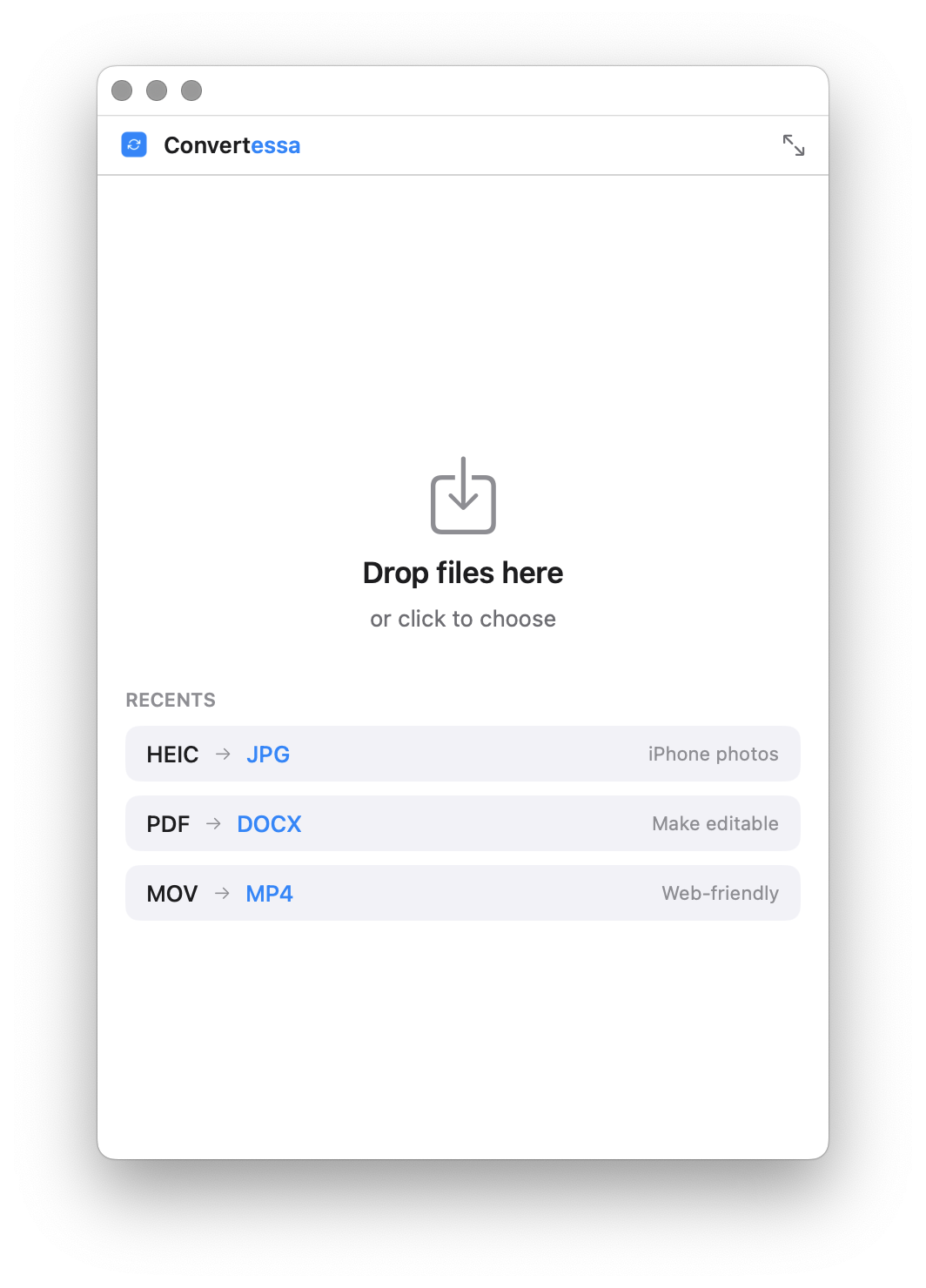
Convertessa in compact mode — a small window with a drop area and recent conversions
Pricing

One price. Yours for good.

Lifetime license
$19
One-time payment
No subscription. No renewals. Ever.
Get the app
  • 1,000+ conversion combinations
  • Lifetime future updates
  • No account required
  • Unlimited devices

macOS 14+ · Apple Silicon & Intel

Changelog

What’s shipped so far.

New formats, new features, and fixes — every release, on the record.

FAQ

Good questions.

Convertessa is a native macOS app that converts your files between formats — images, audio, video, documents, archives and eBooks — entirely on your Mac. Drop a file in, choose an output, and it’s done. No uploads, no account, no subscription.
Convertessa is an orchestrator. Under the hood it relies on best-in-class open-source engines — FFmpeg for audio & video, Pandoc for documents, libvips for images, LibreOffice for office formats, and Calibre for eBooks. It installs them for you with a click, then calls the right tool, or chain of tools, in the right order for whatever you’re converting. You get one clean native interface instead of a tangle of command-line flags. These binaries aren’t bundled with the app and are never installed without your approval — Convertessa simply calls them in a terminal session on your behalf.
Popular ones include JPEG, PNG, HEIC, WebP and AVIF; MP3, AAC, FLAC and WAV; MP4, MOV and MKV; PDF, DOCX and EPUB; ZIP, TAR and 7z — and many more. See exactly what converts to what in the conversion explorer →
Email us and we’ll add it in an upcoming release. Convertessa’s format coverage grows with what people actually need, so your request genuinely helps shape the app.
Your files? Never. Every conversion happens locally on your Mac. Your files are never uploaded, and nothing you convert is ever sent anywhere. Our Privacy Policy spells out exactly what limited data the app does store.
No analytics, no tracking, no telemetry. Your files and conversions stay entirely on your Mac — nothing you convert is ever sent anywhere. The app periodically checks for software updates in the background; like any web request, that check reveals only standard request metadata (your IP and app/OS version) to our update server — never your files, name, email, or license — and updates are always user-approved. Separately, on the website only, our purchase-confirmation page reports a completed sale to Google Ads so we can measure our own ad performance — it never runs while you’re browsing or converting, only after checkout. Our Privacy Policy spells out exactly what’s stored — and what isn’t.
Yes. Convertessa is a universal app and runs natively on Intel Macs. It requires macOS 14 or later.
Yes. It’s tuned for Apple Silicon (M-series) and runs natively — fast and energy-efficient. macOS 14 or later.
Yes — your license works on an unlimited number of your own Macs. Buy once and install it everywhere you work.
You get a genuinely useful, private, native Mac app for a single $19 payment — no subscription, ever. And your purchase directly supports a small independent developer and the app’s ongoing updates and new formats.
There’s no separate trial, but every purchase is backed by a 14-day money-back guarantee. If Convertessa isn’t right for you, contact your payment processor within 14 days to request a full refund — no questions asked. You can also email us and we’ll help route it.
Quite possibly — just email us. If you’re a student, run a non-profit, or have another good reason, reach out and we’ll sort you out.
Convertessa was built by Daler Azimov — a developer who needed a fast, private, native file converter for his own work, and decided to make the one he wished existed. Connect on LinkedIn →

No. Demosaicing and white balance are applied once, on the way out, and the TIFF records the result. The highlight headroom that was still recoverable inside the CR3, and the freedom to re-judge white balance without penalty, do not survive into a rendered image. Keep your CR3 files, because they are the negative. Think of the TIFF as a print you can hand to another program.

Because the preview was never the raw data. What the rear screen and Finder's thumbnail show is a JPEG that Canon rendered inside the camera with your Picture Style applied, contrast and saturation and sharpening baked in. Picture Style, Auto Lighting Optimizer and Digital Lens Optimizer are instructions stored in the maker notes rather than pixels, and an independent renderer does not apply them. The flatter TIFF is a more neutral starting point with more room to grade.

16 bits per channel, which is what makes this conversion worth doing. A CR3 holds roughly 14 bits per photosite, so an 8-bit output would discard most of the tonal range before you had touched the file. At 16 bits, skies and skin gradients survive further exposure and curve work without banding. Three channels at 16 bits is also the reason the resulting files are so large.

Roughly five to six times the card itself. A 45-megapixel R5 frame is about 260 MB as an uncompressed 16-bit RGB TIFF against roughly 45 MB as a CR3, so 300 frames is comfortably 70 GB. Aim the output at a volume that can take it:

convertessa ./DCIM/100EOSR5/*.CR3 --to tiff -o /Volumes/Work/Renders

There is no quality flag to reach for, since TIFF is lossless and --quality does nothing here.

No. Vignetting, chromatic aberration and distortion profiles are recorded in the CR3's maker notes for Canon's own software to act on, and an independent render leaves the frame as the lens actually drew it. Convertessa converts and does not crop, straighten or retouch anything. If those corrections matter to you, render through Canon's Digital Photo Professional, or apply a lens profile to the TIFF in your editor afterwards.

The as-shot value the camera wrote into the CR3 metadata, which is whatever you dialled in, or whatever auto white balance decided, at the moment of the exposure. It is applied during rendering rather than carried alongside the pixels, so correcting a badly judged white balance later in the TIFF is a colour adjustment on finished data, not the free, reversible change it would have been in a raw editor.

Yes. C-RAW is Canon's compact variant of the same CR3 container: the sensor data is compressed with some loss to roughly halve the file size, but the extension and the container structure are identical, so nothing about the conversion changes. The resulting TIFF is still 16-bit and full resolution. It simply started from slightly less information than a standard CR3 of the same scene would have carried.

We’d love to hear from you. Email us and you’ll get a reply from a real person — the one who made the app.