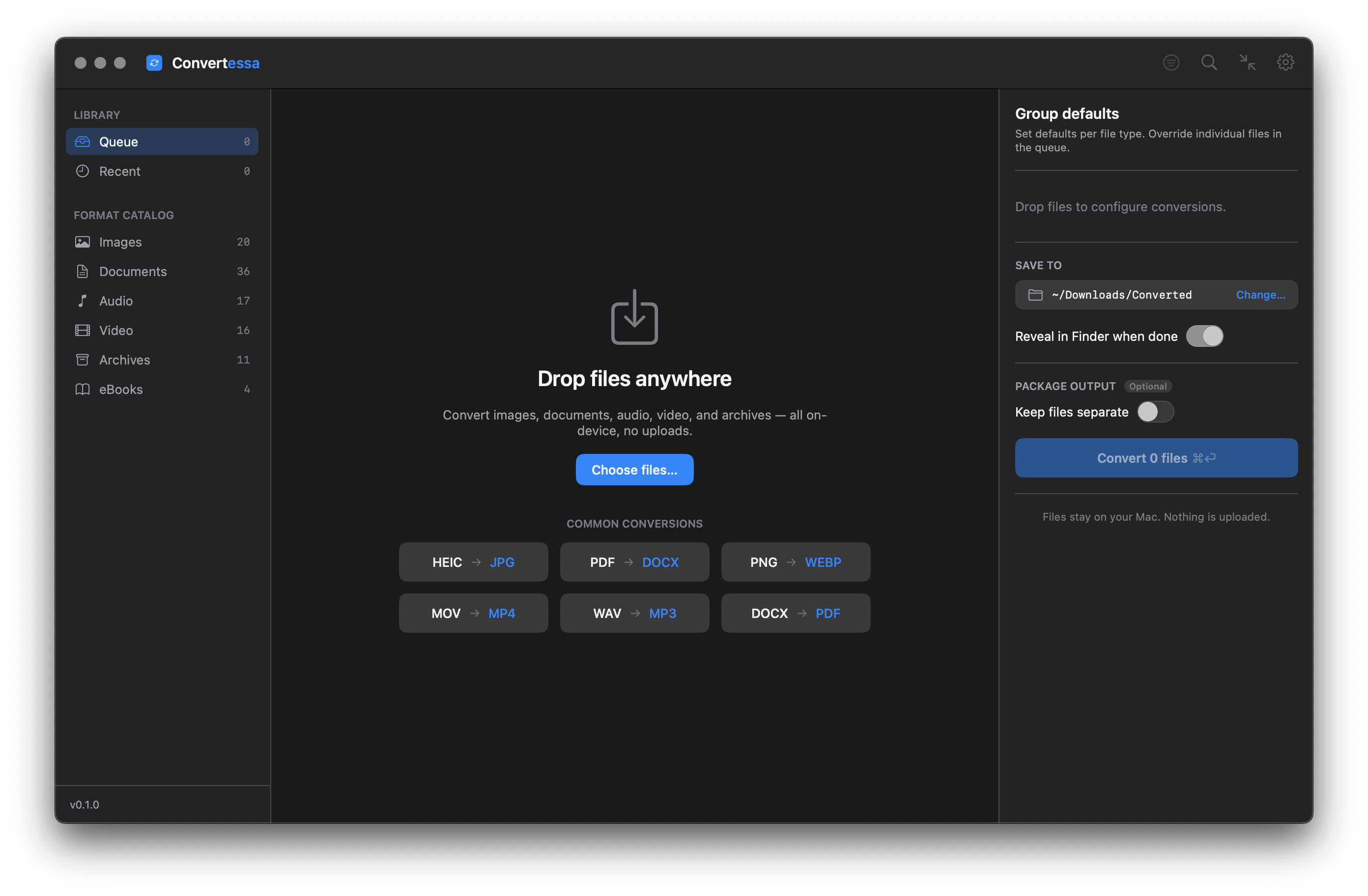
Your files stay on your Mac.
Convertessa turns Apple's HEIC photos into ordinary JPG on your Mac, with libvips doing the decoding and encoding. Full pixel dimensions are kept, the rotation property is honoured so nothing arrives sideways, EXIF travels with the file unless you strip it, and you set the JPG quality that balances size against fidelity. Drop one photo or an entire iPhone import folder and the batch runs in a single pass, offline.
Since iOS 11 in 2017, an iPhone set to High Efficiency saves photos as HEIC: a HEIF container holding an image encoded with HEVC, the same compression family used for video. That is why a 12-megapixel shot lands at roughly half the size of the equivalent JPEG. It is also why Windows machines, older Android phones, print shops and a great many web upload forms reject the file outright.
Convertessa hands HEIC files to libvips, which decodes them through libheif and writes baseline JPEG. Resolution is untouched, the container's rotation property is applied so portrait shots stay upright, and because JPG is lossy you set the quality yourself. Somewhere around 85 to 92 covers most photographic work.
Colour is the one to watch. iPhones capture in Display P3, and the ICC profile travels into the JPG, but any app that ignores embedded profiles will render those files oversaturated. If a photo has to look right everywhere, convert it to sRGB in a photo editor first. EXIF, GPS and the capture date do carry over, so strip the metadata before converting if you would rather not publish where you were standing.
Drag one photo or an entire iPhone import folder onto the window. Convertessa reads .heic and .heif alike, including files from Samsung and Pixel phones that use the same HEIF container.
Choose JPG as the output and set the quality level. Around 90 keeps re-encoding artefacts invisible on photographic content; lower values shrink the file at a visible cost in fine detail and skin texture.
Every file is decoded and re-encoded locally by libvips, then written to the folder you chose. A hundred iPhone photos finish in seconds on Apple Silicon, with nothing leaving the machine.
Images, audio, video, documents, archives, eBooks and fonts — all converted natively, right on your Mac.
Pick a format you have — see everything Convertessa can turn it into.
Convert hundreds of files at once with per-type group defaults and individual overrides.
First-class support for HEIC, AVIF and WebP — encode and decode, both ways. Read JPEG XL and a dozen more modern formats too.
Drop files anywhere on the window. Native, instant, and exactly what you’d expect on a Mac.
Dial in compression, resolution and bitrate. Keep originals pristine or shrink for sharing.
Never overwrite a file by accident. Convertessa appends safe suffixes automatically.
Every job is logged locally. Re-run a previous conversion or revisit recent outputs in a click.
Bundle your converted files straight into a single ZIP, TAR or 7z — packaged and ready to share the moment a job finishes.
Right-click any file in Finder and choose Convert. A Quick Action handles it on the spot — no need to open the app first.
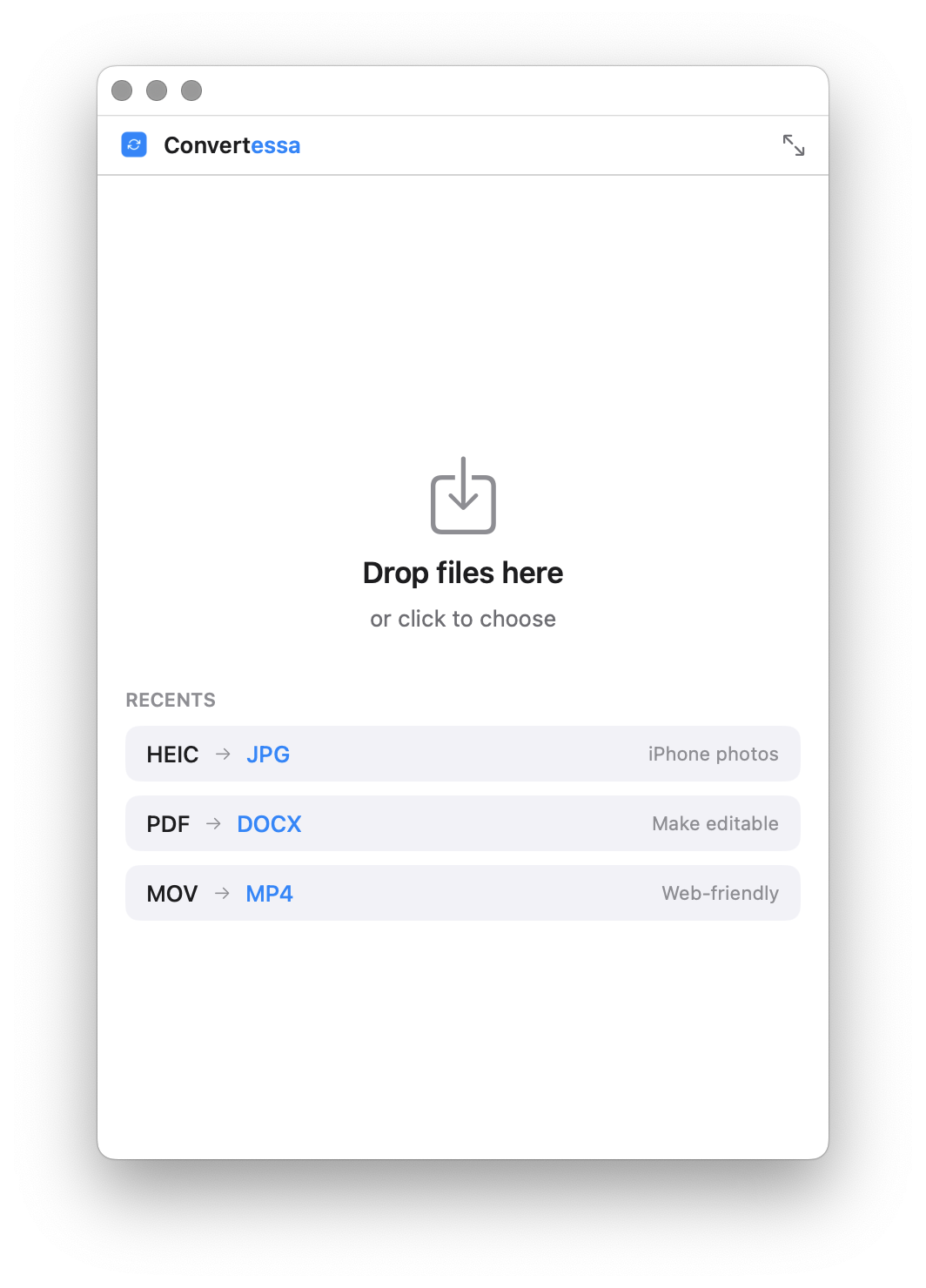
Shrink Convertessa to a tidy mini window that tucks into a corner — just a drop zone and a format picker for quick, one-off conversions.
No cloud. No account. No upload. Every conversion happens entirely on-device, using the power already in your Mac. What you convert is nobody’s business but yours.
Script conversions, wire them into your build, or batch a folder from the terminal. The same engine, no GUI required.
Read the full CLI documentation →Shrink Convertessa down to a small, focused window — drop, convert, done, with your recent conversions one click away.
macOS 14+ · Apple Silicon & Intel
New formats, new features, and fixes — every release, on the record.
Because HEVC compression is far more efficient than JPEG's 1992-era DCT. A 1.6 MB HEIC commonly becomes a 3 to 4 MB JPG at quality 90. That is the price of universal compatibility, not a fault in the conversion. Dropping to quality 80 brings the size back in line for anything destined for the web, while an archival copy is better left at 92 or above.
No. A Live Photo is two files: a HEIC still and a paired MOV holding about three seconds of video. Convert the HEIC and you get the still frame only. If you want the motion, convert the MOV as well, which Photos writes alongside the HEIC when you export Unmodified Original, or export the Live Photo as a video from Photos before converting anything.
Display P3. iPhones capture in a wide gamut and the JPG carries that ICC profile. Apps that respect profiles show the colour correctly; apps that assume everything is sRGB stretch it, which is where the radioactive reds come from. Preview, Safari and Chrome handle it, plenty of older Windows software and web upload previews do not. Converting the image to sRGB in a photo editor sidesteps the whole problem.
HEIF is the container, HEIC is the common Apple flavour of it, and libheif reads the HEVC-in-HEIF files that Samsung and Google phones produce as well. A .heics file is an image sequence such as a burst, and only its primary image becomes a JPG. From the terminal: convertessa burst.heics --to jpg --quality 90.
Yes. HEIC records rotation as a container property rather than a plain EXIF tag, which is exactly why some converters produce sideways images. libvips reads that property and writes the JPG upright, so it looks the same in Preview, Windows Photos and a browser. The frame itself is written pixel for pixel as captured, since Convertessa never crops or resizes anything.
Yes, unless you strip it. EXIF fields including DateTimeOriginal, the camera model, lens and GPS coordinates are copied into the JPG, so Photos and Lightroom file the images by when they were shot rather than when they were converted. If the files are going to a client or onto the web, turn metadata stripping on before converting so your location does not travel with them.
Rarely. JPEG at 100 still quantises, so it is not lossless, but it inflates the file dramatically for differences nobody sees at normal viewing distance. Quality 92 is the practical ceiling for photographs; beyond that you are mostly storing compression noise faithfully. If you genuinely need a lossless copy of a HEIC, convert to PNG or TIFF instead and accept a much larger file.