
Convert HEIC to PNG. Offline.

Your files stay on your Mac.
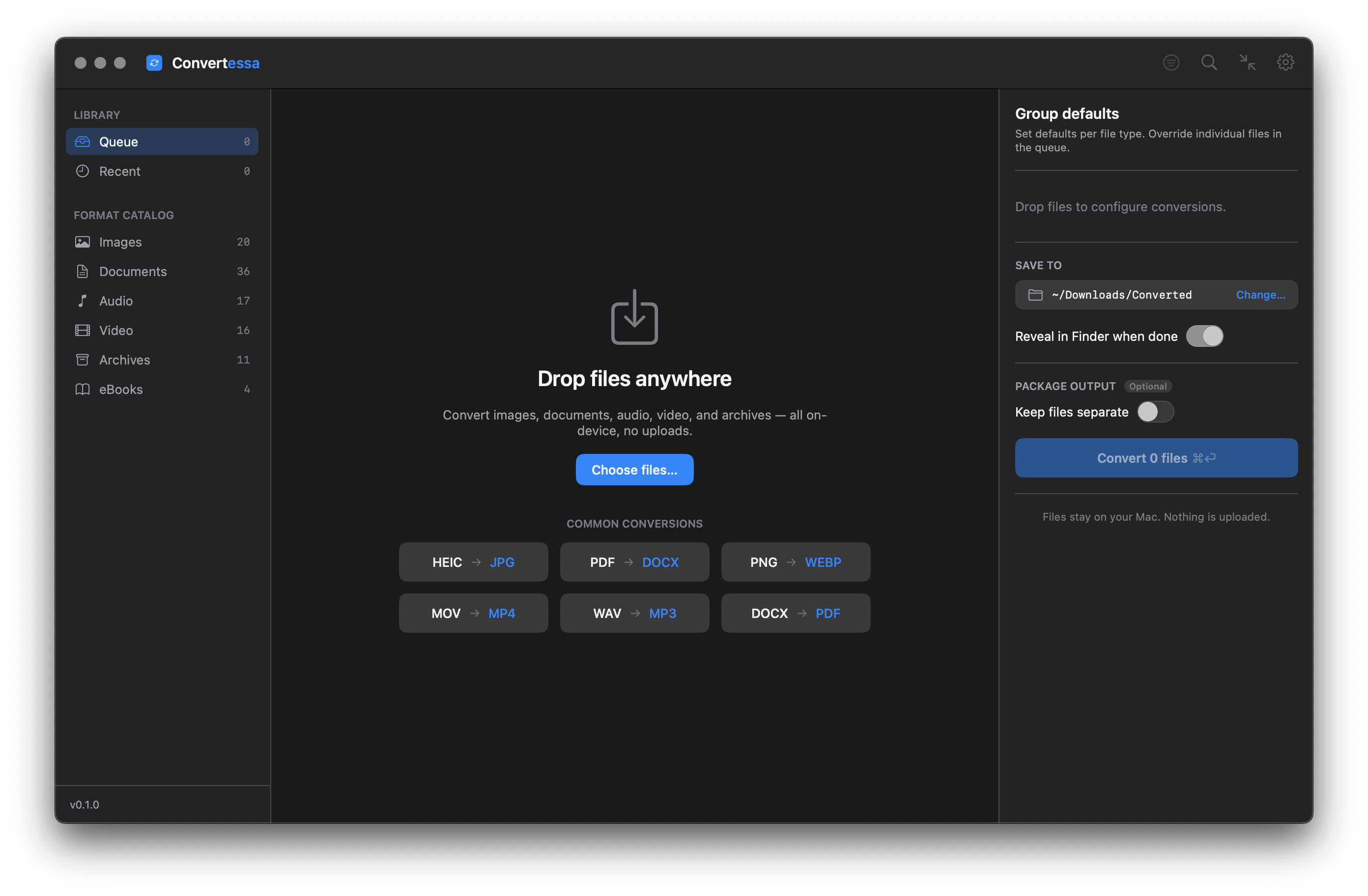
Convertessa app window showing the format catalog and drop area
What it does

HEIC photos decoded to open, lossless PNG

Convertessa hands each HEIC to libvips, decodes the HEVC-coded still inside it and writes a standard PNG beside it. PNG is lossless, so the decoded pixels go into the file exactly as they came out — nothing is recompressed and no quality setting applies. Drop one photo or a folder of a thousand and the queue works through them on your Mac, with no upload and no account.

HEIC in practice

What a HEIC holds that PNG cannot

Since iOS 11, an iPhone left on the High Efficiency camera setting saves stills as HEIC: a HEIF container wrapping HEVC-coded image data. The container half matters more than people expect, because one .heic file is really a small bundle of items, and PNG is a single-image format.

What comes across intact

The primary image at its full pixel dimensions, and its alpha channel if it has one. PNG is lossless, so the decoded pixels are written verbatim — there is no re-encode and no quality setting, because none would mean anything. iPhone photos are usually tagged Display P3, and the ICC profile is written into the PNG so colour-managed apps render it correctly.

What is left behind

  • The HDR gain map. Recent iPhones store an auxiliary image that tells a capable display how far to push the highlights. PNG has nowhere to keep it, so you get the standard-dynamic-range base rendition.
  • Depth and matte images. Portrait-mode files carry a depth map and a segmentation matte as extra items in the same container. Only the primary picture converts.
  • Anything beyond the first image in a burst or multi-picture file. One HEIC in, one PNG out.
  • The moving half of a Live Photo, which was never inside the HEIC — it lives in a paired .mov.

Two practical notes. Orientation first: HEIC records rotation as a metadata flag and PNG has no equivalent, so the rotation is applied to the pixels as the file is written. The picture stands up correctly in every viewer, including the ones that never read metadata. Then size: expect a PNG roughly five to ten times larger than the HEIC it came from. Lossless is expensive, and that is the whole bargain. If you simply need something a browser or a Windows machine can open and the megabytes matter, JPEG or WebP serve better. PNG is the right target when you want exact pixels — screenshots, flat-colour graphics, images with transparency, or anything about to be edited again.

How it works

Three steps. No upload required.

1

Drop the HEIC files

Drag one photo, a Photos export or a whole folder onto the queue. Convertessa picks up every .heic file, including the ones your iPhone named IMG_0001 through IMG_0999, in a single pass.

2

Pick PNG as output

Select PNG in the output list. No quality setting appears, because there is nothing to trade away — the encoder is lossless and every pixel of the decoded HEIC lands in the file.

3

Convert and check colour

Hit Convert. PNGs are written to the folder you chose with the Display P3 profile intact and EXIF removed, so no GPS coordinates or camera serial ride along into a file you share.

Format catalog

From everyday files to pro media.

Images, audio, video, documents, archives, eBooks and fonts — all converted natively, right on your Mac.

Conversion explorer

What do you want to convert?

Pick a format you have — see everything Convertessa can turn it into.

conversion combinations
I have a
can be converted to
From MP4

Features

Built for real work.

Batch conversion

Convert hundreds of files at once with per-type group defaults and individual overrides.

Modern image formats

First-class support for HEIC, AVIF and WebP — encode and decode, both ways. Read JPEG XL and a dozen more modern formats too.

Drag & drop

Drop files anywhere on the window. Native, instant, and exactly what you’d expect on a Mac.

Quality control

Dial in compression, resolution and bitrate. Keep originals pristine or shrink for sharing.

Collision-safe naming

Never overwrite a file by accident. Convertessa appends safe suffixes automatically.

Conversion history

Every job is logged locally. Re-run a previous conversion or revisit recent outputs in a click.

Archive the output

Bundle your converted files straight into a single ZIP, TAR or 7z — packaged and ready to share the moment a job finishes.

Convert from Finder

Right-click any file in Finder and choose Convert. A Quick Action handles it on the spot — no need to open the app first.

Compact mode

Shrink Convertessa to a tidy mini window that tucks into a corner — just a drop zone and a format picker for quick, one-off conversions.

Your files never leave your Mac.

No cloud. No account. No upload. Every conversion happens entirely on-device, using the power already in your Mac. What you convert is nobody’s business but yours.

On-device processing Zero telemetry No file uploads
For power users

There’s a command line, too.

Script conversions, wire them into your build, or batch a folder from the terminal. The same engine, no GUI required.

Read the full CLI documentation
zsh — convertessa
# Convert a single file
$ convertessa input.heic --to png
photo.png · 1.2 MB · 0.4s
 
# Batch a whole folder
$ convertessa ./*.heic --to png -o ~/Exports
14 files converted · 4.1s
Made to fit

And a compact mode.

Shrink Convertessa down to a small, focused window — drop, convert, done, with your recent conversions one click away.
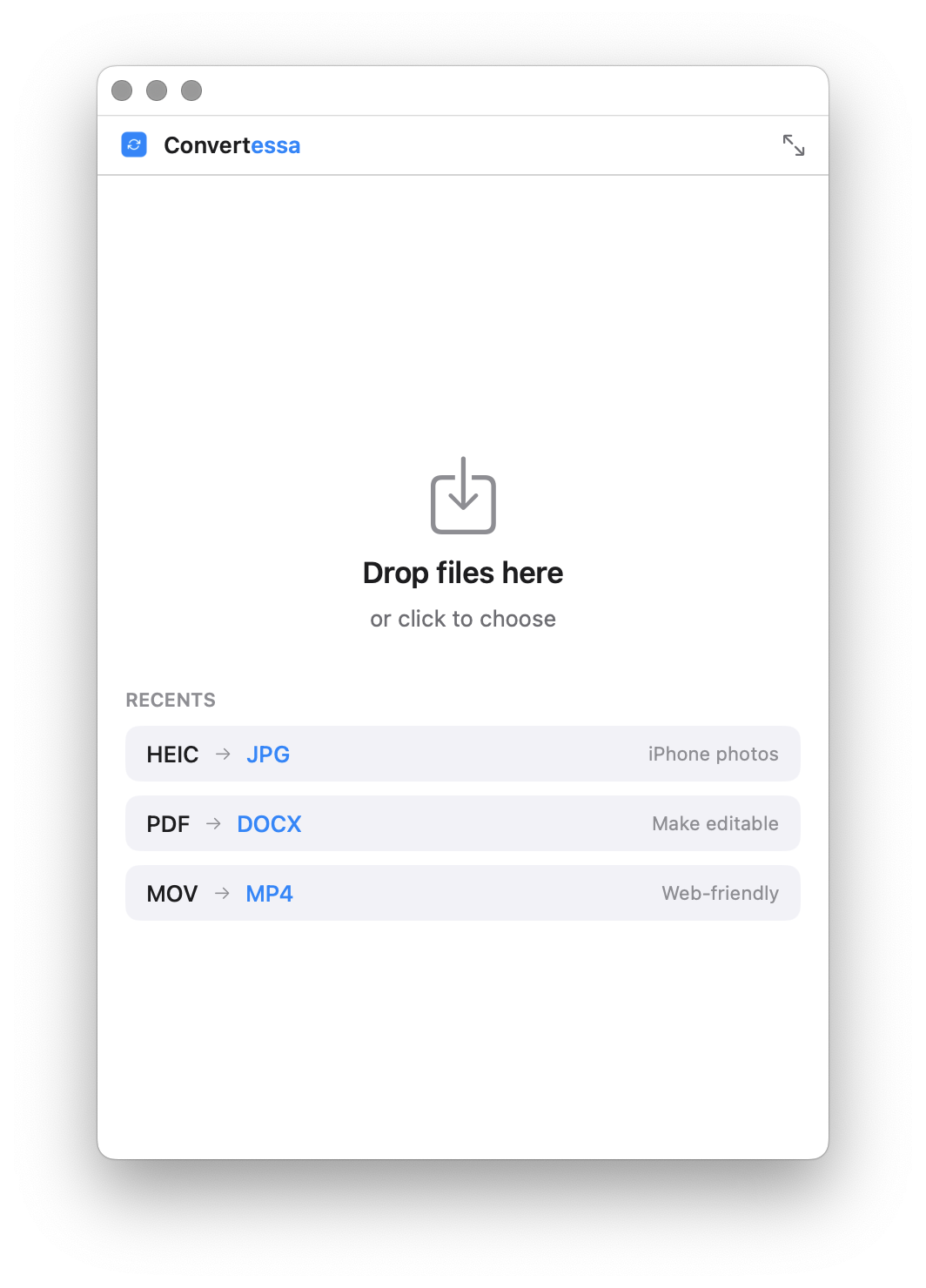
Convertessa in compact mode — a small window with a drop area and recent conversions
Pricing

One price. Yours for good.

Lifetime license
$19
One-time payment
No subscription. No renewals. Ever.
Get the app
  • 1,000+ conversion combinations
  • Lifetime future updates
  • No account required
  • Unlimited devices

macOS 14+ · Apple Silicon & Intel

Changelog

What’s shipped so far.

New formats, new features, and fixes — every release, on the record.

FAQ

Good questions.

Convertessa is a native macOS app that converts your files between formats — images, audio, video, documents, archives and eBooks — entirely on your Mac. Drop a file in, choose an output, and it’s done. No uploads, no account, no subscription.
Convertessa is an orchestrator. Under the hood it relies on best-in-class open-source engines — FFmpeg for audio & video, Pandoc for documents, libvips for images, LibreOffice for office formats, and Calibre for eBooks. It installs them for you with a click, then calls the right tool, or chain of tools, in the right order for whatever you’re converting. You get one clean native interface instead of a tangle of command-line flags. These binaries aren’t bundled with the app and are never installed without your approval — Convertessa simply calls them in a terminal session on your behalf.
Popular ones include JPEG, PNG, HEIC, WebP and AVIF; MP3, AAC, FLAC and WAV; MP4, MOV and MKV; PDF, DOCX and EPUB; ZIP, TAR and 7z — and many more. See exactly what converts to what in the conversion explorer →
Email us and we’ll add it in an upcoming release. Convertessa’s format coverage grows with what people actually need, so your request genuinely helps shape the app.
Your files? Never. Every conversion happens locally on your Mac. Your files are never uploaded, and nothing you convert is ever sent anywhere. Our Privacy Policy spells out exactly what limited data the app does store.
No analytics, no tracking, no telemetry. Your files and conversions stay entirely on your Mac — nothing you convert is ever sent anywhere. The app periodically checks for software updates in the background; like any web request, that check reveals only standard request metadata (your IP and app/OS version) to our update server — never your files, name, email, or license — and updates are always user-approved. Separately, on the website only, our purchase-confirmation page reports a completed sale to Google Ads so we can measure our own ad performance — it never runs while you’re browsing or converting, only after checkout. Our Privacy Policy spells out exactly what’s stored — and what isn’t.
Yes. Convertessa is a universal app and runs natively on Intel Macs. It requires macOS 14 or later.
Yes. It’s tuned for Apple Silicon (M-series) and runs natively — fast and energy-efficient. macOS 14 or later.
Yes — your license works on an unlimited number of your own Macs. Buy once and install it everywhere you work.
You get a genuinely useful, private, native Mac app for a single $19 payment — no subscription, ever. And your purchase directly supports a small independent developer and the app’s ongoing updates and new formats.
There’s no separate trial, but every purchase is backed by a 14-day money-back guarantee. If Convertessa isn’t right for you, contact your payment processor within 14 days to request a full refund — no questions asked. You can also email us and we’ll help route it.
Quite possibly — just email us. If you’re a student, run a non-profit, or have another good reason, reach out and we’ll sort you out.
Convertessa was built by Daler Azimov — a developer who needed a fast, private, native file converter for his own work, and decided to make the one he wished existed. Connect on LinkedIn →

Because you are trading compression for exactness. HEIC stores the picture with HEVC, a modern lossy codec that discards detail your eye is unlikely to miss; PNG keeps every pixel and only squeezes the result with a lossless algorithm. A 2 MB iPhone photo commonly lands somewhere between 8 MB and 20 MB as a PNG. That is expected rather than a fault — if size matters more than pixel-for-pixel exactness, JPEG or WebP is the better target.

No. Recent iPhones store an HDR gain map alongside the main image — an auxiliary picture that tells a capable display how far to lift the highlights. PNG has no place to store it, so the PNG is the standard-dynamic-range base image. Side by side on an HDR screen the original will look brighter and punchier. The base rendition is complete and correct in itself; it simply will not glow.

iPhone photos are usually tagged Display P3, a wider colour space than sRGB. That ICC profile is written into the PNG, so colour-managed software — Preview, Safari, Photoshop, Affinity — renders it accurately. Software that ignores embedded profiles treats P3 numbers as though they were sRGB, and reds and greens come out too vivid. The file is right; the viewer is not. For a profile-blind pipeline, convert to sRGB in an editor before handing the image over.

It is dropped. A Portrait shot keeps auxiliary items inside the HEIC — a depth map and a person segmentation matte — which is how Photos can re-render the background blur months later. PNG holds one image, so only the primary picture converts, carrying whatever blur was already baked into it. If you might still want to adjust the effect, keep the HEIC as your master and treat the PNG as a delivery copy.

Yes, and be specific about how. File → Export → Export Unmodified Original gives you the real HEIC files; the plain Export command hands you JPEGs, which makes the whole exercise pointless. Once they are on disk, point the app or the CLI at the folder:

convertessa ~/Desktop/Originals/*.heic --to png -o ~/Pictures/PNG

Yes. HEIF can carry an alpha channel — stickers, images exported from design tools and some app-generated captures have one — and PNG is among the few widely supported formats that stores transparency losslessly. The alpha channel is written through with the colour channels: nothing is composited underneath, no white rectangle appears. When a HEIC has transparency at all, PNG is usually the reason you are converting in the first place.

Yes. HEIC records orientation as a metadata flag and expects the viewer to honour it; PNG has no such flag, so the rotation has to be applied to the pixels themselves as the file is written. The result stands upright everywhere, including in software that never reads metadata. One side effect worth knowing: the PNG's stored width and height are swapped relative to the HEIC for any photo taken in portrait orientation.

We’d love to hear from you. Email us and you’ll get a reply from a real person — the one who made the app.