
Convert Mamiya RAW to JPG. Offline.

Your files stay on your Mac.
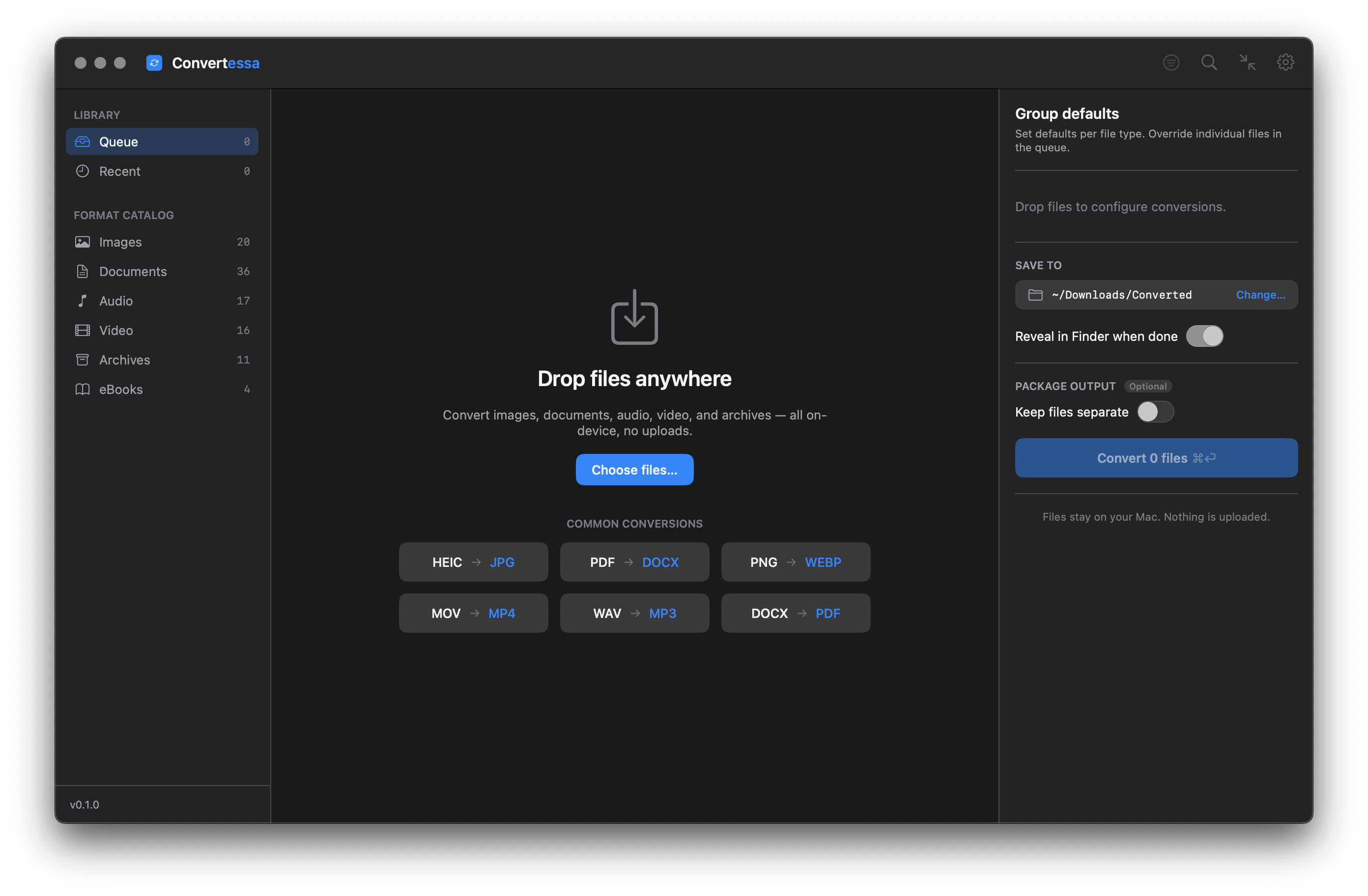
Convertessa app window showing the format catalog and drop area
What it does

What MEF to JPG conversion does

Convertessa opens Mamiya MEF files directly and writes ordinary JPGs — no Mamiya software, no import step, no tethering app. LibRaw demosaics the sensor data, libvips encodes the JPG, and you set the quality before the run. Full capture resolution comes through unchanged, a whole card's worth converts in one pass, and the originals are left untouched next to the exports.

Mamiya RAW in practice

What survives the trip from MEF to JPG

A .mef file is what a Mamiya digital back writes to card: the ZD camera and ZD Back from 2004, and the medium-format backs that followed on 645AFD and 645DF bodies. Under the extension it is a TIFF-EP style container holding one frame of undemosaiced sensor data at 16 bits per channel, plus a small baked JPEG preview that most file browsers show you instead of the real image.

Medium format means 16-bit linear data

That linear payload is the whole reason MEF files are worth keeping, and it is exactly the thing JPG cannot hold. JPG is 8 bits per channel with a fixed gamma curve, so the moment the file is written, the recoverable highlight headroom and the shadow latitude of the original capture stop existing in the output. Convert for delivery; keep the .mef as the master.

Decoding is done by LibRaw, which libvips links against, and libvips writes the JPG. What that pipeline produces is a neutral rendering: white balance as recorded, a standard tone curve, sRGB output. It is not the interpretation Leaf Capture or Mamiya Digital PhotoStudio gave you, and no sidecar those programs wrote is read. If your look lived in a tethering session, it was never in the .mef and it will not be in the .jpg.

Before you batch a whole shoot

  • Resolution comes through untouched — a 21.5-megapixel ZD frame lands as a 5328 x 4000 JPG.
  • Files shrink hard: 30–50 MB per frame becomes single-digit megabytes at a high quality value.
  • EXIF, including anything the back recorded about the shot, rides into the JPG unless you pass --strip-metadata.
  • Mamiya's later medium-format work merged into Phase One, and those backs write .iiq, a separate format with its own decoder. Renaming the extension will not turn one into the other.
How it works

Three steps. No upload required.

1

Add the MEF files

Drag a single frame or the whole card folder onto the window. Convertessa reads the Mamiya back's native RAW payload — there is no catalogue to import into and no sidecar file required.

2

Pick JPG and quality

Choose JPG as the target and set the quality. Max keeps the detail medium format is bought for; a lower value is plenty for contact sheets and client proofs going out over email.

3

Run the batch

Convert. Each MEF is decoded, mapped down to 8 bits and written as a JPG at full capture resolution. A 60-frame ZD shoot finishes in one pass without opening a single dialog.

Format catalog

From everyday files to pro media.

Images, audio, video, documents, archives, eBooks and fonts — all converted natively, right on your Mac.

Conversion explorer

What do you want to convert?

Pick a format you have — see everything Convertessa can turn it into.

conversion combinations
I have a
can be converted to
From MP4

Features

Built for real work.

Batch conversion

Convert hundreds of files at once with per-type group defaults and individual overrides.

Modern image formats

First-class support for HEIC, AVIF and WebP — encode and decode, both ways. Read JPEG XL and a dozen more modern formats too.

Drag & drop

Drop files anywhere on the window. Native, instant, and exactly what you’d expect on a Mac.

Quality control

Dial in compression, resolution and bitrate. Keep originals pristine or shrink for sharing.

Collision-safe naming

Never overwrite a file by accident. Convertessa appends safe suffixes automatically.

Conversion history

Every job is logged locally. Re-run a previous conversion or revisit recent outputs in a click.

Archive the output

Bundle your converted files straight into a single ZIP, TAR or 7z — packaged and ready to share the moment a job finishes.

Convert from Finder

Right-click any file in Finder and choose Convert. A Quick Action handles it on the spot — no need to open the app first.

Compact mode

Shrink Convertessa to a tidy mini window that tucks into a corner — just a drop zone and a format picker for quick, one-off conversions.

Your files never leave your Mac.

No cloud. No account. No upload. Every conversion happens entirely on-device, using the power already in your Mac. What you convert is nobody’s business but yours.

On-device processing Zero telemetry No file uploads
For power users

There’s a command line, too.

Script conversions, wire them into your build, or batch a folder from the terminal. The same engine, no GUI required.

Read the full CLI documentation
zsh — convertessa
# Convert a single file
$ convertessa input.mef --to jpg
photo.jpg · 1.2 MB · 0.4s
 
# Batch a whole folder
$ convertessa ./*.mef --to jpg -o ~/Exports
14 files converted · 4.1s
Made to fit

And a compact mode.

Shrink Convertessa down to a small, focused window — drop, convert, done, with your recent conversions one click away.
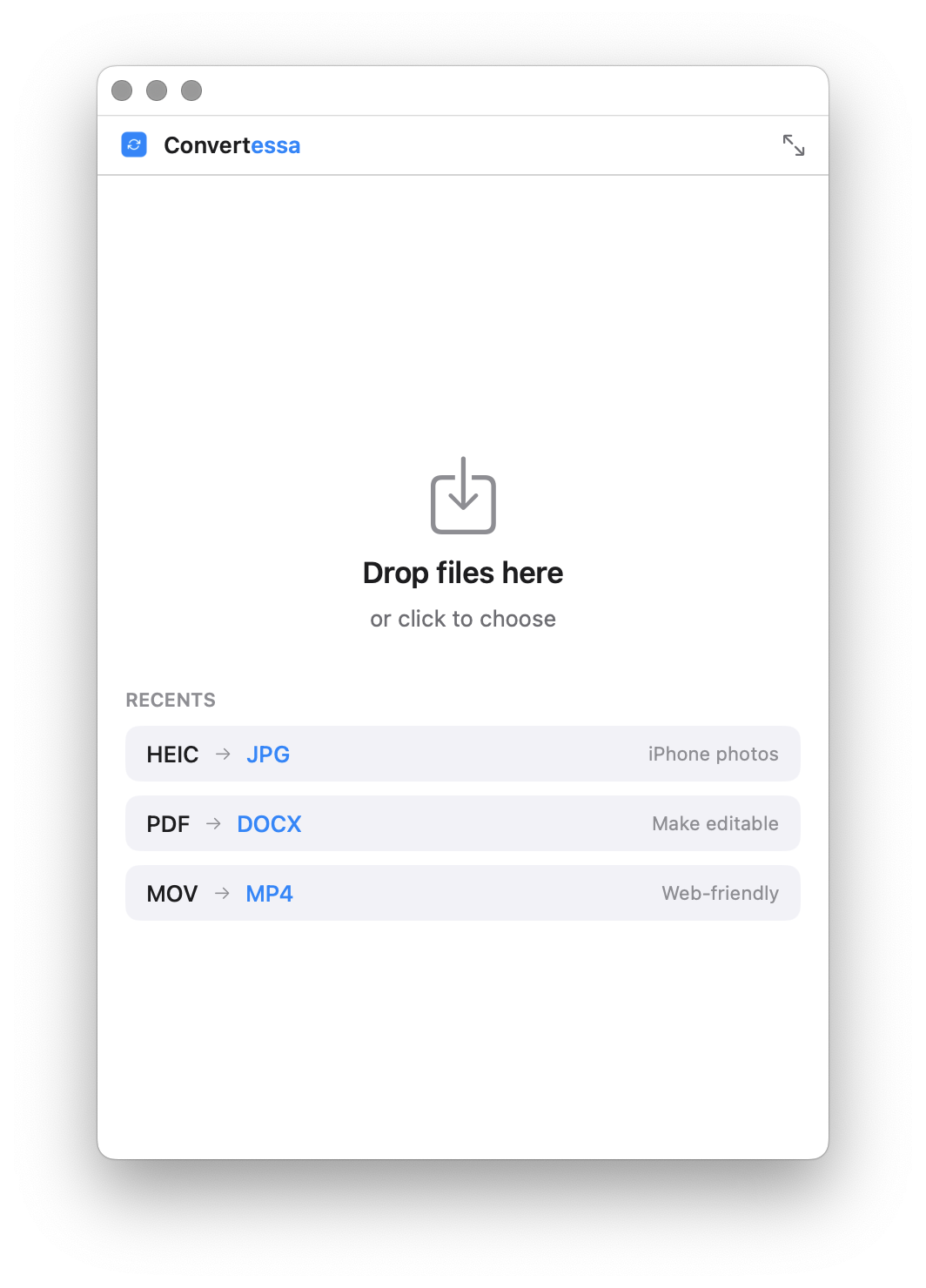
Convertessa in compact mode — a small window with a drop area and recent conversions
Pricing

One price. Yours for good.

Lifetime license
$19
One-time payment
No subscription. No renewals. Ever.
Get the app
  • 1,000+ conversion combinations
  • Lifetime future updates
  • No account required
  • Unlimited devices

macOS 14+ · Apple Silicon & Intel

Changelog

What’s shipped so far.

New formats, new features, and fixes — every release, on the record.

FAQ

Good questions.

Convertessa is a native macOS app that converts your files between formats — images, audio, video, documents, archives and eBooks — entirely on your Mac. Drop a file in, choose an output, and it’s done. No uploads, no account, no subscription.
Convertessa is an orchestrator. Under the hood it relies on best-in-class open-source engines — FFmpeg for audio & video, Pandoc for documents, libvips for images, LibreOffice for office formats, and Calibre for eBooks. It installs them for you with a click, then calls the right tool, or chain of tools, in the right order for whatever you’re converting. You get one clean native interface instead of a tangle of command-line flags. These binaries aren’t bundled with the app and are never installed without your approval — Convertessa simply calls them in a terminal session on your behalf.
Popular ones include JPEG, PNG, HEIC, WebP and AVIF; MP3, AAC, FLAC and WAV; MP4, MOV and MKV; PDF, DOCX and EPUB; ZIP, TAR and 7z — and many more. See exactly what converts to what in the conversion explorer →
Email us and we’ll add it in an upcoming release. Convertessa’s format coverage grows with what people actually need, so your request genuinely helps shape the app.
Your files? Never. Every conversion happens locally on your Mac. Your files are never uploaded, and nothing you convert is ever sent anywhere. Our Privacy Policy spells out exactly what limited data the app does store.
No analytics, no tracking, no telemetry. Your files and conversions stay entirely on your Mac — nothing you convert is ever sent anywhere. The app periodically checks for software updates in the background; like any web request, that check reveals only standard request metadata (your IP and app/OS version) to our update server — never your files, name, email, or license — and updates are always user-approved. Separately, on the website only, our purchase-confirmation page reports a completed sale to Google Ads so we can measure our own ad performance — it never runs while you’re browsing or converting, only after checkout. Our Privacy Policy spells out exactly what’s stored — and what isn’t.
Yes. Convertessa is a universal app and runs natively on Intel Macs. It requires macOS 14 or later.
Yes. It’s tuned for Apple Silicon (M-series) and runs natively — fast and energy-efficient. macOS 14 or later.
Yes — your license works on an unlimited number of your own Macs. Buy once and install it everywhere you work.
You get a genuinely useful, private, native Mac app for a single $19 payment — no subscription, ever. And your purchase directly supports a small independent developer and the app’s ongoing updates and new formats.
There’s no separate trial, but every purchase is backed by a 14-day money-back guarantee. If Convertessa isn’t right for you, contact your payment processor within 14 days to request a full refund — no questions asked. You can also email us and we’ll help route it.
Quite possibly — just email us. If you’re a student, run a non-profit, or have another good reason, reach out and we’ll sort you out.
Convertessa was built by Daler Azimov — a developer who needed a fast, private, native file converter for his own work, and decided to make the one he wished existed. Connect on LinkedIn →

Because the screen showed a rendering, not the file. A .mef stores unprocessed sensor values; the image on the back — and the thumbnail in the Finder — is a small JPEG the camera baked using its own settings. Convertessa's output comes from a full LibRaw decode with a neutral tone curve, so it can look flatter or cooler than you remember. That neutrality is deliberate: it leaves the frame somewhere an editor can take it, rather than locking in one camera's interpretation.

They come from the same lineage — Mamiya's medium-format business merged into Phase One — but IIQ is a different format with a different decoder path, so use the matching conversion rather than renaming the file. Renaming an .iiq to .mef does not make it one; the decode fails instead of quietly producing a wrong image. The same applies in reverse to Leaf-branded backs from that period.

Yes. The pixel count that came off the back is the pixel count in the JPG. Convertessa does not crop, resize or resample — it converts. If you need a smaller file for email, lower the quality value rather than expecting the app to shrink the frame. JPG's own ceiling of 65,535 pixels per side sits far above anything a medium-format back has ever produced, so there is no risk of hitting it.

Not in a JPG. The format is defined at 8 bits per channel, so the 16-bit linear values in the .mef are mapped down to 256 levels per channel on write, and that step is one-way. If the goal is to escape a format nothing opens while keeping tonal depth, convert to TIFF instead and hold on to the .mef as the archival master. JPG is for the copies you hand out.

EXIF from the back — shutter, aperture, lens, capture date and anything else the system recorded — is written into the JPG. If the files are going to a client or a public gallery and you would rather not ship that, add the flag: convertessa shoot.mef --to jpg --strip-metadata. It affects the output only; the .mef keeps everything it always had.

Point the CLI at the folder and give it a destination:

convertessa ~/Cards/ZD_0012/*.mef --to jpg --quality high -o ~/Proofs

Every .mef in that folder is decoded and written into ~/Proofs, which is created if it does not exist. --quality takes a number from 0 to 100 or one of the presets web, balanced, high and max. Leave the flag off and you get max.

That file fails and the rest of the run continues — one bad frame off a dying card does not stop the batch. To find out why, re-run that file alone with --debug, which prints the resolved path, the engine route and the full decoder error instead of a one-line failure. The CLI also refuses to overwrite an existing JPG unless you pass --force, so re-running a half-finished batch is safe.

We’d love to hear from you. Email us and you’ll get a reply from a real person — the one who made the app.