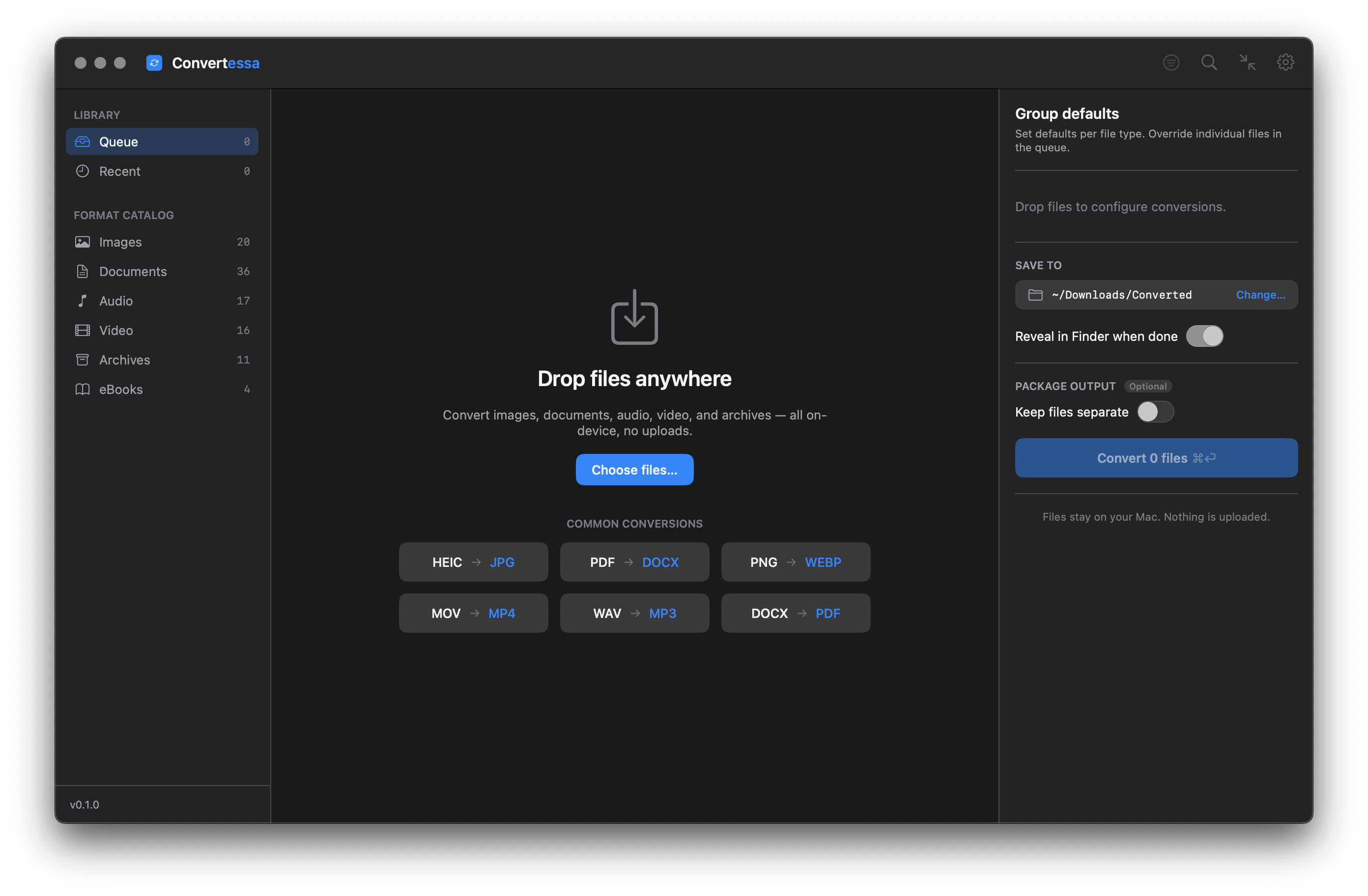
Your files stay on your Mac.
MP4 and QuickTime MOV descend from the same file format, so the job here is mostly repackaging rather than re-encoding. FFmpeg rewrites the container, carries the H.264 or HEVC video and its audio across, and keeps the rotation and colour tags that tell a player how to display the result. Drop a single clip or a whole shoot folder; everything runs locally on your Mac.
QuickTime came first. When MPEG needed a file format for MPEG-4 it started from Apple's QuickTime File Format, submitted for exactly that purpose in 1998, which is why an .mp4 and a .mov are built from the same nested boxes — ftyp, moov, mdat — and why the video sitting inside them is the same sort of data. FFmpeg does the work here, and most of that work is rewriting the wrapper rather than touching the pictures.
People end up needing MOV for unglamorous reasons: an import dialog that lists QuickTime movies and nothing else, a delivery spec written a decade ago, an older plugin that refuses the file on sight, a colleague's Motion project. The pixels are rarely the problem. The packaging is.
What travels across. Frame size and frame rate; the display matrix that records your iPhone clip as vertical; colour primaries and transfer characteristics, so HDR10 material stays tagged as HDR10; the audio track; and timed text where MOV has an equivalent. Soft subtitles in an MP4 are usually tx3g, a QuickTime construct to begin with, so those carry. WebVTT tracks, which MP4 also allows, have no home in MOV and drop out.
What to check afterwards. Chapter markers and iTunes-style tags live under udta in both containers, but the mapping between them is imperfect — verify anything you depend on. Variable frame rate footage from a phone or a screen recorder stays variable; an NLE will conform it in its own way, and that conforming, not the conversion, is what makes audio appear to drift.
Two honest warnings. Renaming .mp4 to .mov in Finder works often enough that people assume it always does, but strict readers check the ftyp brand and reject the file, which is precisely when you need a real rewrite. And MOV is a poor choice for the web: if the destination is a browser, stay on MP4.
Drag one clip or a card's worth of footage onto Convertessa. The queue takes the whole folder in a single pass, which matters when a shoot is two hundred files deep.
Select QuickTime MOV as the output. Because MOV is a lossy video target, a quality control sits alongside it; leave it high for anything heading into an edit and a second compression pass.
Click Convert. FFmpeg writes a genuine QuickTime file — header, track metadata and all — so importers that reject a renamed MP4 accept this one without complaint. Files land in the folder you picked.
Images, audio, video, documents, archives, eBooks and fonts — all converted natively, right on your Mac.
Pick a format you have — see everything Convertessa can turn it into.
Convert hundreds of files at once with per-type group defaults and individual overrides.
First-class support for HEIC, AVIF and WebP — encode and decode, both ways. Read JPEG XL and a dozen more modern formats too.
Drop files anywhere on the window. Native, instant, and exactly what you’d expect on a Mac.
Dial in compression, resolution and bitrate. Keep originals pristine or shrink for sharing.
Never overwrite a file by accident. Convertessa appends safe suffixes automatically.
Every job is logged locally. Re-run a previous conversion or revisit recent outputs in a click.
Bundle your converted files straight into a single ZIP, TAR or 7z — packaged and ready to share the moment a job finishes.
Right-click any file in Finder and choose Convert. A Quick Action handles it on the spot — no need to open the app first.
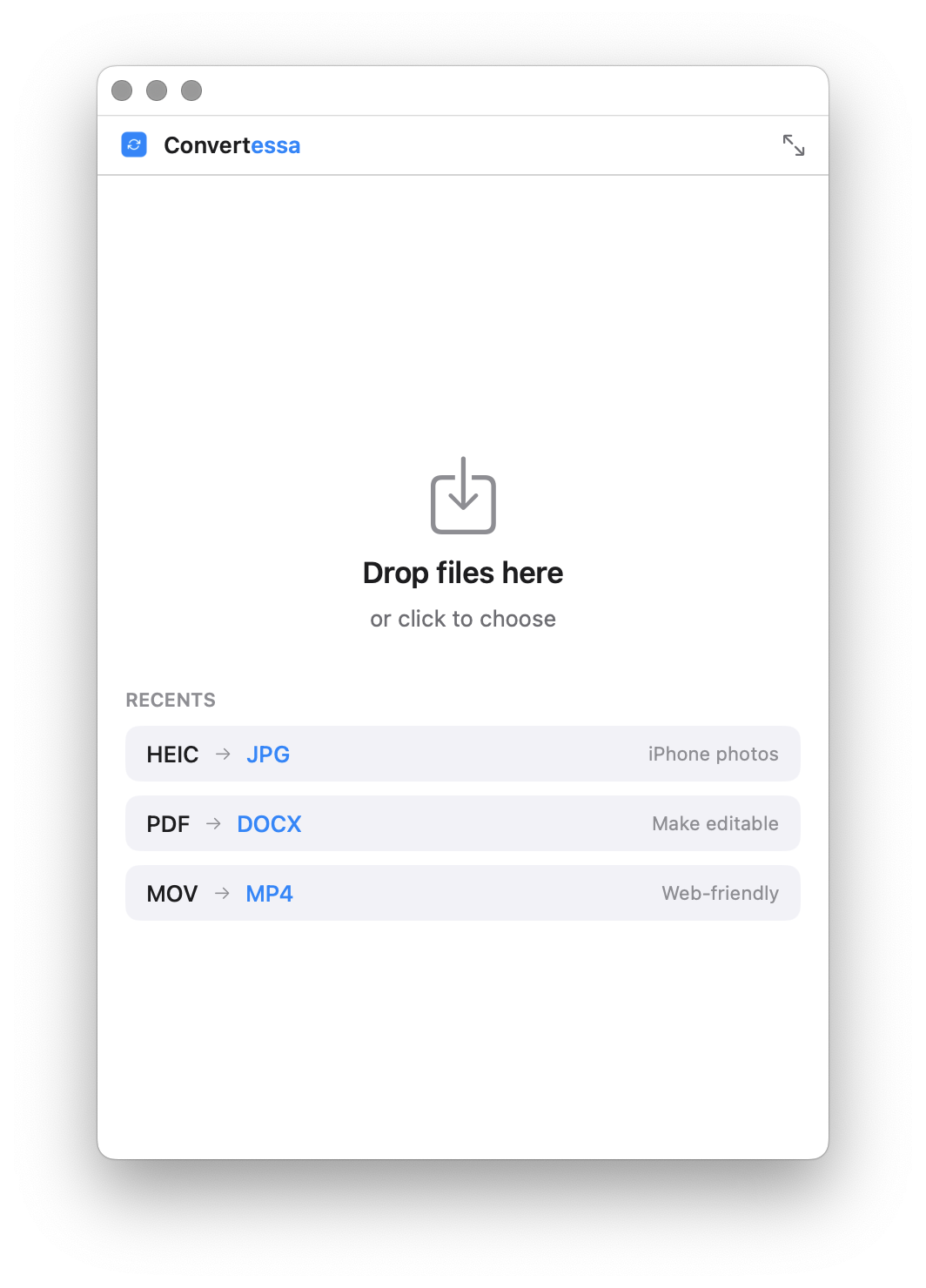
Shrink Convertessa to a tidy mini window that tucks into a corner — just a drop zone and a format picker for quick, one-off conversions.
No cloud. No account. No upload. Every conversion happens entirely on-device, using the power already in your Mac. What you convert is nobody’s business but yours.
Script conversions, wire them into your build, or batch a folder from the terminal. The same engine, no GUI required.
Read the full CLI documentation →Shrink Convertessa down to a small, focused window — drop, convert, done, with your recent conversions one click away.
macOS 14+ · Apple Silicon & Intel
New formats, new features, and fixes — every release, on the record.
Sometimes that works, which is why the advice keeps circulating. Both containers use the same box structure, so a permissive player reads a renamed file happily. Strict readers do not: the ftyp box at the front still declares an MP4 brand, and QuickTime-based importers can refuse the file outright or misreport its tracks. A real conversion rewrites that header and the track metadata so the file genuinely is a QuickTime movie.
The picture data in an MP4 is normally H.264 or HEVC, and MOV holds both natively, so this is far closer to repackaging than to a fresh encode. MOV is still a lossy video target, so a quality control is offered for the cases where a re-encode is involved. Keep it high when the clip is going into an edit, since the export from that edit will compress everything a second time.
No. MOV has a reputation for carrying transparency because ProRes 4444 and QuickTime Animation support it, but the alpha has to exist in the source. An MP4 carries H.264 or HEVC, and neither stores an alpha channel in any form a normal player reads. Changing the container cannot invent transparency that was never recorded. For a genuinely transparent movie, re-export from whatever produced the animation in a codec that has an alpha channel.
It depends which kind they are. Soft subtitles in an MP4 are usually tx3g timed text, which QuickTime understands, so they carry over. WebVTT tracks have no clean equivalent in MOV and are dropped. Subtitles burned into the picture are just pixels and are unaffected either way. If subtitles are part of your delivery, open the finished MOV and confirm the track is listed before you send it on.
Vertical iPhone video is recorded landscape with a rotation stored in the track's display matrix, and that matrix is copied across. Players that honour it show the clip upright; a few older editors ignore it and show a sideways picture with the rotation still pending. That is a reading difference, not damage. In an NLE, set the clip's rotation on the timeline instead of converting the file a second time.
Barely. You are changing the wrapper, not the compression, so expect the MOV to land within a percent or two of the MP4 — header differences either way. A result that is dramatically larger means an intermediate codec was involved, which is a different operation entirely. For a full shoot, the CLI is quicker than dragging:
convertessa ./Footage/*.mp4 --to mov -o ~/Movies/Edit
No. Browsers overwhelmingly expect MP4, and MOV support in HTML video is inconsistent outside Safari. MOV earns its place on the desktop: editing, archiving into an Apple-centric pipeline, feeding an application that only opens QuickTime movies. If the destination is a web page, a CDN or a social platform, stay with the MP4 you already have — converting it out and back gains you nothing and risks a generation of quality.