Convert PDF to Plain Text. Offline.

Your files stay on your Mac.
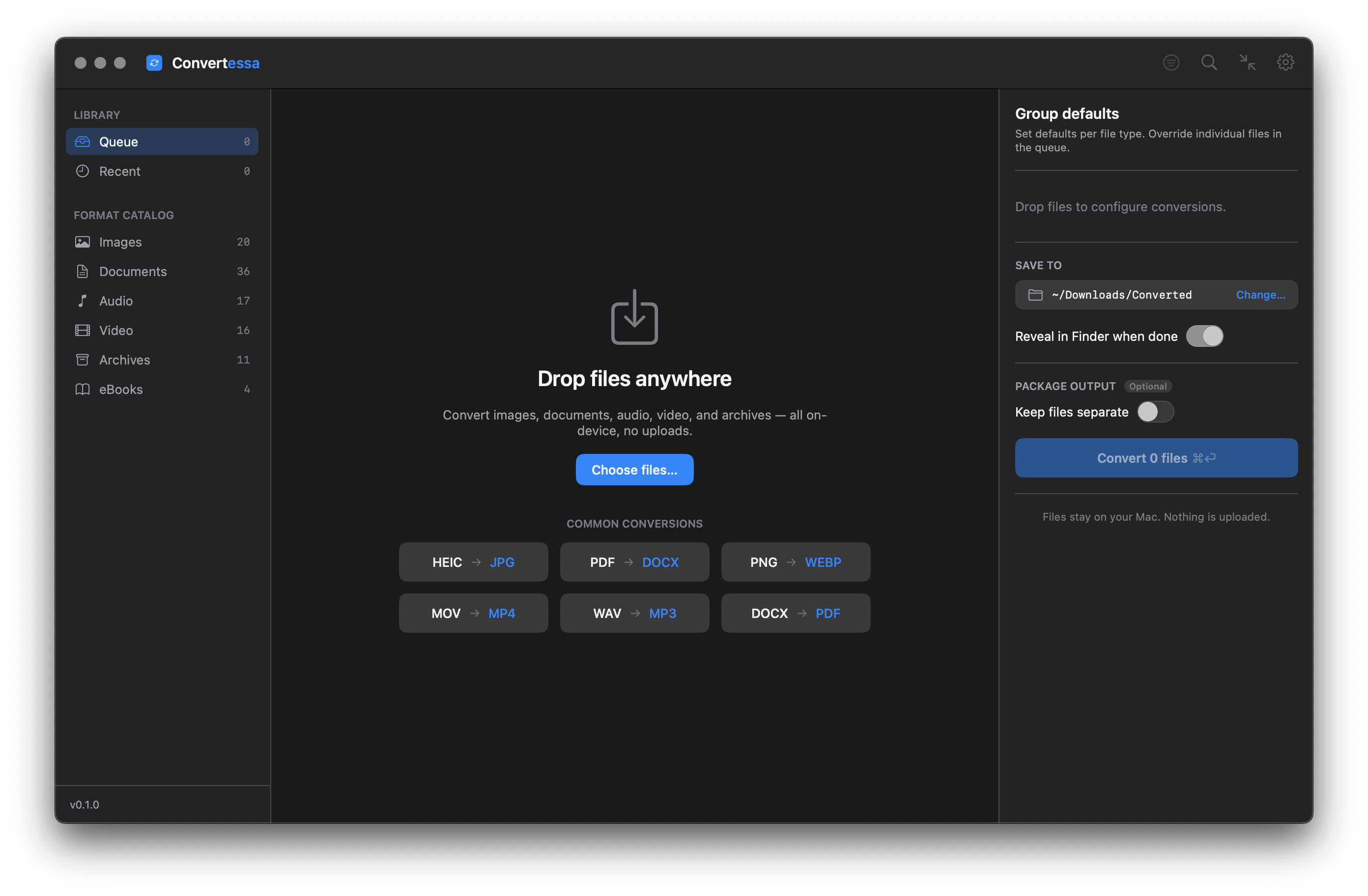
Convertessa app window showing the format catalog and drop area
What it does

Pull the text layer out of any PDF

Convertessa pulls the embedded text layer out of a PDF and writes it as UTF-8 plain text, one file per document, entirely on your Mac. It is the quick route from a paper, contract or manual to something you can grep, diff, word-count or pipe into a script. Point it at one file or a folder of hundreds and it works through the queue in a single pass.

Text layer realities

Why a PDF has no paragraphs

A PDF is a page-description program, not a document in the sense a word processor means. Inside, each page is a list of drawing operators: select this font, move to these coordinates, show this run of glyphs. There is no paragraph object, no sentence, no reading order, only marks placed on a canvas in whatever sequence the producing application happened to emit them. Extracting text means reconstructing prose from that arrangement.

The extractor walks those content streams, maps each glyph back to a Unicode character through the font's ToUnicode table, and groups marks into lines by position. When the PDF came out of LaTeX, Word, InDesign or a browser's print engine, this produces clean, readable output. When the PDF is unusual, the seams show.

Where extraction gets messy

  • Multiple columns. A two-column paper can interleave, one line of the left column followed by one line of the right, because visual columns are not part of the file's structure.
  • Running heads. Headers, footers and page numbers are ordinary text drawn on the page, so they land in the middle of your prose once per page.
  • Hyphenation. A word broken across a line break stays broken, hyphen included, because the break is a layout decision baked into the glyph positions.
  • Tables. Cells arrive as runs of words separated by spaces. The grid was drawn as lines, not stored as structure, so it is gone.
  • Subset fonts. An embedded subset with no character map yields plausible-looking gibberish: the glyphs draw correctly on screen, but the file holds no record of which characters they represent.

Two things deserve bluntness. Convertessa does not run OCR, so a scanned or photographed PDF whose pages are simply images with no text layer produces an empty or near-empty file; the tell is that you cannot select any text in Preview either. And plain text is lossless in the sense that nothing is compressed or degraded once the characters are written, which is why no quality control appears for this target. The losses are structural instead: fonts, bold and italic, images, links, annotations and page geometry have nowhere to go in a .txt file.

How it works

Three steps. No upload required.

1

Queue your PDFs

Drag in one document or a folder of them. Password-protected files fail at open, so decrypt those first; everything else joins the queue and keeps its filename, with the extension swapped.

2

Choose Plain Text

Pick Plain Text as the output. No quality control appears here, because a text file is only characters and there is nothing to trade away. Each PDF produces its own matching text file.

3

Read the first result

Open one output before you trust the batch. Interleaved columns or runs of gibberish point at an awkward source layout or a font with no character map, rather than a failed conversion.

Format catalog

From everyday files to pro media.

Images, audio, video, documents, archives, eBooks and fonts — all converted natively, right on your Mac.

Conversion explorer

What do you want to convert?

Pick a format you have — see everything Convertessa can turn it into.

conversion combinations
I have a
can be converted to
From MP4

Features

Built for real work.

Batch conversion

Convert hundreds of files at once with per-type group defaults and individual overrides.

Modern image formats

First-class support for HEIC, AVIF and WebP — encode and decode, both ways. Read JPEG XL and a dozen more modern formats too.

Drag & drop

Drop files anywhere on the window. Native, instant, and exactly what you’d expect on a Mac.

Quality control

Dial in compression, resolution and bitrate. Keep originals pristine or shrink for sharing.

Collision-safe naming

Never overwrite a file by accident. Convertessa appends safe suffixes automatically.

Conversion history

Every job is logged locally. Re-run a previous conversion or revisit recent outputs in a click.

Archive the output

Bundle your converted files straight into a single ZIP, TAR or 7z — packaged and ready to share the moment a job finishes.

Convert from Finder

Right-click any file in Finder and choose Convert. A Quick Action handles it on the spot — no need to open the app first.

Compact mode

Shrink Convertessa to a tidy mini window that tucks into a corner — just a drop zone and a format picker for quick, one-off conversions.

Your files never leave your Mac.

No cloud. No account. No upload. Every conversion happens entirely on-device, using the power already in your Mac. What you convert is nobody’s business but yours.

On-device processing Zero telemetry No file uploads
For power users

There’s a command line, too.

Script conversions, wire them into your build, or batch a folder from the terminal. The same engine, no GUI required.

Read the full CLI documentation
zsh — convertessa
# Convert a single file
$ convertessa input.pdf --to txt
photo.txt · 1.2 MB · 0.4s
 
# Batch a whole folder
$ convertessa ./*.pdf --to txt -o ~/Exports
14 files converted · 4.1s
Made to fit

And a compact mode.

Shrink Convertessa down to a small, focused window — drop, convert, done, with your recent conversions one click away.
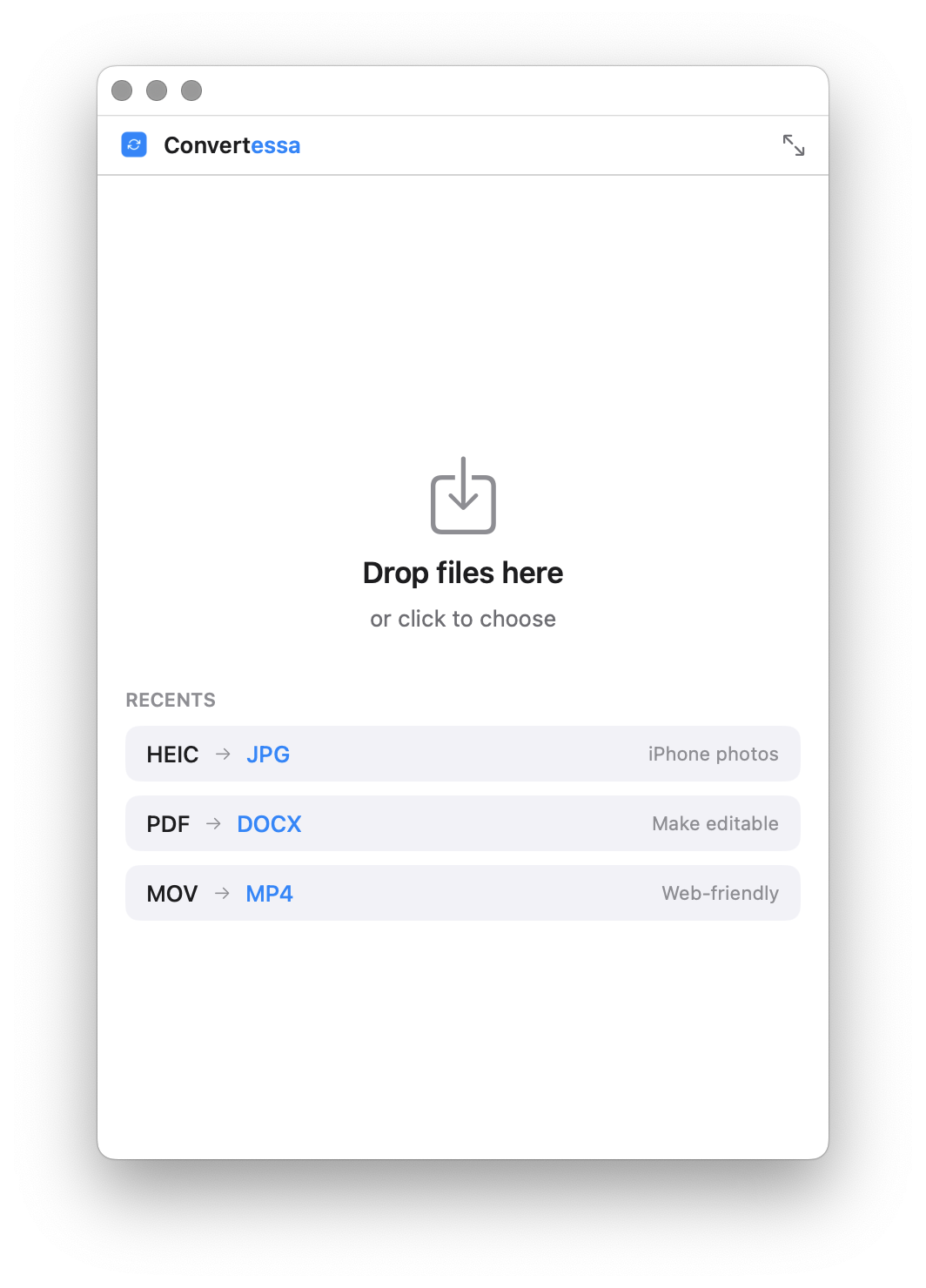
Convertessa in compact mode — a small window with a drop area and recent conversions
Pricing

One price. Yours for good.

Lifetime license
$19
One-time payment
No subscription. No renewals. Ever.
Get the app
  • 1,000+ conversion combinations
  • Lifetime future updates
  • No account required
  • Unlimited devices

macOS 14+ · Apple Silicon & Intel

Changelog

What’s shipped so far.

New formats, new features, and fixes — every release, on the record.

FAQ

Good questions.

Convertessa is a native macOS app that converts your files between formats — images, audio, video, documents, archives and eBooks — entirely on your Mac. Drop a file in, choose an output, and it’s done. No uploads, no account, no subscription.
Convertessa is an orchestrator. Under the hood it relies on best-in-class open-source engines — FFmpeg for audio & video, Pandoc for documents, libvips for images, LibreOffice for office formats, and Calibre for eBooks. It installs them for you with a click, then calls the right tool, or chain of tools, in the right order for whatever you’re converting. You get one clean native interface instead of a tangle of command-line flags. These binaries aren’t bundled with the app and are never installed without your approval — Convertessa simply calls them in a terminal session on your behalf.
Popular ones include JPEG, PNG, HEIC, WebP and AVIF; MP3, AAC, FLAC and WAV; MP4, MOV and MKV; PDF, DOCX and EPUB; ZIP, TAR and 7z — and many more. See exactly what converts to what in the conversion explorer →
Email us and we’ll add it in an upcoming release. Convertessa’s format coverage grows with what people actually need, so your request genuinely helps shape the app.
Your files? Never. Every conversion happens locally on your Mac. Your files are never uploaded, and nothing you convert is ever sent anywhere. Our Privacy Policy spells out exactly what limited data the app does store.
No analytics, no tracking, no telemetry. Your files and conversions stay entirely on your Mac — nothing you convert is ever sent anywhere. The app periodically checks for software updates in the background; like any web request, that check reveals only standard request metadata (your IP and app/OS version) to our update server — never your files, name, email, or license — and updates are always user-approved. Separately, on the website only, our purchase-confirmation page reports a completed sale to Google Ads so we can measure our own ad performance — it never runs while you’re browsing or converting, only after checkout. Our Privacy Policy spells out exactly what’s stored — and what isn’t.
Yes. Convertessa is a universal app and runs natively on Intel Macs. It requires macOS 14 or later.
Yes. It’s tuned for Apple Silicon (M-series) and runs natively — fast and energy-efficient. macOS 14 or later.
Yes — your license works on an unlimited number of your own Macs. Buy once and install it everywhere you work.
You get a genuinely useful, private, native Mac app for a single $19 payment — no subscription, ever. And your purchase directly supports a small independent developer and the app’s ongoing updates and new formats.
There’s no separate trial, but every purchase is backed by a 14-day money-back guarantee. If Convertessa isn’t right for you, contact your payment processor within 14 days to request a full refund — no questions asked. You can also email us and we’ll help route it.
Quite possibly — just email us. If you’re a student, run a non-profit, or have another good reason, reach out and we’ll sort you out.
Convertessa was built by Daler Azimov — a developer who needed a fast, private, native file converter for his own work, and decided to make the one he wished existed. Connect on LinkedIn →

Almost always because the PDF has no text layer. Scans, photographed pages and faxes are images wrapped in a PDF, and there are no characters in the file to extract. Test it in Preview: if you cannot drag-select a word on the page, no extractor can read it either. You need recognition software to create a text layer first, then convert the resulting PDF.

Because columns are a visual illusion produced by glyph coordinates, not a structure stored in the file. Some producers emit a whole column before starting the next and extract perfectly; others alternate line by line and you get a zip-merge of both columns. If the paper is also published as HTML or as a LaTeX source, either will give you far cleaner text than the print PDF will.

No, there is no page-range option. Convertessa converts whole documents. In practice you convert once and then slice the result with tools already on your Mac:

convertessa report.pdf --to txt -o ~/Out && sed -n '1,120p' ~/Out/report.txt > intro.txt

That is usually faster than picking pages by hand anyway, because you can search the full text first and then cut at the line you actually care about.

Figures vanish entirely: they are images, and a text file cannot hold them. Tables survive only as their words. A row becomes a sequence of cell contents separated by spaces, with no reliable marker for where one column ends and the next begins, because the ruling lines were drawn as graphics. If you need the table back as a table, a spreadsheet or a Word target is the better destination.

Often not. AcroForm values live in the annotation layer rather than the page content stream, so an extractor reading the page can miss them completely while the values still show on screen. The reliable workaround is to flatten the form first: open it in Preview, print to PDF, and convert that copy. Flattening bakes the field values into the page content where extraction can see them.

The PDF's. Every line break you see in the output corresponds to a typeset line on the page, so a paragraph arrives as a stack of short lines wrapped at the original column width rather than as one flowing paragraph. Text editors that soft-wrap will look odd until you reflow. If you need reflowable prose, Markdown, DOCX or EPUB are better targets than plain text.

UTF-8. Curly quotes, em dashes, accented characters and typographic ligatures survive as their real Unicode codepoints, which means a word like find can arrive containing U+FB01 rather than the letters f and i. That trips naive search scripts. If a downstream tool insists on plain ASCII, run the output through iconv -f UTF-8 -t ASCII//TRANSLIT in.txt > out.txt before using it.

We’d love to hear from you. Email us and you’ll get a reply from a real person — the one who made the app.