Convert DVD VOB to MP4. Offline.

Your files stay on your Mac.
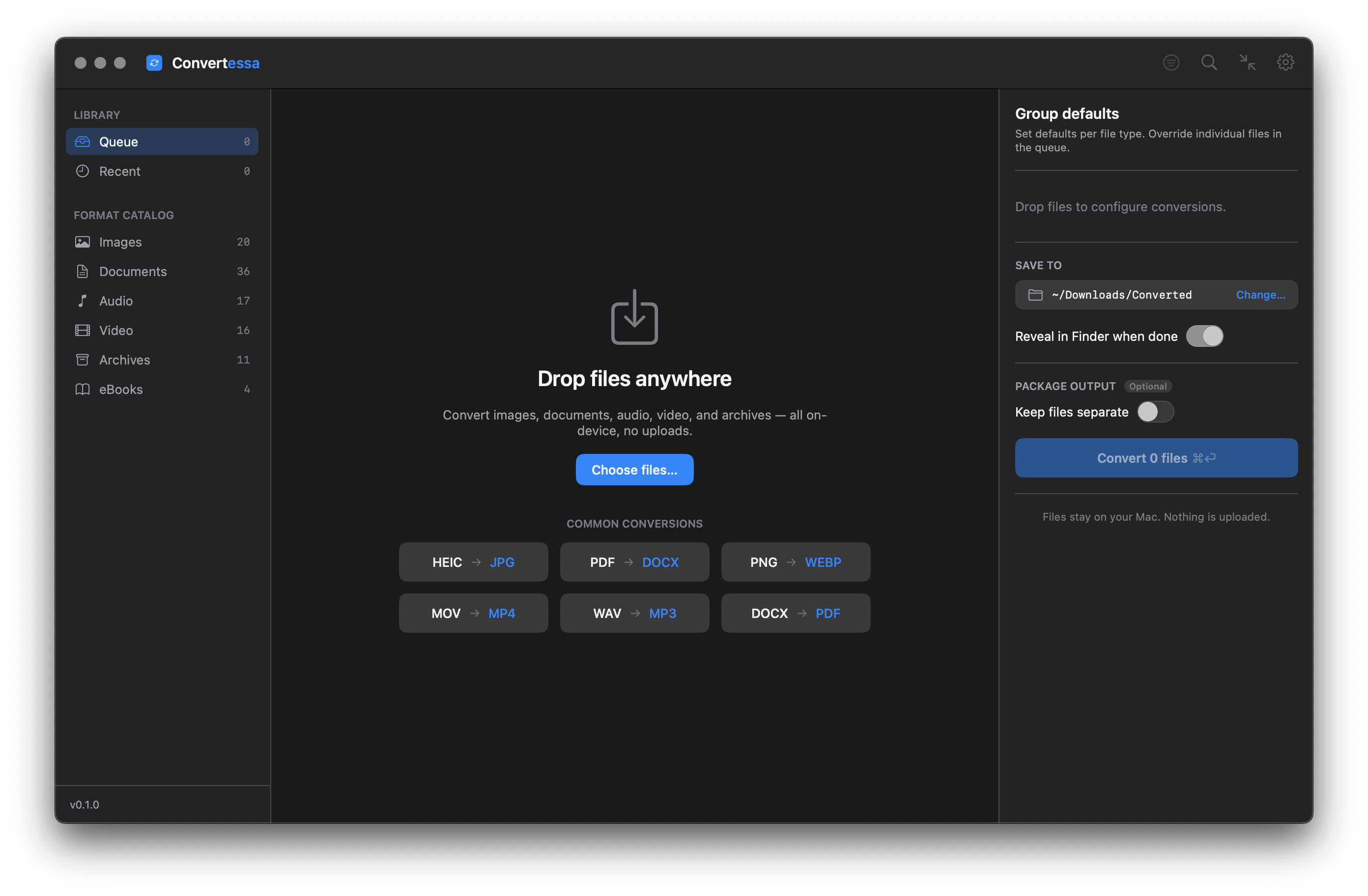
Convertessa app window showing the format catalog and drop area
What it does

What VOB-to-MP4 conversion does

VOB files are slabs of MPEG-2 program stream lifted straight off a DVD. Convertessa passes them to FFmpeg, which unpicks the multiplex, re-encodes the ageing MPEG-2 picture to H.264 and the AC-3 or LPCM sound to AAC, and writes an MP4 a phone, browser or Apple TV will actually play. Choose a quality value, queue the whole folder, and it all runs locally.

DVD anatomy

One VOB is rarely one whole movie

Open a DVD's VIDEO_TS folder and you will find VTS_01_1.VOB, VTS_01_2.VOB, VTS_01_3.VOB and so on. Those are not three features. They are one feature cut into pieces, because the DVD-Video specification caps a single VOB file at one gigabyte. Convert just one of them and you get roughly twenty minutes of film that begins and ends mid-scene. Join them in order first, then convert the joined file:

cat VTS_01_*.VOB > movie.vob

Inside, a VOB is an MPEG-2 program stream: MPEG-2 video, audio as AC-3, DTS, MP2 or uncompressed LPCM, plus subpicture and navigation packets all multiplexed together. FFmpeg pulls that apart, re-encodes the picture to H.264 and the sound to AAC, and writes an MP4. Because MPEG-2 is an old and inefficient codec, a four-gigabyte title routinely lands well under a gigabyte with no visible difference. This is one of the rare conversions where the output shrinks dramatically even at a generous quality value.

What a DVD carries that MP4 cannot

  • Subtitles. DVD subtitles are not text. They are run-length-encoded bitmaps in a subpicture stream, and an MP4 subtitle track expects characters, so there is nothing to translate them into.
  • Chapter marks. Chapter positions are stored in the IFO files sitting next to the VOBs, not in the VOB itself, so a conversion that reads only the VOB has no way to know where they were.
  • Menus and angles. Navigation packets, seamless branching and multi-angle blocks are DVD-player concepts with no MP4 equivalent.

Two more things worth knowing before you judge the result. DVD video uses non-square pixels, 720 by 480 for NTSC and 720 by 576 for PAL, with a flag stating whether to display the picture as 4:3 or 16:9; that flag travels into the MP4, so a player that honours it shows the right shape and one that ignores it shows a squashed one. And most discs are interlaced, stored as two fields per frame, which is why motion can comb on a progressive screen. Neither effect is introduced by the conversion. Both were pressed onto the disc.

How it works

Three steps. No upload required.

1

Join the VOB pieces

A DVD title is cut at one-gigabyte boundaries. In Terminal, run cat VTS_01_*.VOB > movie.vob inside the VIDEO_TS folder so the feature converts as one film rather than twenty-minute fragments.

2

Drop it in, pick MP4

Add the joined file to the queue and choose MP4. FFmpeg demultiplexes the program stream, re-encodes MPEG-2 video to H.264 and the AC-3 or LPCM audio to AAC in the same pass.

3

Set quality, then convert

MPEG-2 wastes a great deal of space, so even a generous quality value usually yields a file a quarter of the disc's size. Expect a feature-length title to take several minutes to finish.

Format catalog

From everyday files to pro media.

Images, audio, video, documents, archives, eBooks and fonts — all converted natively, right on your Mac.

Conversion explorer

What do you want to convert?

Pick a format you have — see everything Convertessa can turn it into.

conversion combinations
I have a
can be converted to
From MP4

Features

Built for real work.

Batch conversion

Convert hundreds of files at once with per-type group defaults and individual overrides.

Modern image formats

First-class support for HEIC, AVIF and WebP — encode and decode, both ways. Read JPEG XL and a dozen more modern formats too.

Drag & drop

Drop files anywhere on the window. Native, instant, and exactly what you’d expect on a Mac.

Quality control

Dial in compression, resolution and bitrate. Keep originals pristine or shrink for sharing.

Collision-safe naming

Never overwrite a file by accident. Convertessa appends safe suffixes automatically.

Conversion history

Every job is logged locally. Re-run a previous conversion or revisit recent outputs in a click.

Archive the output

Bundle your converted files straight into a single ZIP, TAR or 7z — packaged and ready to share the moment a job finishes.

Convert from Finder

Right-click any file in Finder and choose Convert. A Quick Action handles it on the spot — no need to open the app first.

Compact mode

Shrink Convertessa to a tidy mini window that tucks into a corner — just a drop zone and a format picker for quick, one-off conversions.

Your files never leave your Mac.

No cloud. No account. No upload. Every conversion happens entirely on-device, using the power already in your Mac. What you convert is nobody’s business but yours.

On-device processing Zero telemetry No file uploads
For power users

There’s a command line, too.

Script conversions, wire them into your build, or batch a folder from the terminal. The same engine, no GUI required.

Read the full CLI documentation
zsh — convertessa
# Convert a single file
$ convertessa input.vob --to mp4
photo.mp4 · 1.2 MB · 0.4s
 
# Batch a whole folder
$ convertessa ./*.vob --to mp4 -o ~/Exports
14 files converted · 4.1s
Made to fit

And a compact mode.

Shrink Convertessa down to a small, focused window — drop, convert, done, with your recent conversions one click away.
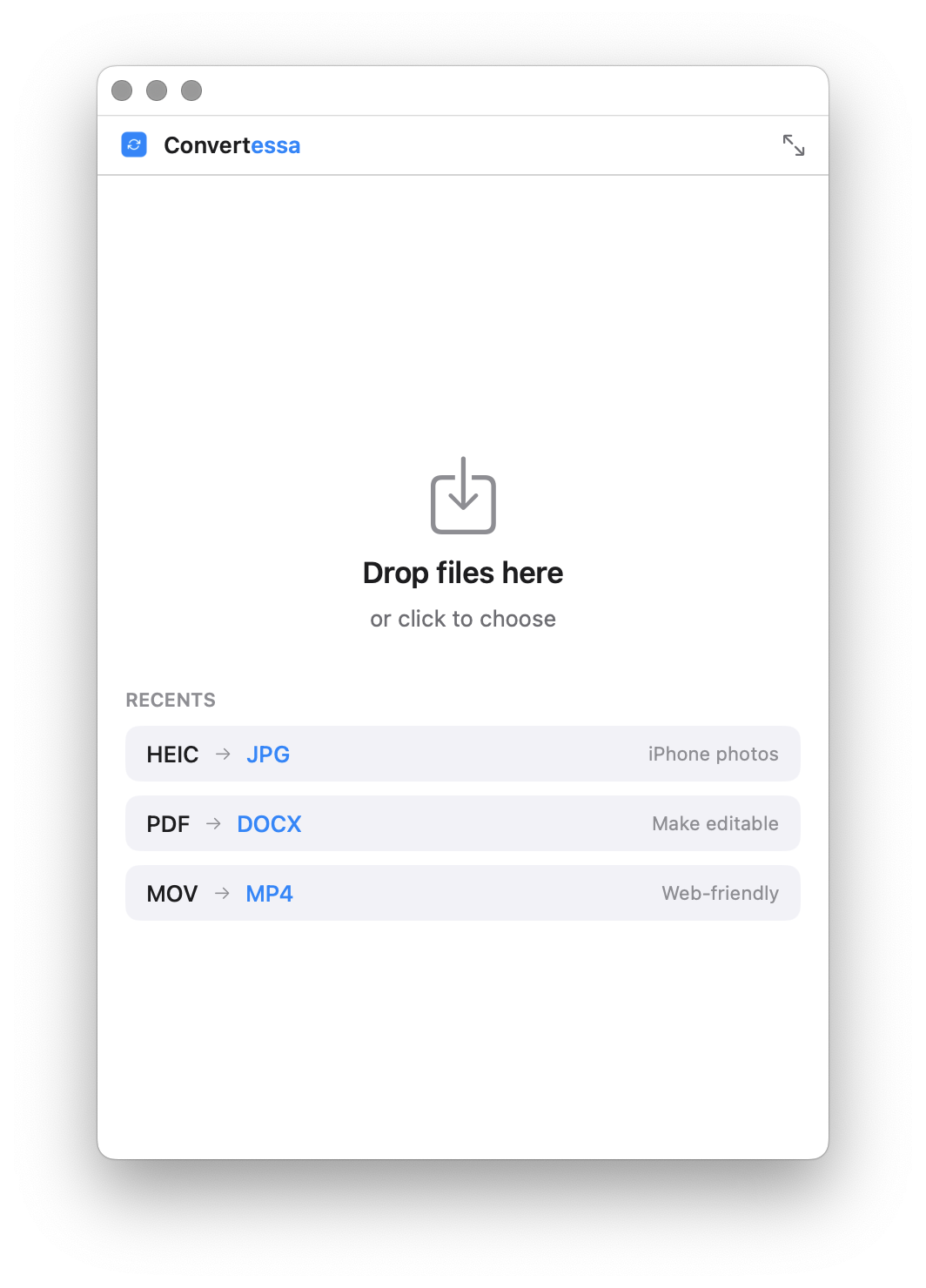
Convertessa in compact mode — a small window with a drop area and recent conversions
Pricing

One price. Yours for good.

Lifetime license
$19
One-time payment
No subscription. No renewals. Ever.
Get the app
  • 1,000+ conversion combinations
  • Lifetime future updates
  • No account required
  • Unlimited devices

macOS 14+ · Apple Silicon & Intel

Changelog

What’s shipped so far.

New formats, new features, and fixes — every release, on the record.

FAQ

Good questions.

Convertessa is a native macOS app that converts your files between formats — images, audio, video, documents, archives and eBooks — entirely on your Mac. Drop a file in, choose an output, and it’s done. No uploads, no account, no subscription.
Convertessa is an orchestrator. Under the hood it relies on best-in-class open-source engines — FFmpeg for audio & video, Pandoc for documents, libvips for images, LibreOffice for office formats, and Calibre for eBooks. It installs them for you with a click, then calls the right tool, or chain of tools, in the right order for whatever you’re converting. You get one clean native interface instead of a tangle of command-line flags. These binaries aren’t bundled with the app and are never installed without your approval — Convertessa simply calls them in a terminal session on your behalf.
Popular ones include JPEG, PNG, HEIC, WebP and AVIF; MP3, AAC, FLAC and WAV; MP4, MOV and MKV; PDF, DOCX and EPUB; ZIP, TAR and 7z — and many more. See exactly what converts to what in the conversion explorer →
Email us and we’ll add it in an upcoming release. Convertessa’s format coverage grows with what people actually need, so your request genuinely helps shape the app.
Your files? Never. Every conversion happens locally on your Mac. Your files are never uploaded, and nothing you convert is ever sent anywhere. Our Privacy Policy spells out exactly what limited data the app does store.
No analytics, no tracking, no telemetry. Your files and conversions stay entirely on your Mac — nothing you convert is ever sent anywhere. The app periodically checks for software updates in the background; like any web request, that check reveals only standard request metadata (your IP and app/OS version) to our update server — never your files, name, email, or license — and updates are always user-approved. Separately, on the website only, our purchase-confirmation page reports a completed sale to Google Ads so we can measure our own ad performance — it never runs while you’re browsing or converting, only after checkout. Our Privacy Policy spells out exactly what’s stored — and what isn’t.
Yes. Convertessa is a universal app and runs natively on Intel Macs. It requires macOS 14 or later.
Yes. It’s tuned for Apple Silicon (M-series) and runs natively — fast and energy-efficient. macOS 14 or later.
Yes — your license works on an unlimited number of your own Macs. Buy once and install it everywhere you work.
You get a genuinely useful, private, native Mac app for a single $19 payment — no subscription, ever. And your purchase directly supports a small independent developer and the app’s ongoing updates and new formats.
There’s no separate trial, but every purchase is backed by a 14-day money-back guarantee. If Convertessa isn’t right for you, contact your payment processor within 14 days to request a full refund — no questions asked. You can also email us and we’ll help route it.
Quite possibly — just email us. If you’re a student, run a non-profit, or have another good reason, reach out and we’ll sort you out.
Convertessa was built by Daler Azimov — a developer who needed a fast, private, native file converter for his own work, and decided to make the one he wished existed. Connect on LinkedIn →

Because you converted one fragment. The DVD-Video spec limits each VOB to one gigabyte, so a feature is split across VTS_01_1.VOB, VTS_01_2.VOB and however many more it needs. Join them in numerical order before converting:

cat VTS_01_*.VOB > movie.vob && convertessa movie.vob --to mp4 --quality 85 -o ~/Movies

The shell expands the wildcard in sorted order, which is exactly the play order on the disc.

They were never text. DVD subtitles are a subpicture stream of compressed bitmap images overlaid on the video, one small picture per subtitle. MP4's subtitle tracks store characters, so there is no way to carry a bitmap subtitle across as a subtitle. If you need them, the usual route is a separate tool that reads the subpicture stream and produces a subtitle file you can pair with the MP4 yourself.

Only if they are readable as ordinary files. Most retail discs are scrambled with CSS, so the VOBs copied off them are encrypted and decode to noise. Convertessa converts files that already sit readable on your disk and does not decrypt anything. Home-burned discs, camcorder DVDs, corporate and training discs and anything authored without copy protection are unencrypted and convert directly.

DVD stores non-square pixels. A widescreen NTSC feature is 720 by 480 samples on the disc with a flag saying to display it at 16:9, and a 4:3 title uses the same sample count with a different flag. That flag is carried into the MP4, but a player or web component that ignores it will draw the raw sample grid and everyone will look too tall or too wide. Try the file in a second player before assuming the conversion went wrong.

Interlacing. Standard-definition DVD holds two fields per frame captured a fiftieth or sixtieth of a second apart, which a tube television drew alternately and never showed as a whole frame. On a progressive display, horizontal motion tears into a comb pattern. The disc was authored that way, so it is present in the source rather than introduced by the conversion. Film-sourced discs suffer less than material shot on video.

The one the demultiplexer maps by default, which is normally the first audio stream in the program stream and usually the disc's primary language. A director's commentary or a second dub sitting later in the multiplex is not guaranteed to be carried across. Play the first minute of your converted file before running the rest of the disc, and if the wrong track came out, check whether the title has a separate VOB set for that language.

Yes, and it is the right move when a disc holds several separate titles, such as an episode collection:

convertessa ~/Rips/VIDEO_TS/*.VOB --to mp4 --quality 85 -o ~/Movies

Be aware of what that produces: one MP4 per VOB file, which means one MP4 per fragment. For a single feature split across four VOBs, join them first. For a disc where each VOB really is a separate short, the batch is exactly what you want.

Far smaller than the disc. A dual-layer DVD holds up to 8.5 GB and a single-layer one 4.7 GB, nearly all of it spent on MPEG-2 video that H.264 encodes far more efficiently. A feature film typically lands between 700 MB and 1.5 GB at a generous quality value, and looks the same on any modern screen. Standard definition simply does not need much space once a modern codec is doing the work.

We’d love to hear from you. Email us and you’ll get a reply from a real person — the one who made the app.